H.R. 1917 explained · 119th Congress · Pending in Congress
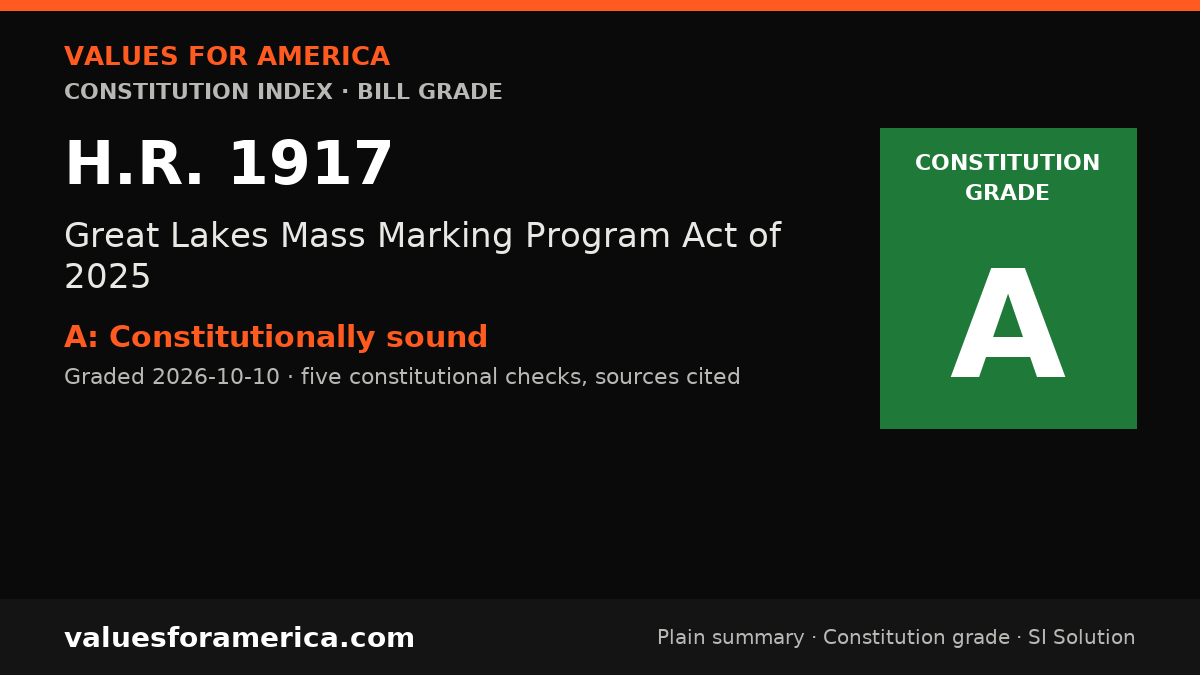
Great Lakes Mass Marking Program Act of 2025
Cosponsors: 6 (2 D, 4 R) · per Congress.gov, 2026-10-11
Introduced: 2025-03-06
Latest action (2025-07-23): Received in the Senate and Read twice and referred to the Committee on Environment and Public Works.
What H.R. 1917 does, in plain terms
Great Lakes Mass Marking Program Act of 2025 This bill provides statutory authority for a program of the U.S. Fish and Wildlife Service (FWS) for the mass marking of hatchery-produced fish in the Great Lakes basin. Mass marking is the practice of tagging large numbers of hatchery-produced fish in order to distinguish them from the wild fish population. The FWS initiated the program in 2010 on a limited scale. Under the existing program, the FWS (1) tags hatchery-produced fish stocked in the Great Lakes, and (2) produces data used by state and tribal fish management agencies to make management decisions regarding Great Lakes fisheries. This bill allows the FWS, in carrying out the program, to (1) purchase items to support and carry out tagging and tag recovery operations on a greater scale, and (2) hire additional personnel. The FWS must make the data collected under the program available to applicable federal, state, and tribal fish management agencies to increase the understanding of the outcomes of management action; assist in meeting the restoration objectives of the Great Lakes; assist in balancing predators and prey; support and improve the economic status of tribal, recreational, and commercial fisheries; and assist in evaluating the effectiveness of habitat restoration efforts in the Great Lakes.
Official summary by the Congressional Research Service, via Congress.gov.
Constitution Index
“VFA Constitution grade”
Constitutionally sound
Graded 2026-10-10
SI-generated grade · five published checks · not individually reviewed by a person · methodology
This bill is fully constitutional. It operates within Congress's enumerated powers under the Commerce Clause and Property Clause, does not infringe any Bill of Rights protections, respects individual sovereignty, passes all decentralization tests, and involves no due process or takings issues.
-
✓ Passes · Enumerated powers
Congress has authority under Article I, Section 8, Clause 3 (Commerce Clause) to regulate fisheries that affect interstate commerce, and under Article IV, Section 3, Clause 2 (Property Clause) to manage federal property and resources. The Great Lakes are a body of water spanning multiple states and the U.S.-Canada border, and their fisheries directly affect interstate and international commerce. T… -
✓ Passes · Bill of Rights
The bill involves tagging hatchery fish and sharing data with government agencies. It does not restrict speech, religion, assembly, press, petition, arms, quartering, search and seizure, self-incrimination, due process, takings, trial rights, jury rights, cruel and unusual punishment, or any other right protected by the first ten amendments. No individual's rights are implicated. -
✓ Passes · Individual sovereignty
The bill regulates hatchery-produced fish stocked in the Great Lakes by the federal government itself. It does not restrict what any individual may do with their own person, property, speech, labor, or belief. There is no mandate, prohibition, or penalty imposed on private citizens. The burden of justification is not triggered because no individual freedom is restricted. -
✓ Passes · Decentralization
The bill passes all four questions. (1) Individuals and families cannot manage interstate Great Lakes fisheries on their own; this requires coordinated management across multiple states and tribal nations. (2) Local communities and counties cannot manage a resource spanning eight states and an international border. (3) No single state can manage the Great Lakes fishery effectively because fish mig… -
✓ Passes · Due process and takings
The bill imposes no penalties, deprivations, or property takings. It authorizes the federal government to tag its own hatchery fish and share data. No individual is subject to any government action that would require notice, hearing, or just compensation. The Fifth Amendment's Due Process and Takings Clauses are not implicated.
Sources: Congress.gov: HR 1917 summary
Report an error in this grade
What should pass
“VFA SI Solution”
No solution yet
A sourced SI draft appears here once it passes automated checks (Constitution citation, source verification, independent SI critic). How publication works.
Related on VFA

For journalists and bloggers
“Embed this grade”
Free to use with the link back. The badge and card update when the grade changes. Embed terms →
