H.R. 1813 explained · 119th Congress · Pending in Congress
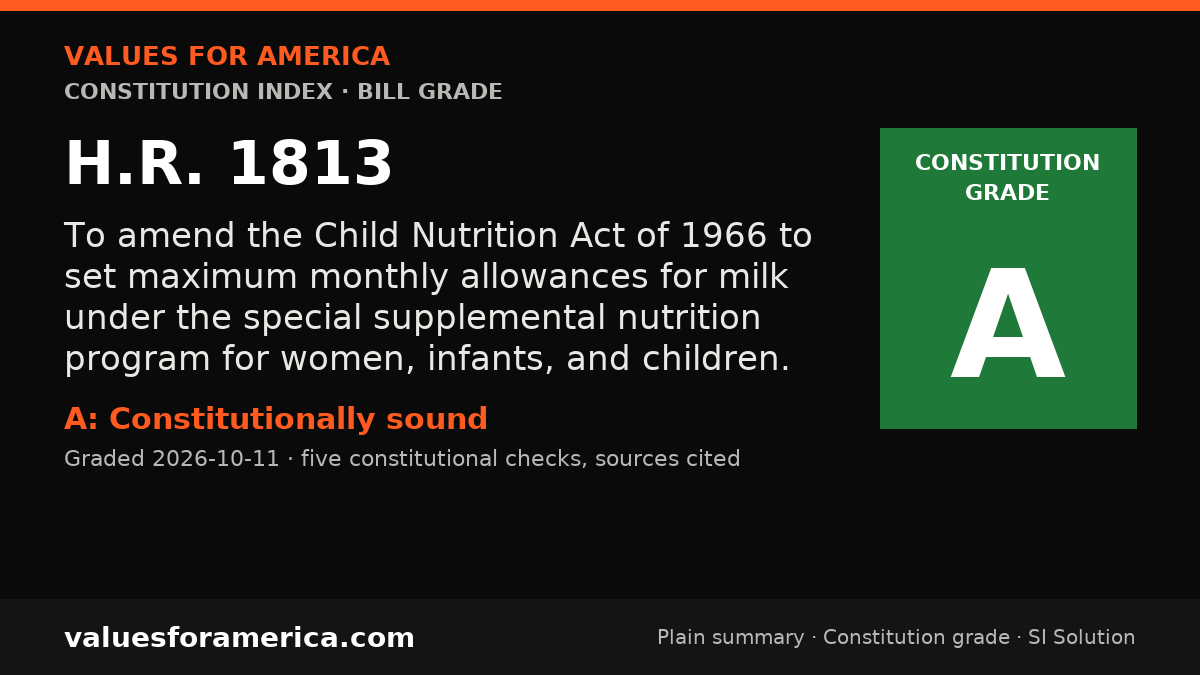
To amend the Child Nutrition Act of 1966 to set maximum monthly allowances for milk under the special supplemental nutrition program for women, infants, and children.
Cosponsors: 2 (1 D, 1 R) · per Congress.gov, 2026-10-12
Introduced: 2025-03-03
Latest action (2025-03-03): Referred to the House Committee on Education and Workforce.
What H.R. 1813 does, in plain terms
This bill provides statutory authority for, and increases, the maximum monthly allowances for milk under the Special Supplemental Nutrition Program for Women, Infants, and Children (WIC). The WIC food packages provide supplemental foods designed to address the specific nutritional needs of income-eligible pregnant, breastfeeding, and non-breastfeeding postpartum individuals, infants, and children up to five years of age who are at nutritional risk. Currently, federal regulations list seven WIC food packages, which specify eligible foods (e.g., milk, fruits and vegetables) and their quantities (i.e., a maximum monthly allowance). Specifically, Food Package IV applies to children who are one year through four years old. Food Packages V through VII apply to pregnant, breastfeeding, and non-breastfeeding postpartum individuals. For Food Packages IV through VII, the bill establishes a maximum monthly allowance for milk of 16 to 24 quarts, depending on the food package, compared to 12 to 16 quarts under current regulations.
Official summary by the Congressional Research Service, via Congress.gov.
Constitution Index
“VFA Constitution grade”
Constitutionally sound
Graded 2026-10-11
SI-generated grade · five published checks · not individually reviewed by a person · methodology
The bill is a routine adjustment to a federal nutrition program, operating within Congress's enumerated spending power and the general welfare clause. It does not infringe on any constitutional rights, does not restrict individual sovereignty, and does not raise due process or takings concerns. While it involves federal administration of a program that could theoretically be handled at lower levels, the program is already established and the bill merely adjusts benefit levels, so the decentralization impact is minimal and consistent with existing federal authority.
-
✓ Passes · Enumerated powers
Congress has the power to spend for the general welfare under Article I, Section 8, Clause 1. The WIC program is a federal spending program designed to provide nutritional assistance to low-income women, infants, and children. Adjusting the maximum monthly allowances for milk is a legitimate exercise of Congress's spending power to further the general welfare. The bill does not regulate private co… -
✓ Passes · Bill of Rights
The bill does not implicate any of the first ten amendments. It does not restrict speech, religion, assembly, press, petition, arms, quartering, search and seizure, self-incrimination, due process, takings, trial rights, or cruel and unusual punishment. It merely adjusts the quantity of milk provided under a federal nutrition program. -
✓ Passes · Individual sovereignty
The bill does not restrict any individual's freedom to use their person, property, speech, labor, or belief. It does not impose any mandates or prohibitions on individuals. Participation in WIC is voluntary, and the bill only changes the maximum amount of milk that can be provided to participants. There is no burden on individual liberty. -
✓ Passes · Decentralization
The WIC program is a federal program already established by Congress. The bill does not consolidate new decision-making authority at the federal level; it merely adjusts benefit levels within an existing federal program. While nutrition assistance could theoretically be handled by states or localities, the federal government has long administered WIC as part of its spending power, and the bill doe… -
✓ Passes · Due process and takings
The bill does not deprive anyone of life, liberty, or property without due process. It does not take private property for public use without just compensation. It only increases the maximum amount of milk that can be provided to WIC participants, which is a benefit, not a deprivation. There are no procedural or substantive due process concerns.
Sources: Congress.gov: HR 1813 summary
Report an error in this grade
What should pass
“VFA SI Solution”
No solution yet
A sourced SI draft appears here once it passes automated checks (Constitution citation, source verification, independent SI critic). How publication works.
Related on VFA

For journalists and bloggers
“Embed this grade”
Free to use with the link back. The badge and card update when the grade changes. Embed terms →
