H.R. 1047 explained · 119th Congress · Pending in Congress
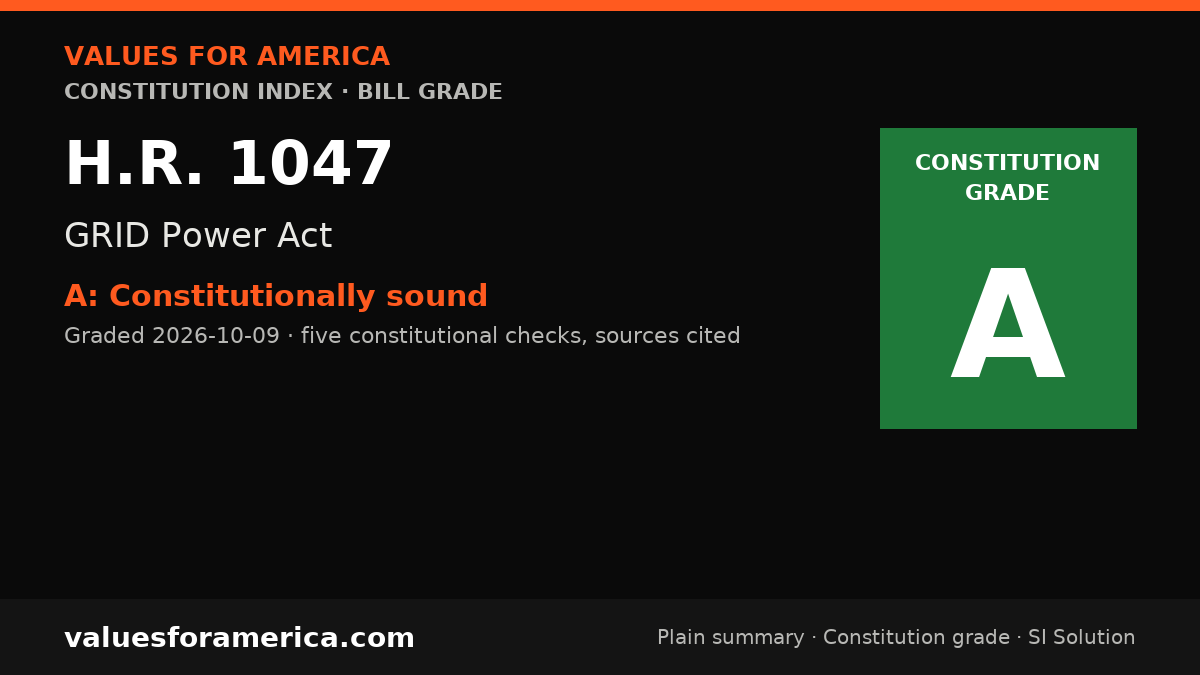
GRID Power Act
Cosponsors: 17 (0 D, 17 R) · per Congress.gov, 2026-10-10
Introduced: 2025-02-06
Latest action (2025-09-19): Received in the Senate and Read twice and referred to the Committee on Energy and Natural Resources.
What H.R. 1047 does, in plain terms
Guaranteeing Reliability through the Interconnection of Dispatchable Power Act or the GRID Power Act This bill requires the Federal Energy Regulatory Commission (FERC) to issue and periodically review a rule that revises the approval process for interconnection requests of generating units that produce electricity to prioritize dispatchable power projects (e.g., certain fossil fuel projects). Under the bill, dispatchable power generally refers to an electric energy generation resource, such as a generating unit that produces electricity from fossil fuels, capable of providing known and forecastable electric supply in time intervals necessary to ensure grid reliability. Currently, FERC receives interconnection requests from those projects and other generating units, such as units that produce electricity from renewable energy. Interconnection requests are requests from generating units to connect to the high voltage transmission lines of the electric grid. First, the rule must address the efficiency and effectiveness of the existing procedures for processing interconnection requests to ensure that new dispatchable power projects that improve grid reliability and resource adequacy can interconnect to the electric grid quickly, cost-effectively, and reliably. Second, the rule must revise the pro forma Large Generator Interconnection Procedures, and the pro forma Large Generator Interconnection Agreement as appropriate, to authorize transmission providers to submit proposals to FERC to prioritize new dispatchable power projects that will improve grid reliability and resource adequacy by assigning those projects higher positions in the interconnection queue of the provider. FERC must review and approve or deny such proposals within 60 days after the proposal is submitted.
Official summary by the Congressional Research Service, via Congress.gov.
Constitution Index
“VFA Constitution grade”
Constitutionally sound
Graded 2026-10-09
SI-generated grade · five published checks · not individually reviewed by a person · methodology
The GRID Power Act operates within FERC's existing authority over interstate electricity transmission and wholesale power markets. It directs prioritization of dispatchable generation in interconnection queues to improve grid reliability and resource adequacy. This is an economic regulation reasonably tied to Congress's Commerce Clause power, does not infringe individual rights, and does not take property or bypass due process. The rulemaking and proposal-review process preserves procedural safeguards.
-
✓ Passes · Enumerated powers
Congress has authority under Article I, Section 8, Clause 3 to regulate interstate commerce, and the interstate transmission and wholesale electricity grid has long been an area of federal regulation through FERC. Interconnection requests to high-voltage transmission lines are part of that interstate system. The bill asks FERC to revise procedures within its existing jurisdiction, so it does not e… -
✓ Passes · Bill of Rights
The bill does not restrict speech, religion, assembly, petition, press, arms, or any other provision of the Bill of Rights. It is an economic regulatory directive to FERC and transmission providers. It does not involve search, seizure, self-incrimination, trial rights, cruel punishment, or quartering. -
✓ Passes · Individual sovereignty
The bill does not restrict what individuals may do with their own person, property, speech, labor, or belief. It affects the order in which large generating units are processed for grid interconnection. To the extent it affects business interests, the government's interest in reliable electricity supply and resource adequacy is a permissible and substantial justification for the prioritization. -
✓ Passes · Decentralization
The interstate electricity grid cannot be effectively managed by individual families, local communities, or single states alone because transmission lines and wholesale markets cross state lines. FERC already has the federal role in interconnection queue procedures. The bill does not consolidate power at a higher level than necessary; it merely directs FERC to modify an existing federal process. I… -
✓ Passes · Due process and takings
The bill does not take private property without just compensation. Interconnection queue position is not a vested property right, and even if it were, the bill operates through FERC rulemaking and transmission provider proposals subject to FERC review. Affected parties have the opportunity to participate in the regulatory process. The 60-day approval requirement does not bypass due process.
Sources: Congress.gov: HR 1047 summary
Report an error in this grade
What should pass
“VFA SI Solution”
No solution yet
A sourced SI draft appears here once it passes automated checks (Constitution citation, source verification, independent SI critic). How publication works.
Related on VFA

For journalists and bloggers
“Embed this grade”
Free to use with the link back. The badge and card update when the grade changes. Embed terms →
