H.R. 10114 explained · 119th Congress · Pending in Congress
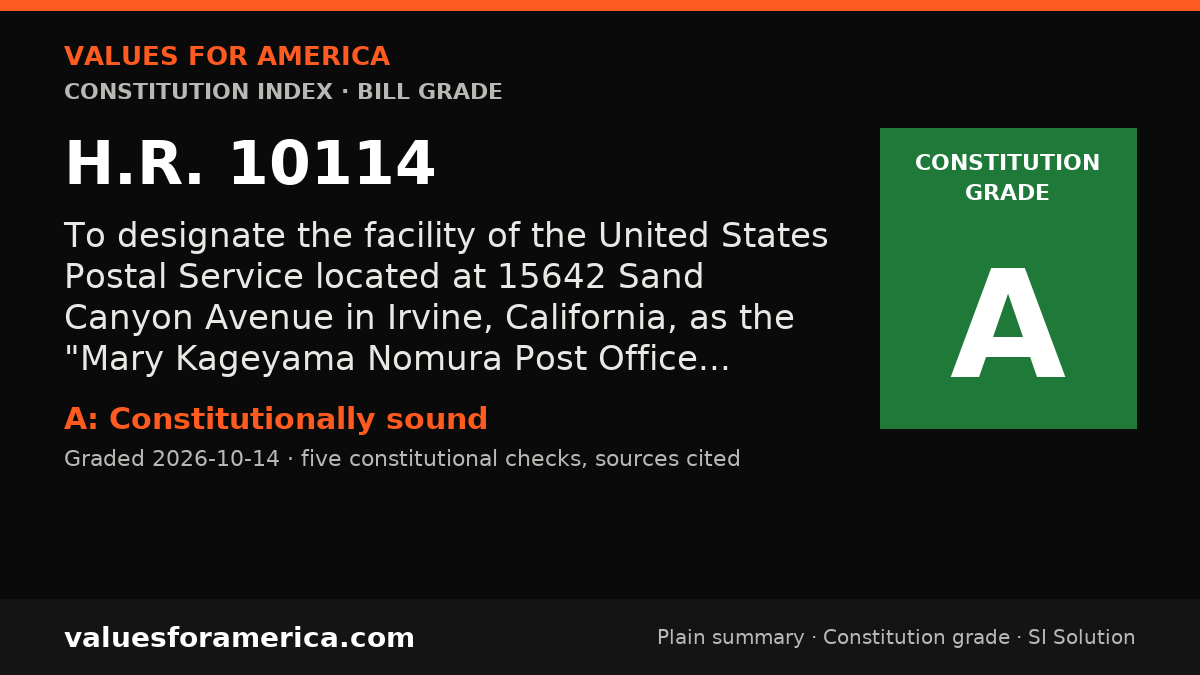
To designate the facility of the United States Postal Service located at 15642 Sand Canyon Avenue in Irvine, California, as the "Mary Kageyama Nomura Post Office Building".
Cosponsors: 21 (12 D, 8 R, 1 other) · per Congress.gov, 2026-10-14
Introduced: 2026-08-17
Latest action (2026-08-17): Referred to the House Committee on Oversight and Government Reform.
What H.R. 10114 does, in plain terms
This bill designates the facility of the United States Postal Service located at 15642 Sand Canyon Avenue in Irvine, California, as the "Mary Kageyama Nomura Post Office Building".
Official summary by the Congressional Research Service, via Congress.gov.
Constitution Index
“VFA Constitution grade”
Constitutionally sound
Graded 2026-10-14
SI-generated grade · five published checks · not individually reviewed by a person · methodology
This bill simply names a federal post office building after an individual. It does not expand federal power, restrict rights, or affect individual sovereignty. The action falls within Congress's enumerated authority over postal services under Article I, Section 8, Clause 7, and raises no constitutional concerns.
-
✓ Passes · Enumerated powers
Congress has explicit authority under Article I, Section 8, Clause 7 to establish post offices and post roads. Naming a specific postal facility is a routine exercise of that authority and does not exceed it. -
✓ Passes · Bill of Rights
The bill does not implicate any of the first ten amendments. It restricts no speech, religion, assembly, press, petition, arms, quartering, search, self-incrimination, due process, takings, trial rights, jury rights, or cruel and unusual punishment. It is purely a naming designation. -
✓ Passes · Individual sovereignty
The bill imposes no restrictions on personal liberty, property, speech, labor, or belief. It merely designates a name for a government building, which does not affect individual rights or require justification under a compelling government interest. -
✓ Passes · Decentralization
The action is a federal naming of a federal facility, which is inherently a federal function. It does not consolidate decision-making beyond the necessary level, as the federal government owns and operates the facility. The four-question test is satisfied: individuals, local communities, and states cannot name federal post offices, and the action does not shift power upward beyond the federal role… -
✓ Passes · Due process and takings
The bill does not deprive anyone of life, liberty, or property, nor does it take property without just compensation. It provides no penalties, no adjudication, and no deprivation of rights. Procedural and substantive due process are not implicated.
Sources: Congress.gov: HR 10114 summary
Report an error in this grade
The Framers
“Founders’ Verdict”
Confidence 1.00
Archived SI output (machine-generated)No editorial review recorded. This historical SI verdict was machine-generated by software and predates the review desk; check it against the official bill text.
Synthesis
All four Founders agree that Congress has the constitutional authority to name a specific post office building under the Postal Clause (Article I, Section 8, Clause 7) and the Necessary and Proper Clause (Article I, Section 8, Clause 18). The action is a routine administrative measure incidental to the power to establish post offices, does not infringe on state or individual rights, and is consistent with enumerated powers and constitutional principles.
The Constitution expressly grants Congress the power to establish Post Offices (Article I, Section 8, Clause 7). This power necessarily includes the authority to designate and name the facilities it establishes, as such naming is incidental to the full exercise of the postal power. The Necessary and Proper Clause (Article I, Section 8, Clause 18) further empowers Congress to make all laws which shall be necessary and proper for carrying into execution the foregoing powers. Naming a specific post office building is a routine administrative act well within the scope of the postal power, and does…
The Constitution grants Congress the power to establish post offices, and naming a specific postal facility is a proper exercise of that enumerated power. This action does not infringe upon any individual liberty or state authority reserved by the Tenth Amendment.
The naming of a specific postal facility is a matter of internal administration and does not exceed the enumerated powers of Congress under Article I, Section 8, Clause 7, which grants Congress the power 'To establish Post Offices and post Roads.' This power includes the authority to designate and name such facilities as a necessary and proper incident of establishing and operating the postal system. The action does not involve any expansion of federal power beyond the postal service, nor does it infringe upon the rights of the states or the people. It is a routine and limited exercise of a de…
This bill is a valid exercise of the power granted to Congress by the Constitution to establish Post Offices. The designation of a specific postal facility by name is an incidental measure necessary and proper to the operation of the postal system. The Constitution, in Article I, Section 8, Clause 7, grants Congress the authority 'To establish Post Offices and post Roads,' and the Necessary and Proper Clause (Article I, Section 8, Clause 18) permits Congress to make all laws which shall be necessary and proper for carrying into execution the foregoing powers. As Chief Justice Marshall stated i…
Report an error in this Founders' Verdict
What should pass
“VFA SI Solution”
Archived SI output (machine-generated) · No editorial review recorded
This historical draft has no editorial review time on record. Check its claims against the original bill and current law.
Mary Kageyama Nomura Post Office Building Designation Act of 2025
Generated by VFA SI Solutions
To honor Mary Kageyama Nomura by naming a specific federal post office building after her.
Bipartisan rationale: Honors Democratic priorities of recognizing historical contributions, especially of a Japanese American community member, and Republican priorities of fiscal restraint and limited government by imposing a sunset clause and using existing funds without new appropriations.
Article I, Section 8, Clause 7 Article I, Section 8, Clause 18 Amendment X
Report an error in this Solution
Citizen Consensus
“Do you support this VFA SI Solution?”
One vote per verified account; you can change it any time. Only verified accounts count, results publish once 30 verified people have voted, and state and district results count only people who attested a home ZIP code. How this works.
Email verification is not switched on yet, so no vote counts toward results yet. Votes cast now are saved and count once the voter verifies their email address.
Sign in or create a free account to vote.
Add a short reason (optional)
/280 · no links or contact details · reasons are reviewed before anyone sees them, and many never are shown.
Your vote is saved but held out of published results by an automated integrity check (for example, several accounts voting from one browser).
Your vote is saved. It will count once you verify your email address. Verify on your account page.
Your vote counts nationally. Add your home ZIP code to count in your state and district too.
Your vote counts nationally and in .
Reason saved privately; it is shown only if it passes review.
Verified participants nationwide · n =
Self-selected participants, not a random sample; ± is the 95% sampling margin.
Not enough verified votes yet. Results publish at verified votes.
A sudden surge of votes on this item was flagged and is under review; votes from new accounts in that surge are held out until it is resolved.
Related on VFA

For journalists and bloggers
“Embed this grade”
Free to use with the link back. The badge and card update when the grade changes. Embed terms →
