H.J.Res. 72 explained · 119th Congress · Pending in Congress
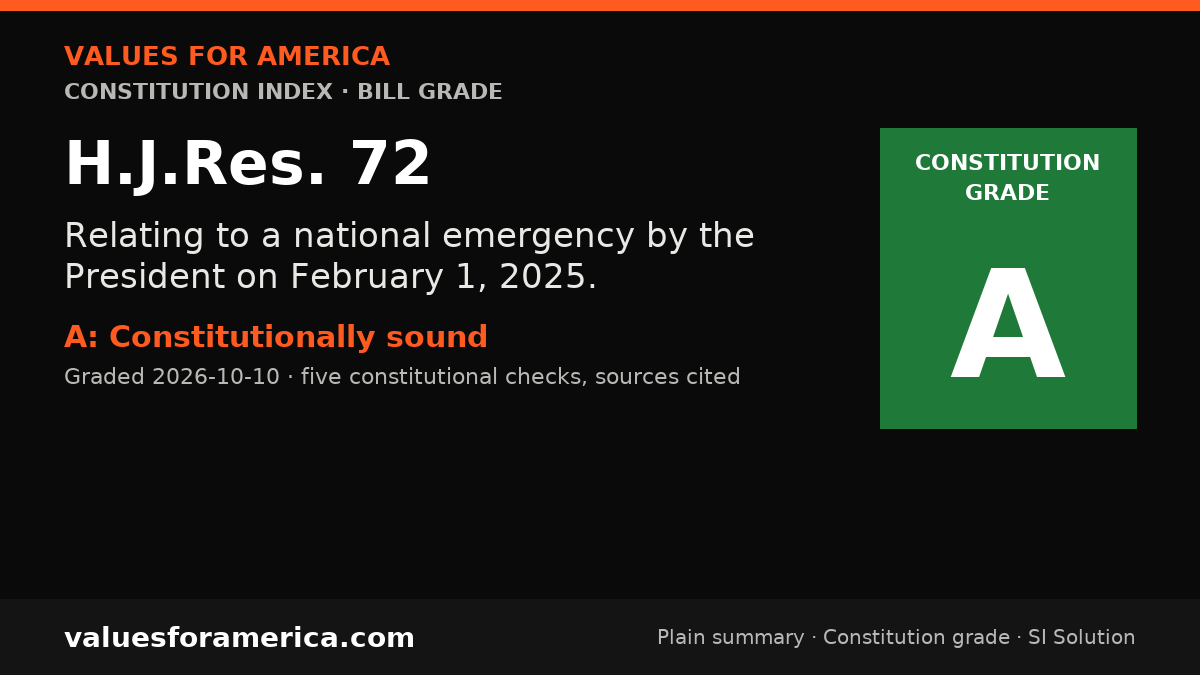
Relating to a national emergency by the President on February 1, 2025.
Cosponsors: 10 (10 D, 0 R) · per Congress.gov, 2026-10-09
Introduced: 2025-03-06
Latest action (2026-02-12): Received in the Senate and Read twice and referred to the Committee on Finance.
What H.J.Res. 72 does, in plain terms
The Congressional Research Service has not published a summary of H.J.Res. 72 yet. Its official title: “Relating to a national emergency by the President on February 1, 2025.”.
Constitution Index
“VFA Constitution grade”
Constitutionally sound
Graded 2026-10-10
SI-generated grade · five published checks · not individually reviewed by a person · methodology
This joint resolution terminates a national emergency declared by the President under the National Emergencies Act. Congress's power to terminate such declarations is expressly granted by statute and is consistent with its enumerated legislative powers, including the power to declare war and to make all laws necessary and proper. The resolution does not infringe on any constitutional rights, does not restrict individual sovereignty, does not consolidate power upward, and does not implicate due process or takings concerns. It is a straightforward exercise of Congress's constitutional oversight authority.
-
✓ Passes · Enumerated powers
Congress has the enumerated power to declare war (Article I, Section 8, Clause 11) and to make all laws necessary and proper for executing its powers (Article I, Section 8, Clause 18). The National Emergencies Act, enacted pursuant to these powers, expressly grants Congress the authority to terminate a national emergency by joint resolution (50 U.S.C. 1622). This resolution is a direct exercise of… -
✓ Passes · Bill of Rights
The resolution does not implicate any of the first ten amendments. It does not restrict speech, religion, assembly, press, petition, arms, quartering, search and seizure, self-incrimination, due process, takings, trial rights, jury rights, cruel and unusual punishment, unenumerated rights, or reserved powers. It simply terminates a presidential declaration of emergency. -
✓ Passes · Individual sovereignty
The resolution does not restrict any individual's person, property, speech, labor, or belief. It does not impose any new obligations or prohibitions on individuals. It merely ends a state of emergency, which generally reduces government power over individuals. -
✓ Passes · Decentralization
This action does not consolidate decision-making at a higher level of government; rather, it exercises Congress's constitutional check on executive power. The National Emergencies Act specifically provides for congressional termination, and this resolution is the most direct and appropriate mechanism. It does not involve individuals, local communities, or states, and it does not shift power upward… -
✓ Passes · Due process and takings
The resolution does not bypass due process, does not affect the presumption of innocence, and does not take property without just compensation. It is a legislative act that terminates an executive declaration, with no adverse effect on any person's procedural or substantive rights.
Report an error in this grade
What should pass
“VFA SI Solution”
No solution yet
A sourced SI draft appears here once it passes automated checks (Constitution citation, source verification, independent SI critic). How publication works.
Related on VFA

For journalists and bloggers
“Embed this grade”
Free to use with the link back. The badge and card update when the grade changes. Embed terms →
