H.J.Res. 24 explained · 119th Congress · Became law
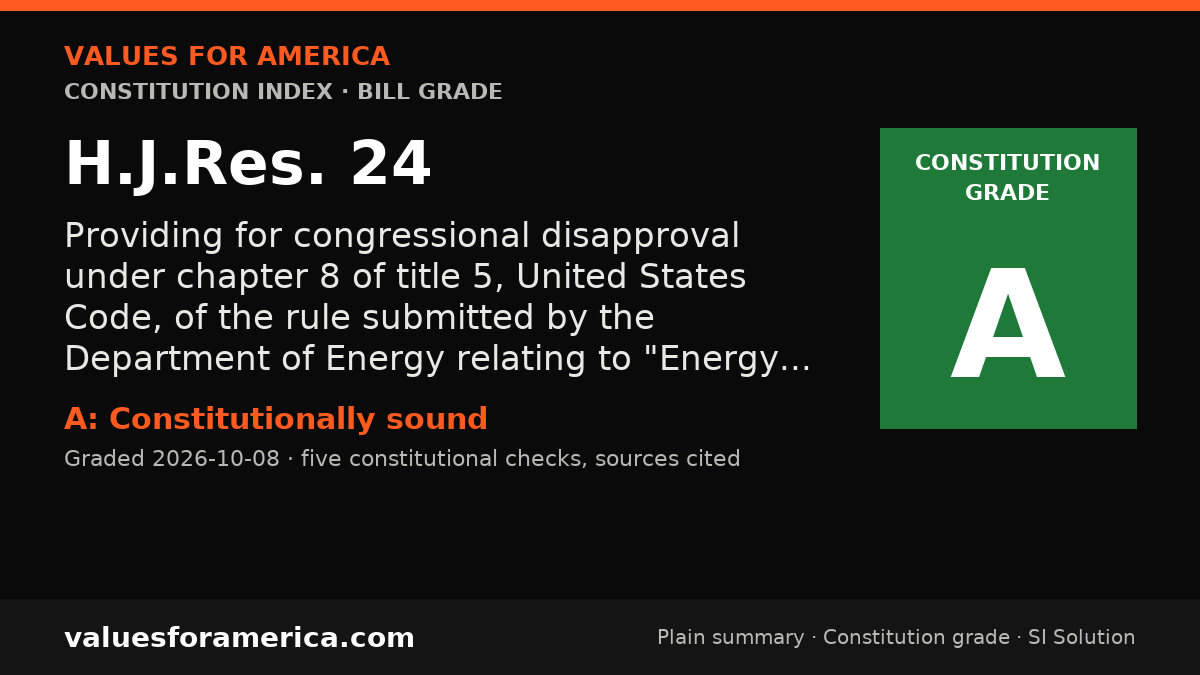
Providing for congressional disapproval under chapter 8 of title 5, United States Code, of the rule submitted by the Department of Energy relating to "Energy Conservation Program: Energy Conservation Standards for Walk-In Coolers and Walk-In Freezers".
Cosponsors: 10 (0 D, 10 R) · per Congress.gov, 2026-10-11
Introduced: 2025-01-16
Latest action (2025-05-09): Became Public Law No: 119-7.
What H.J.Res. 24 does, in plain terms
This joint resolution eliminates new, more stringent energy conservation standards for certain walk-in coolers and freezers, including the new limits on maximum daily energy consumption for walk-in non-display doors. Under the joint resolution, walk-in non-display doors and walk-in refrigeration systems are no longer required to comply with the new standards. Specifically, the joint resolution nullifies the rule titled Energy Conservation Program: Energy Conservation Standards for Walk-In Coolers and Walk-In Freezers and submitted by the Department of Energy (DOE) on December 23, 2024. Under the rule, DOE adopted energy conservation standards for walk-in coolers and freezers to achieve the maximum improvement in energy efficiency that DOE determined was technologically feasible and economically justified. The rule required walk-in non-display doors to comply with those standards by December 23, 2027, and walk-in refrigeration systems to comply with them by December 31, 2028.
Official summary by the Congressional Research Service, via Congress.gov.
Constitution Index
“VFA Constitution grade”
Constitutionally sound
Graded 2026-10-08
SI-generated grade · five published checks · not individually reviewed by a person · methodology
HJRES 24 uses lawful congressional review power to cancel a 2024 Department of Energy efficiency mandate for walk-in coolers and freezers. It imposes no new speech, search, property, or due-process burden, expands individual and business choice, and returns authority toward states and markets. It is constitutionally sound.
-
✓ Passes · Enumerated powers
Congress acts within express authority. Article I, Section 8, Clause 3 gives Congress power to regulate commerce among the states, and Article I, Section 8, Clause 18 gives power to make laws necessary and proper for carrying federal powers into effect. Here Congress uses that authority to restrain executive rulemaking through the Congressional Review Act, chapter 8 of title 5, United States Code,… -
✓ Passes · Bill of Rights
This resolution removes rather than imposes a federal mandate on manufacturers and owners of walk-in coolers and freezers. It compels no speech, prohibits no belief, authorizes no search under the Fourth Amendment, and takes no property. It therefore infringes none of the first ten Amendments and tends to protect Ninth Amendment retained rights and Tenth Amendment reserved powers by withdrawing fe… -
✓ Passes · Individual sovereignty
The resolution lessens government restraint on person, property, labor, and contract. Manufacturers, grocers, restaurants, and cold-storage owners regain freedom to choose equipment based on cost and need rather than the maximum federal efficiency standard the Department deemed feasible. No showing by the government is needed because no new burden is imposed; sovereignty is expanded, consistent wi… -
✓ Passes · Decentralization
The resolution moves decision-making downward. (1) Businesses and buyers can weigh energy cost against upfront price without a federal mandate. (2) Local building and business choices need no federal door standard. (3) States retain authority under the Tenth Amendment to set their own efficiency policies if they choose. (4) It does not consolidate power upward; it reverses upward consolidation by … -
✓ Passes · Due process and takings
No deprivation of life, liberty, or property occurs under the Fifth Amendment Due Process Clause, and no taking requiring just compensation occurs. The measure eliminates future compliance costs and deadlines of December 2027 and December 2028 rather than imposing a fine, seizure, or retroactive penalty without notice and hearing. It restores the prior legal baseline through the public legislative…
Sources: Congress.gov: HJRES 24 summary
Report an error in this grade
What should pass
“VFA SI Solution”
No solution yet
A sourced SI draft appears here once it passes automated checks (Constitution citation, source verification, independent SI critic). How publication works.
Related on VFA

For journalists and bloggers
“Embed this grade”
Free to use with the link back. The badge and card update when the grade changes. Embed terms →
