H.Con.Res. 89 explained · 119th Congress · Pending in Congress
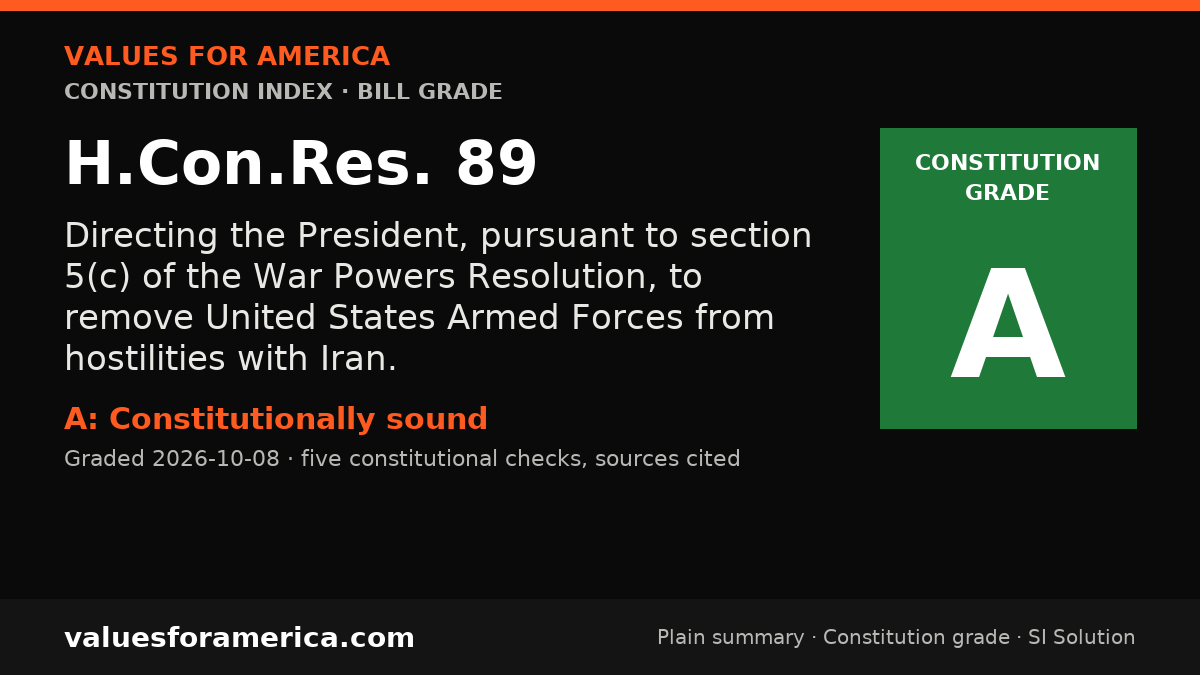
Directing the President, pursuant to section 5(c) of the War Powers Resolution, to remove United States Armed Forces from hostilities with Iran.
Cosponsors: 16 (15 D, 1 R) · per Congress.gov, 2026-10-14
Introduced: 2026-04-23
Latest action (2026-09-24): Failed of passage in Senate by Yea-Nay Vote. 49 - 50. Record Vote Number: 244.
What H.Con.Res. 89 does, in plain terms
This concurrent resolution directs the President to remove U.S. Armed Forces from hostilities against Iran or any part of its government or military unless a declaration of war or authorization to use military force for such purpose has been enacted. The resolution specifies that it shall not be construed to prevent the United States from defending itself, its Armed Forces, its diplomatic facilities, or allied states from imminent attack.
Official summary by the Congressional Research Service, via Congress.gov.
Constitution Index
“VFA Constitution grade”
Constitutionally sound
Graded 2026-10-08
SI-generated grade · five published checks · not individually reviewed by a person · methodology
HCONRES 89 is constitutional. It enforces Congress's Article I war-declare power by ending unauthorized hostilities with Iran while preserving self-defense, infringes no Bill of Rights protection, takes no property without due process, and properly exercises federal authority over war rather than consolidating new federal power.
-
✓ Passes · Enumerated powers
Ordering removal from unauthorized hostilities is squarely within congressional authority. Article I, Section 8, Clause 11 grants Congress power to declare war, and Article I, Section 8, Clause 14 grants power over the government and regulation of the Armed Forces. Section 5(c) of the War Powers Resolution implements that authority. A concurrent resolution directing an end to undeclared hostilitie… -
✓ Passes · Bill of Rights
This resolution restricts government war-making, it does not restrict private rights. It implicates no First Amendment speech, religion, press or assembly interest, no Second Amendment arms interest, no Fourth Amendment search, and no Fifth through Eighth Amendment trial or punishment interest. By restoring congressional control over hostilities, it protects the Ninth and Tenth Amendments' reserva… -
✓ Passes · Individual sovereignty
The resolution imposes no restriction on any person's body, property, speech, labor, or belief. It restricts only the federal executive's conduct of hostilities without authorization. Because no private freedom is burdened, the government bears no additional justification burden here, and sovereignty of the individual is left fully intact. -
✓ Passes · Decentralization
National defense and war with a foreign state cannot be handled by an individual, county, or single state, so the first three questions are answered no. The action does not consolidate power upward; it does the opposite by moving the decision to use force from the executive back to Congress as the Tenth Amendment and separation of powers require. De-centralization within the federal level is const… -
✓ Passes · Due process and takings
No person is deprived of life, liberty, or property, and no property is taken. The resolution orders no punishment, creates no tribunal, and presumes no guilt. It therefore satisfies Fifth Amendment procedural and substantive due process and raises no Takings Clause issue requiring just compensation.
Sources: Congress.gov: HCONRES 89 summary
Report an error in this grade
What should pass
“VFA SI Solution”
SI-generated · passed automated checks (Constitution citation, source verification, independent SI critic) · not individually reviewed by a person · Report an error: hello@valuesforamerica.com
SI Bipartisan War Powers Compliance and Force Protection Proposal for Iran Hostilities
Generated by VFA SI Solutions
Prevent an unauthorized United States war with Iran by ending direct hostilities unless Congress votes to declare war or authorize force, while preserving self-defense.
Bipartisan rationale: VFA assesses this draft would give Republicans or conservatives a gain in fiscal restraint with no new spending and a capped withdrawal cost, a clear statutory bar on open-ended conflict, and full protection of command authority for self-defense. VFA assesses it would give Democrats or progressives a gain in preventing an unauthorized wider war with Iran, returning the war decision to Congress, and protecting service members and diplomats from mission creep while keeping a narrow defense exception for imminent attack.
Possible legislative path: In the House and Senate, support may come from members favoring congressional authorization and restraint, while opposition may come from members favoring broad executive flexibility in the region.
Source limits: The full bill text, current deployments, current law, cost effects, eligibility rules, and waiver or appeal rules were not supplied and remain unverified. Proposed reports, certifications, funding cap, and sunset are new VFA proposals, not existing rights. Readers should verify the official Congress.gov text and record before acting.
Article I, Section 8, Clause 11 Article I, Section 8, Clause 14 Article I, Section 8, Clause 1 Article I, Section 9, Clause 7 Article I, Section 7, Clause 2 Article II, Section 2, Clause 1
Report an error in this Solution
Citizen Consensus
“Do you support this VFA SI Solution?”
One vote per verified account; you can change it any time. Only verified accounts count, results publish once 30 verified people have voted, and state and district results count only people who attested a home ZIP code. How this works.
Email verification is not switched on yet, so no vote counts toward results yet. Votes cast now are saved and count once the voter verifies their email address.
Sign in or create a free account to vote.
Add a short reason (optional)
/280 · no links or contact details · reasons are reviewed before anyone sees them, and many never are shown.
Your vote is saved but held out of published results by an automated integrity check (for example, several accounts voting from one browser).
Your vote is saved. It will count once you verify your email address. Verify on your account page.
Your vote counts nationally. Add your home ZIP code to count in your state and district too.
Your vote counts nationally and in .
Reason saved privately; it is shown only if it passes review.
Verified participants nationwide · n =
Self-selected participants, not a random sample; ± is the 95% sampling margin.
Not enough verified votes yet. Results publish at verified votes.
A sudden surge of votes on this item was flagged and is under review; votes from new accounts in that surge are held out until it is resolved.
Related on VFA

For journalists and bloggers
“Embed this grade”
Free to use with the link back. The badge and card update when the grade changes. Embed terms →
