H.Con.Res. 86 explained · 119th Congress · Pending in Congress
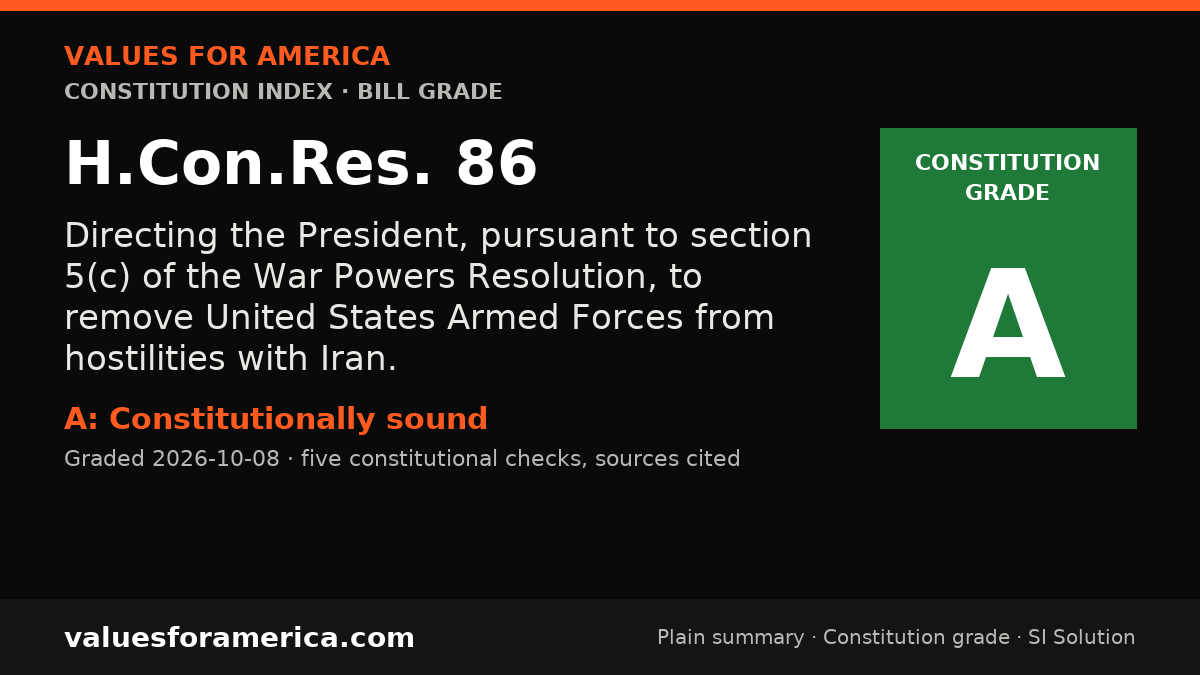
Directing the President, pursuant to section 5(c) of the War Powers Resolution, to remove United States Armed Forces from hostilities with Iran.
Cosponsors: 5 (4 D, 1 R) · per Congress.gov, 2026-10-08
Introduced: 2026-04-20
Latest action (2026-06-24): Message on Senate action sent to the House.
What H.Con.Res. 86 does, in plain terms
This concurrent resolution directs the President to remove U.S. Armed Forces from hostilities against Iran unless explicitly authorized by a declaration of war or a congressional authorization for use of military force against Iran. Elements of the U.S. Armed Forces needed to defend the United States, an ally, or a partner from imminent attack are not covered by this requirement provided the President complies with a specified provision of the War Powers Resolution. (The provision generally requires the President to remove U.S. Armed Forces from hostilities no more than 60 days after the President notifies or is required to notify Congress of such involvement, unless Congress authorizes such use. For more information on the War Powers Resolution, see CRS In Focus 13134.)
Official summary by the Congressional Research Service, via Congress.gov.
Constitution Index
“VFA Constitution grade”
Constitutionally sound
Graded 2026-10-08
SI-generated grade · five published checks · not individually reviewed by a person · methodology
HCONRES 86 is a constitutional correction. It enforces Article I congressional control over war by requiring removal from hostilities with Iran unless Congress declares war or authorizes force, with a narrow imminent-defense exception. No rights are infringed and no power is usurped; SI review finds full compliance.
-
✓ Passes · Enumerated powers
Congress holds explicit authority under Article I, Section 8, Clause 11 to declare war and grant letters of marque, and Clause 14 to govern Armed Forces. Directing removal absent a declaration or authorization for use of military force enforces that grant and Section 5(c) of the War Powers Resolution. This corrects executive overreach rather than creating new federal power. -
✓ Passes · Bill of Rights
Resolution restricts no speech, religion, press, assembly, arms, search, trial or other protected right. It expands liberty by preventing undeclared hostilities and protects First Amendment petition and Ninth Amendment retained rights to live free from undeclared conflict, consistent with Article I war authority. -
✓ Passes · Individual sovereignty
Resolution imposes no restriction on person, property, speech, labor, or belief. It removes the burden of undeclared hostilities from service members and the public, placing the burden on the government to obtain constitutional authorization under Article I, Section 8, Clause 11 before committing lives and resources. -
✓ Passes · Decentralization
National defense against a foreign state cannot be handled by individuals, counties, or single states, so higher-level action is necessary. This measure does not consolidate upward; it de-consolidates by pulling war-making back from the President to Congress as required by Article I, Section 8, Clauses 11-14 and the Tenth Amendment, preserving the minimum necessary level which is the federal legis… -
✓ Passes · Due process and takings
No person is deprived of life, liberty, or property and no property is taken. Procedural due process under Fifth Amendment is honored because use of force requires prior congressional deliberation and authorization. Substantive action is non-arbitrary and preserves the 60-day War Powers notice rule for imminent defense.
Sources: Congress.gov: HCONRES 86 summary
Report an error in this grade
The Framers
“Founders’ Verdict”
Confidence 0.60
Archived SI output (machine-generated)No editorial review recorded. This historical SI verdict was machine-generated by software and predates the review desk; check it against the official bill text.
Synthesis
The concurrent resolution is unconstitutional because it attempts to direct the President's conduct of military hostilities without satisfying the bicameralism and presentment requirements of Article I, Section 7, and impermissibly encroaches on the President's Commander-in-Chief powers under Article II, Section 2. A concurrent resolution lacks the force of law and cannot bind the executive; only a joint resolution or a formal declaration of war can constitutionally compel the withdrawal of forces.
This concurrent resolution attempts to direct the President's conduct of military hostilities without a binding legislative act. The Constitution vests the executive power in the President (Article II, Section 1), and makes him Commander-in-Chief of the Army and Navy (Article II, Section 2, Clause 1). The War Powers Resolution of 1973, while a statutory framework, cannot by concurrent resolution (which does not have the force of law and is not presented to the President) compel removal of forces. Section 5(c) of that resolution purports to allow such a directive, but a concurrent resolution is…
The Constitution vests in Congress alone the power to declare war (Article I, Section 8, Clause 11). The President, as Commander-in-Chief (Article II, Section 2, Clause 1), may repel sudden attacks but cannot initiate or sustain hostilities without congressional authorization. This resolution rightly insists that any prolonged or offensive use of force against Iran must be preceded by a formal declaration of war or a specific authorization. The War Powers Resolution, though a statutory framework, properly reinforces this constitutional separation. To allow the President to wage war without the…
This concurrent resolution attempts to direct the President in the exercise of his constitutional authority as Commander in Chief without the force of a law passed by both Houses and presented to the President. The Constitution vests the power to declare war in Congress (Article I, Section 8, Clause 11) and makes the President the Commander in Chief of the Armed Forces (Article II, Section 2, Clause 1). While Congress may regulate the armed forces through legislation, a concurrent resolution—which lacks bicameralism and presentment—cannot bind the President. The mechanism of section 5(c) of th…
The Constitution vests in Congress the sole power to declare war (Article I, Section 8, Clause 11). The War Powers Resolution, as a statute, cannot alter the constitutional allocation of war powers. However, the concurrent resolution here purports to direct the President to remove forces from hostilities unless Congress has authorized the use of military force. This is consistent with Congress's power to control the initiation and continuation of war, but it must be read in harmony with the President's duty as Commander in Chief (Article II, Section 2) to repel sudden attacks. Therefore, the r…
Report an error in this Founders' Verdict
What should pass
“VFA SI Solution”
No solution yet
A sourced SI draft appears here once it passes automated checks (Constitution citation, source verification, independent SI critic). How publication works.
Related on VFA

For journalists and bloggers
“Embed this grade”
Free to use with the link back. The badge and card update when the grade changes. Embed terms →
