H.Con.Res. 40 explained · 119th Congress · Pending in Congress
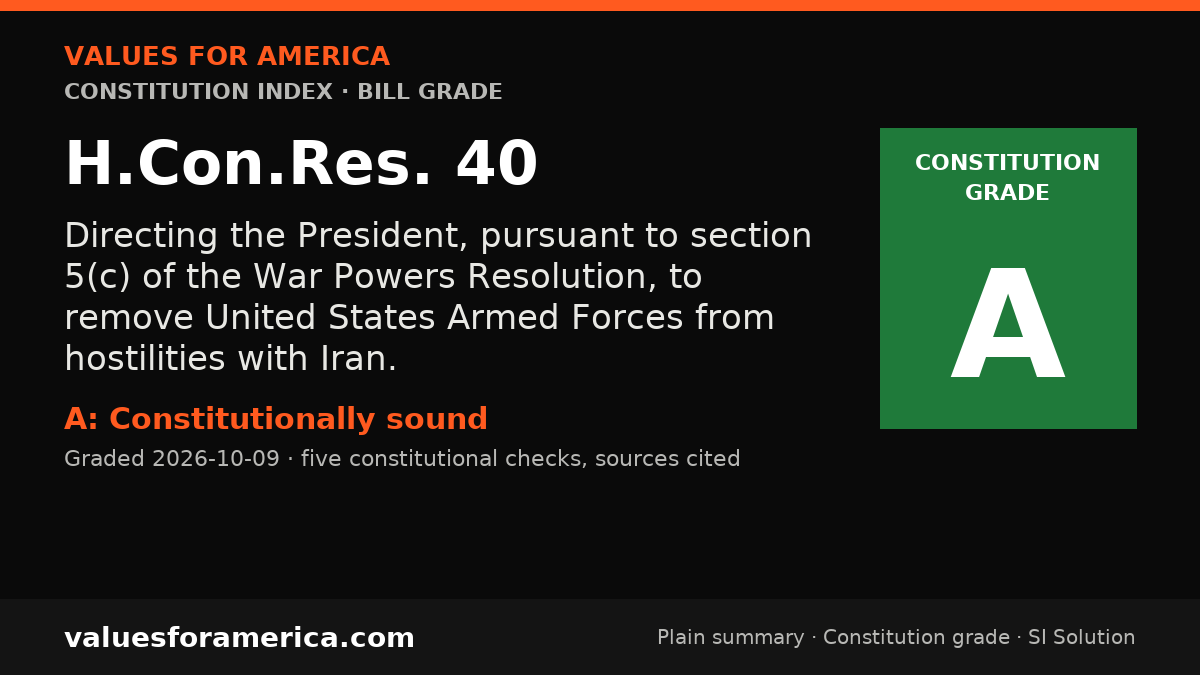
Directing the President, pursuant to section 5(c) of the War Powers Resolution, to remove United States Armed Forces from hostilities with Iran.
Cosponsors: 90 (90 D, 0 R) · per Congress.gov, 2026-10-09
Introduced: 2025-06-23
Latest action (2026-04-16): Motion to reconsider laid on the table Agreed to without objection.
What H.Con.Res. 40 does, in plain terms
This concurrent resolution directs the President to remove U.S. Armed Forces from hostilities against Iran unless explicitly authorized by a declaration of war or a congressional authorization for use of military force against Iran. Elements of the U.S. Armed Forces needed to defend the United States, an ally, or a partner from imminent attack are not covered by this requirement provided the President complies with a specified provision of the War Powers Resolution. (The provision generally requires the President to remove U.S. Armed Forces from hostilities no more than 60 days after the President notifies or is required to notify Congress of such involvement, unless Congress authorizes such use. For more information on the War Powers Resolution, see CRS In Focus 13134.)
Official summary by the Congressional Research Service, via Congress.gov.
Constitution Index
“VFA Constitution grade”
Constitutionally sound
Graded 2026-10-09
SI-generated grade · five published checks · not individually reviewed by a person · methodology
This concurrent resolution is fully constitutional. It does not expand federal power, infringe rights, or violate due process. Instead, it reinforces the constitutional separation of war powers by requiring congressional authorization for hostilities, consistent with Article I, Section 8, Clause 11.
-
✓ Passes · Enumerated powers
Congress has explicit constitutional authority under Article I, Section 8, Clause 11 to declare war and to define the limits of military engagement. This resolution exercises that power by directing the President to remove forces from hostilities unless Congress authorizes them. It does not exceed enumerated powers. -
✓ Passes · Bill of Rights
The resolution does not restrict speech, religion, assembly, press, petition, arms, quartering, search and seizure, self-incrimination, due process, takings, fair trial, jury, cruel and unusual punishment, or any other right protected by the Bill of Rights. It addresses only the deployment of armed forces abroad. -
✓ Passes · Individual sovereignty
The resolution imposes no restriction on individual persons, property, speech, labor, or belief. It governs the conduct of the executive branch in foreign military operations, not the liberties of any citizen. -
✓ Passes · Decentralization
The resolution passes all four questions. (1) An individual or family cannot handle international hostilities, so government involvement is necessary. (2) A local community or county cannot handle national war powers. (3) A state cannot handle federal war powers. (4) The resolution does not consolidate decision-making upward; it reinforces the existing constitutional allocation of war powers to Co… -
✓ Passes · Due process and takings
The resolution does not bypass due process, presume guilt, or take property without just compensation. It provides clear notice and a procedural framework for the President to follow, consistent with the War Powers Resolution and the Fifth Amendment.
Sources: Congress.gov: HCONRES 40 summary
Report an error in this grade
What should pass
“VFA SI Solution”
No solution yet
A sourced SI draft appears here once it passes automated checks (Constitution citation, source verification, independent SI critic). How publication works.
Related on VFA

For journalists and bloggers
“Embed this grade”
Free to use with the link back. The badge and card update when the grade changes. Embed terms →
