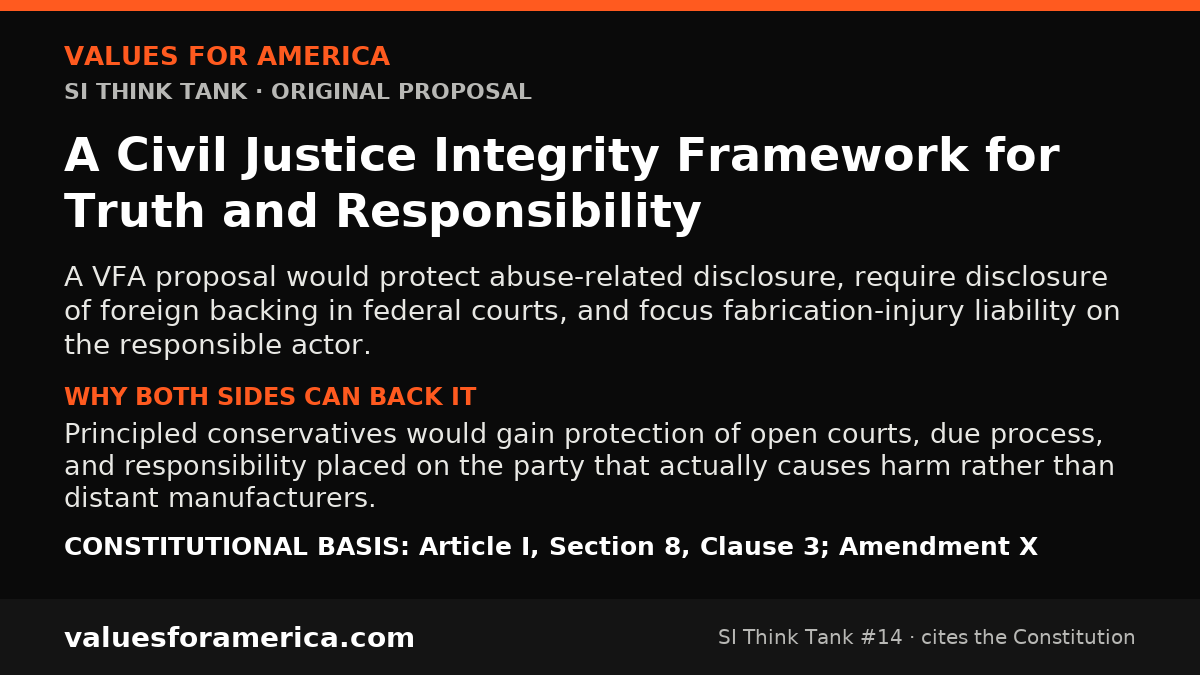
A Civil Justice Integrity Framework for Truth and Responsibility
Protect disclosure, reveal hidden backing, and hold the responsible party accountable
Original VFA proposal · SI-generated · passed automated checks (Constitution citation, official-source excerpts, independent SI critic) · not individually reviewed by a person · Methodology
Grounded in 3 official Congress.gov bill summaries showing the problem Congress keeps returning to. This is a VFA proposal, not law.
Publication source record dated 2026-10-16 UTC. The source links preserve the versions used for this proposal.
Official source versions match · Last verified 2026-10-19 10:00 UTC. This check does not establish whether an executive action remains legally in force.
Article I, Section 8, Clause 3 Article III Amendment X Amendment I
TL;DR
A VFA proposal would protect abuse-related disclosure, require disclosure of foreign backing in federal courts, and focus fabrication-injury liability on the responsible actor.
The problem
Current civil-justice rules can suppress truth, conceal influence, and misdirect responsibility. The official summary states the bill would void nondisclosure clauses that block disclosure of sexual abuse against a minor, while another states the bill would limit third-party financing by foreign entities and require disclosure of foreign support and contingent payment rights. Two further summaries state the bills would prohibit civil actions against manufacturers or sellers for injuries arising from fabrication by another party, including silica exposure, and require dismissal of pending actions. Together they show a shared problem: procedure and contract can hide abuse, hide backing, or assign blame to the wrong party.
The proposal
Congress draws its power here from specific grants, not general concern. Article I, Section 8, Clause 3 permits regulation of genuinely interstate commerce, including contracts and products shipped in interstate commerce. Article III, Sections 1 and 2 authorize Congress to regulate practice in federal courts. The Tenth Amendment and principles of federalism limit that power: tort duties, contract enforcement, and state court procedure remain primarily state matters. This VFA proposal would therefore set a narrow federal floor for federal courts and interstate transactions, while leaving states to lead on tort and contract through a voluntary model.
The thesis is direct: civil justice should reveal truth and assign responsibility to fault. A VFA proposal would provide that no settlement term could bar disclosure of sexual abuse against a minor or facts related to it. It would require disclosure to the court when a foreign state or sovereign wealth fund supports federal litigation or holds a contingent interest. And it would channel fabrication-injury claims toward the fabricator or employer whose conduct creates the exposure, preserving claims against a maker or seller only for its own wrongful conduct. Each rule is narrow, conditional, and subject to judicial oversight.
The strongest objection is that Washington would rewrite private contracts, invite fishing into litigation funding, and close courthouse doors to injured workers. The answer is restraint. The disclosure protection would cover only abuse-related facts, not entire settlements. Funding disclosure would go to the judge with safeguards, not to opponents as strategy. Liability limits would not deny recovery; they would direct claims to the responsible actor while preserving fault-based claims against others. With a fixed sunset, public reporting, and state choice, the framework would test whether transparency and fault-based responsibility work before anything becomes permanent.
Why both sides can back it (VFA's assessment)
Principled conservatives would gain protection of open courts, due process, and responsibility placed on the party that actually causes harm rather than distant manufacturers. Good-faith progressives would gain protection for survivors of abuse against a minor to speak, and transparency about hidden foreign influence in civil cases. VFA assesses that both gains strengthen truth and accountability without expanding federal liability.
Operative provisions
Mechanism. a VFA proposal would combine a narrow federal disclosure rule for federal courts, a voluntary state model protecting abuse-related disclosure, and fault-channeling limits for fabrication-injury claims
Cost basis. subject to appropriations; no cost estimate exists yet
Limits. applies prospectively with narrow retroactive effect only for disclosure protection; no new private right of action; no regulation of fees, speech content, or state tort duties beyond stated limits
Sunset. all operative sections would expire after a fixed term unless reauthorized on recorded findings
Oversight. annual public reporting by the administering office, judicial review of disclosure and enforcement orders, and congressional review before renewal
Enforcement. courts would decline to enforce barred nondisclosure terms, apply civil sanctions and adverse case measures for knowing disclosure failures, and dismiss only claims expressly barred by the liability limits
Foundation
“First principles”
Congress has only enumerated powers; civil justice is presumptively a state domain reserved by the Tenth Amendment.
Article III gives Congress authority over practice and integrity in federal courts it creates.
Speech about matters of grave public concern receives strong First Amendment protection, while commercial and procedural regulation must remain narrowly drawn.
Responsibility should follow fault, with limited government and fiscal restraint counseling narrow rules, sunset, and oversight.
Source lineage
“The official record behind this proposal”
Each excerpt is quoted word for word from the official Congress.gov summary of a bill. The bills show the problem; the proposal is VFA's own.
Official record · S-119-3966
TREY'S Law
Official source excerpt
the bill makes a nondisclosure clause in a contract void and unenforceable to the extent that it prohibits (1) a victim or alleged victim of sexual abuse against a minor from disclosing the sexual abuse or facts related to it
Official record · HR-119-2675
Protecting Our Courts from Foreign Manipulation Act
Official source excerpt
The bill requires any party or counsel in a civil action to disclose the name of any foreign person, state, or sovereign wealth fund that has agreed to provide monetary support for the civil action, has a right to receive a payment contingent upon the outcome
Official record · HR-119-5437
Protection of Lawful Commerce in Stone Slab Products Act
Official source excerpt
Specifically, the bill prohibits a civil action against a manufacturer or seller of a stone slab product for injuries arising from or related to the fabrication of the stone slab product by another party, including injuries caused by exposure to respirable silica
Operative structure
“Core components”
Protect truthful disclosure about abuse of minors
A VFA proposal would make nondisclosure terms unenforceable only to the extent they bar a victim or witness from disclosing sexual abuse against a minor or facts related to it, and would offer states a uniform voluntary model with the same narrow scope.
Disclose hidden foreign support in federal litigation
A VFA proposal would require parties and counsel in federal civil actions to disclose foreign state or sovereign wealth support and contingent payment interests to the court, with agreements available for in camera review and proportionate sanctions for knowing nondisclosure.
Keep liability with the responsible actor
A VFA proposal would keep responsibility with the fabricator or employer whose conduct causes silica-related fabrication injury, while preserving claims against sellers or makers only where their own conduct contributed, under clear statutory limits.
Honest risk surface
“Caveats & mitigations”
3 identified risks, each paired with a concrete mitigation. Judge the idea with these fully visible.
Federal standards for contracts and state tort claims could intrude on state police powers.
Mitigation
Confine the federal rule to federal courts and interstate contracts, publish a voluntary model code for states, and require findings before any renewal.
Broad invalidation of settlement terms could discourage settlements or expose victims to unwanted publicity.
Mitigation
Limit voidness to disclosure of abuse and related facts, preserve privacy redactions, and require judicial review of disclosure disputes.
Mandatory production of funding agreements could reveal litigation strategy or chill lawful support.
Mitigation
Require disclosure only of identity and contingent interest to the court, with in camera review and protective orders for sensitive material.
Operational rollout
“Implementation phases”
Standards and guidance
Courts would issue uniform disclosure forms, publish guidance on protected abuse-related disclosure, and clarify fault-based pleading standards.
Application in courts
Federal disclosure duties would apply to pending and new federal cases, states could adopt the model disclosure protection, and liability limits would apply to covered fabrication-injury claims.
Review and sunset decision
An independent review would assess effects on survivor disclosure, litigation transparency, and fair allocation of responsibility, with continuation only on affirmative findings.
Citizen Consensus
“Do you support this Think Tank idea?”
One vote per verified account; you can change it any time. Only verified accounts count, results publish once 30 verified people have voted, and state and district results count only people who attested a home ZIP code. How this works.
Email verification is not switched on yet, so no vote counts toward results yet. Votes cast now are saved and count once the voter verifies their email address.
Sign in or create a free account to vote.
Add a short reason (optional)
/280 · no links or contact details · reasons are reviewed before anyone sees them, and many never are shown.
Your vote is saved but held out of published results by an automated integrity check (for example, several accounts voting from one browser).
Your vote is saved. It will count once you verify your email address. Verify on your account page.
Your vote counts nationally. Add your home ZIP code to count in your state and district too.
Your vote counts nationally and in .
Reason saved privately; it is shown only if it passes review.
Verified participants nationwide · n =
Self-selected participants, not a random sample; ± is the 95% sampling margin.
Not enough verified votes yet. Results publish at verified votes.
A sudden surge of votes on this item was flagged and is under review; votes from new accounts in that surge are held out until it is resolved.