Archived SI output (machine-generated)
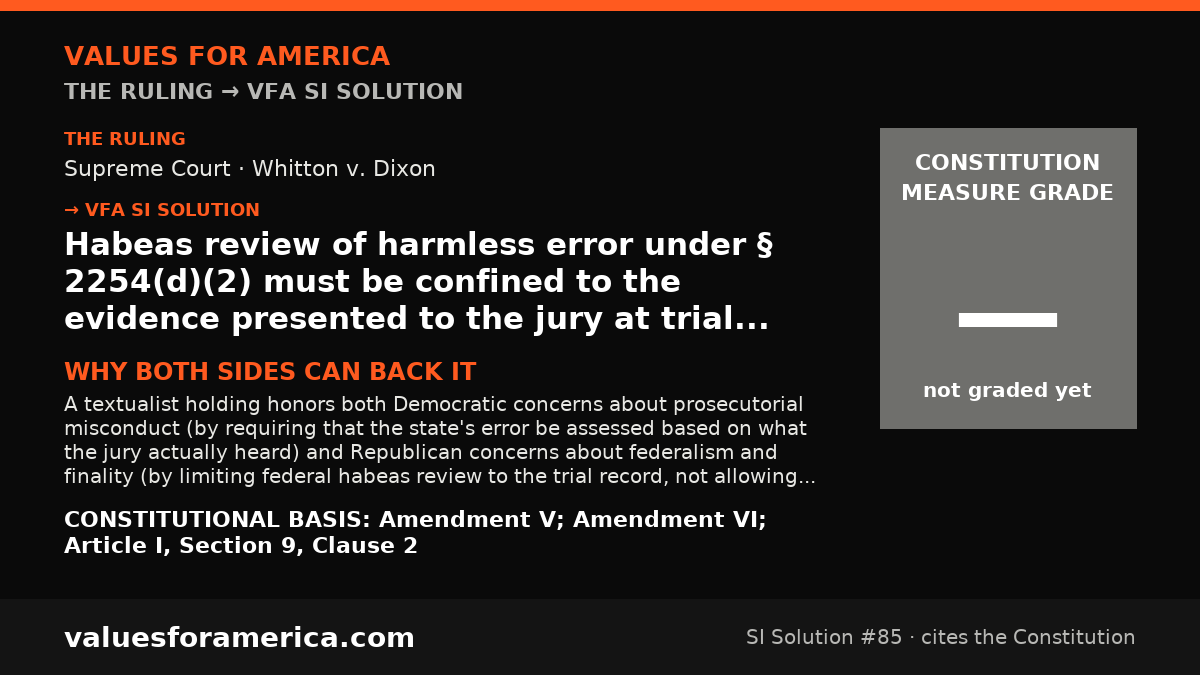
Habeas review of harmless error under § 2254(d)(2) must be confined to the evidence presented to the jury at trial; post-trial evidence cannot be considered.
Archived SI output (machine-generated) · No editorial review recorded
This historical SI draft was machine-generated by software and has no editorial review time on record. Verify its factual and legal claims against the original source before relying on it.
Whitton v. Dixon
Per Curiam
Habeas review of harmless error under § 2254(d)(2) must be confined to the evidence presented to the jury at trial; post-trial evidence cannot be considered.
Whether a federal habeas court may consider post-trial DNA evidence that was not presented to the jury when assessing whether a state court's determination that a Giglio error was harmless was reasonable under 28 U.S.C. § 2254(d)(2).
Constitutional concerns with the original
- The majority's reliance on Brecht v. Abrahamson (1993) and Giglio v. United States (1972) imports judge-made harmless-error standards that have no textual basis in the Constitution. The Sixth Amendment right to trial by jury and the Due Process Clause of the Fifth Amendment require that the jury's verdict be based solely on evidence admitted at trial, not on post-trial evidence or judicial speculation about what a jury might have done.
- The majority's analysis under § 2254(d)(2) defers to a state court's factual determination that was itself based on a post-trial DNA test. This creates a circular inquiry: the state court's 'reasonableness' is judged by evidence that did not exist at the time of its decision, violating the original meaning of habeas corpus as a remedy for unlawful detention, not a vehicle for reweighing evidence not before the trial court.
- The majority's holding implicitly endorses the use of post-trial evidence to cure constitutional errors at trial, which undermines the Fifth Amendment's guarantee that no person shall be deprived of life without due process of law. The jury's verdict must stand or fall on the evidence actually presented, not on evidence discovered later.
Solution text
Operative provisions
Bipartisan rationale
A textualist holding honors both Democratic concerns about prosecutorial misconduct (by requiring that the state's error be assessed based on what the jury actually heard) and Republican concerns about federalism and finality (by limiting federal habeas review to the trial record, not allowing endless post-trial evidence to justify convictions). It respects the original meaning of the jury trial right and due process, which both parties' constitutional traditions can recognize as fundamental.
Constitutional citations
- → Fifth Amendment (Due Process Clause)
- → Sixth Amendment (right to trial by jury)
- → Article I, Section 9, Clause 2 (Suspension Clause)
- → Federalist No. 83 (jury trial as 'the very palladium of free government')
Report an error in this Solution

Citizen Consensus
“Do you support this VFA SI Solution?”
One vote per verified account; you can change it any time. Only verified accounts count, results publish once 30 verified people have voted, and state and district results count only people who attested a home ZIP code. How this works.
Email verification is not switched on yet, so no vote counts toward results yet. Votes cast now are saved and count once the voter verifies their email address.
Sign in or create a free account to vote.
Add a short reason (optional)
/280 · no links or contact details · reasons are reviewed before anyone sees them, and many never are shown.
Your vote is saved but held out of published results by an automated integrity check (for example, several accounts voting from one browser).
Your vote is saved. It will count once you verify your email address. Verify on your account page.
Your vote counts nationally. Add your home ZIP code to count in your state and district too.
Your vote counts nationally and in .
Reason saved privately; it is shown only if it passes review.
Verified participants nationwide · n =
Self-selected participants, not a random sample; ± is the 95% sampling margin.
Not enough verified votes yet. Results publish at verified votes.
A sudden surge of votes on this item was flagged and is under review; votes from new accounts in that surge are held out until it is resolved.
Generated by VFA SI Solutions · 2026.06.06 06:03 UTC · ← Back to the Republic