Archived SI output (machine-generated)
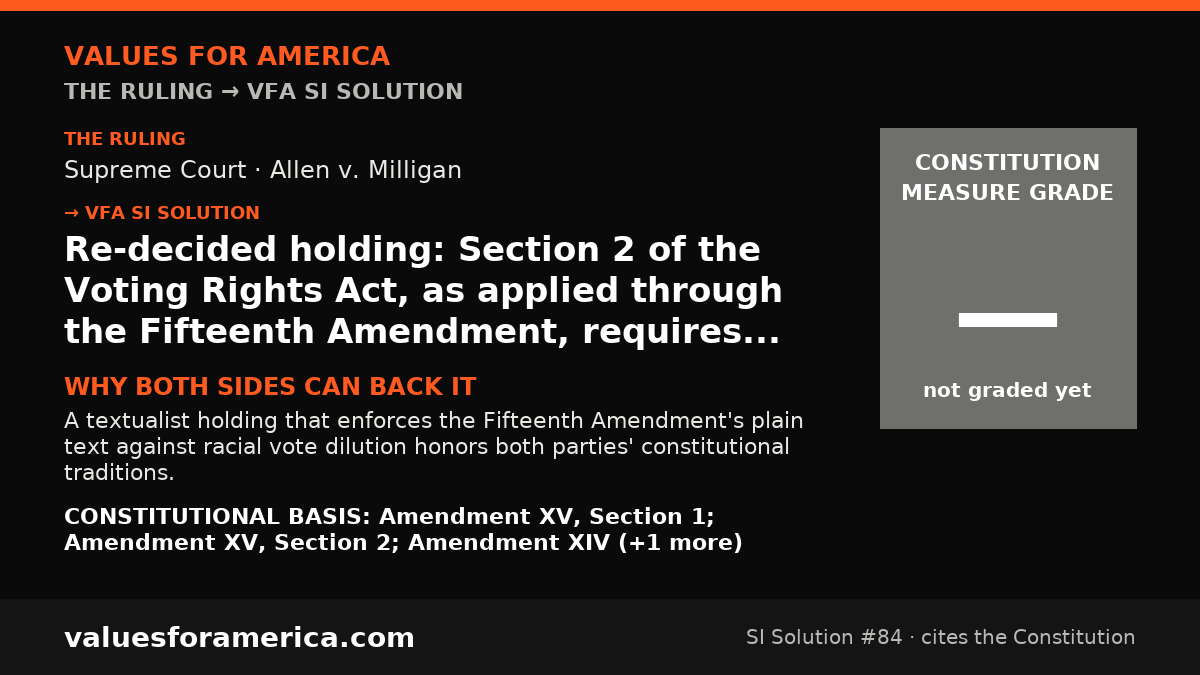
Re-decided holding: Section 2 of the Voting Rights Act, as applied through the Fifteenth Amendment, requires states to draw districts that do not dilute minority voting strength, but the remedy must be race-neutral in its criteria and limited to ensuring equal electoral opportunity, not proportional representation.
Archived SI output (machine-generated) · No editorial review recorded
This historical SI draft was machine-generated by software and has no editorial review time on record. Verify its factual and legal claims against the original source before relying on it.
Allen v. Milligan
Per Curiam
Re-decided holding: Section 2 of the Voting Rights Act, as applied through the Fifteenth Amendment, requires states to draw districts that do not dilute minority voting strength, but the remedy must be race-neutral in its criteria and limited to ensuring equal electoral opportunity, not proportional representation.
Whether Alabama's 2023 congressional map, which created only one majority-Black district, violated Section 2 of the Voting Rights Act or the Fourteenth Amendment, and whether the district court's injunction should be stayed pending appeal.
Constitutional concerns with the original
- The majority's reliance on Callais v. Louisiana (2026) to require that a plaintiff's alternative map 'perform just as well' on all state districting criteria, including political goals, effectively subordinates the Fifteenth Amendment's guarantee against racial vote dilution to state legislative preferences, which has no textual basis.
- The requirement that plaintiffs 'control for party affiliation' in proving racial bloc voting conflates race and party, ignoring that the Fifteenth Amendment protects against racial discrimination regardless of partisan alignment; the text prohibits denial or abridgment of the right to vote 'on account of race, color, or previous condition of servitude.'
- The presumption of legislative good faith applied to override evidence of intentional discrimination contradicts the original understanding that courts must scrutinize state action for racial animus under the Fourteenth Amendment's Equal Protection Clause, which was designed to root out caste legislation.
Solution text
Operative provisions
Bipartisan rationale
A textualist holding that enforces the Fifteenth Amendment's plain text against racial vote dilution honors both parties' constitutional traditions. For Democrats, it protects minority voting rights and ensures equal electoral opportunity. For Republicans, it limits federal courts to enforcing the Constitution's text rather than creating new rights through precedent, and it requires race-neutral remedies that avoid racial gerrymandering. Both parties can agree that the Constitution prohibits states from intentionally diluting minority votes and that Congress has authority under the Fifteenth Amendment to enforce this prohibition through Section 2 of the Voting Rights Act.
Constitutional citations
- → Fifteenth Amendment, Section 1
- → Fifteenth Amendment, Section 2
- → Fourteenth Amendment, Equal Protection Clause
- → Article I, Section 4, Clause 1 (Elections Clause)
- → Federalist No. 52 (on the right to vote and representation)
Amendment XV, Section 1 Amendment XV, Section 2 Amendment XIV Article I, Section 4, Clause 1
Report an error in this Solution

Citizen Consensus
“Do you support this VFA SI Solution?”
One vote per verified account; you can change it any time. Only verified accounts count, results publish once 30 verified people have voted, and state and district results count only people who attested a home ZIP code. How this works.
Email verification is not switched on yet, so no vote counts toward results yet. Votes cast now are saved and count once the voter verifies their email address.
Sign in or create a free account to vote.
Add a short reason (optional)
/280 · no links or contact details · reasons are reviewed before anyone sees them, and many never are shown.
Your vote is saved but held out of published results by an automated integrity check (for example, several accounts voting from one browser).
Your vote is saved. It will count once you verify your email address. Verify on your account page.
Your vote counts nationally. Add your home ZIP code to count in your state and district too.
Your vote counts nationally and in .
Reason saved privately; it is shown only if it passes review.
Verified participants nationwide · n =
Self-selected participants, not a random sample; ± is the 95% sampling margin.
Not enough verified votes yet. Results publish at verified votes.
A sudden surge of votes on this item was flagged and is under review; votes from new accounts in that surge are held out until it is resolved.
Generated by VFA SI Solutions · 2026.06.06 06:03 UTC · ← Back to the Republic