SI-generated Constitutional Solution
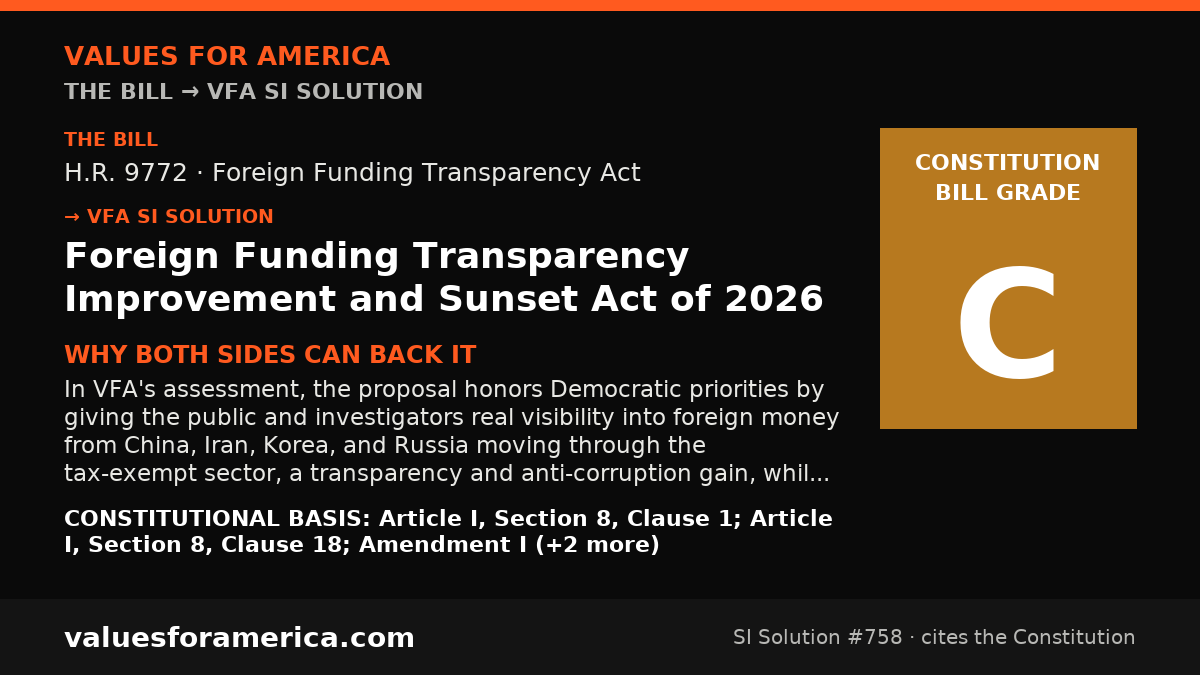
Foreign Funding Transparency Improvement and Sunset Act of 2026
SI-generated · passed automated checks (Constitution citation, source verification, independent SI critic) · not individually reviewed by a person · Report an error: hello@valuesforamerica.com
Brief for congressional offices →
Foreign Funding Transparency Act
Foreign Funding Transparency Improvement and Sunset Act of 2026
The bill wants to shed light on foreign money flowing into U.S. tax-exempt organizations, including money from countries of concern, by requiring larger 501(c) groups to report those contributions to the IRS.
Constitutional concerns with the original
- Aggregate reporting keyed to named foreign states may chill First Amendment association and speech rights unless reporting thresholds are high and disclosure obligations are clearly bounded, and the full bill's treatment of donor identity is not stated in the official summary.
- The 'knows or should know' donor-representation standard is vague as summarized; without a clearer, narrower trigger it risks arbitrary enforcement and Fifth Amendment due process concerns.
- The exemption threshold levels ($200,000 gross receipts or $500,000 assets) may sweep in many small civic leagues and labor organizations, imposing paperwork burdens that fall harder on modest groups, a proportionality concern under the taxing and spending power in Article I, Section 8, Clause 1.
- Any condition placed on tax-exempt status must stay within Congress's power to lay and collect taxes and attach conditions to federal tax benefits; extending the rule beyond reporting into regulation of state-chartered organizations could implicate the Tenth Amendment.
Solution text
Operative provisions
Source basis and limits
Basis: The Congress.gov summary of H.R. 9772 (119th Congress), which supports these facts: the bill would require certain 501(c) organizations to report to the IRS aggregate foreign-national contributions and the portion from China, Iran, Korea, or Russia; the $200,000 gross receipts / $500,000 assets thresholds applied in the alternative; the Form 990 filing predicate; the 'knows or should know' donor-representation reliance rule; and the latest action of placement on the Union Calendar, Calendar No. 666.
Check before relying on this: The full bill text and current law are not reflected in the official summary, so readers should verify at the Congress.gov bill page whether the bill imposes donor-level or aggregate reporting, what penalties it actually contains, whether any existing law already requires similar disclosure, and the bill's fiscal cost. The 'and' threshold design, the narrowed knowledge standard, the aggregate-only safeguard, the penalty structure, the funding cap, and the sunset in this proposal are new provisions not found in the summary.
Bipartisan rationale
In VFA's assessment, the proposal honors Democratic priorities by giving the public and investigators real visibility into foreign money from China, Iran, Korea, and Russia moving through the tax-exempt sector, a transparency and anti-corruption gain, while protecting donors and small civic groups from exposure and paperwork. It honors Republican priorities by imposing a hard spending cap, a five-year sunset, an Inspector General audit mandate, use of existing filing infrastructure rather than new bureaucracy, and a narrow, enumerated-power basis that respects the Tenth Amendment and limits IRS discretion with a defined knowledge standard and pre-penalty correction window.
Constitutional citations
- → Article I, Section 8, Clause 1
- → Article I, Section 8, Clause 18
- → First Amendment
- → Fifth Amendment Due Process
- → Tenth Amendment
Article I, Section 8, Clause 1 Article I, Section 8, Clause 18 Amendment I Amendment V Amendment X
Possible legislative path
In the House, national-security and transparency-minded members of both parties could support it, while some members may oppose any expanded IRS reporting on tax-exempt groups or object to naming specific countries; in the Senate, the sunset and spending cap may attract fiscal hawks, but some may push to raise or remove the thresholds, and others may seek broader foreign-money disclosure.
Report an error in this Solution

Citizen Consensus
“Do you support this VFA SI Solution?”
One vote per verified account; you can change it any time. Only verified accounts count, results publish once 30 verified people have voted, and state and district results count only people who attested a home ZIP code. How this works.
Email verification is not switched on yet, so no vote counts toward results yet. Votes cast now are saved and count once the voter verifies their email address.
Sign in or create a free account to vote.
Add a short reason (optional)
/280 · no links or contact details · reasons are reviewed before anyone sees them, and many never are shown.
Your vote is saved but held out of published results by an automated integrity check (for example, several accounts voting from one browser).
Your vote is saved. It will count once you verify your email address. Verify on your account page.
Your vote counts nationally. Add your home ZIP code to count in your state and district too.
Your vote counts nationally and in .
Reason saved privately; it is shown only if it passes review.
Verified participants nationwide · n =
Self-selected participants, not a random sample; ± is the 95% sampling margin.
Not enough verified votes yet. Results publish at verified votes.
A sudden surge of votes on this item was flagged and is under review; votes from new accounts in that surge are held out until it is resolved.
Related on VFA
Generated by VFA SI Solutions · 2026.11.05 22:01 UTC · ← Back to the Republic