SI-generated Constitutional Solution
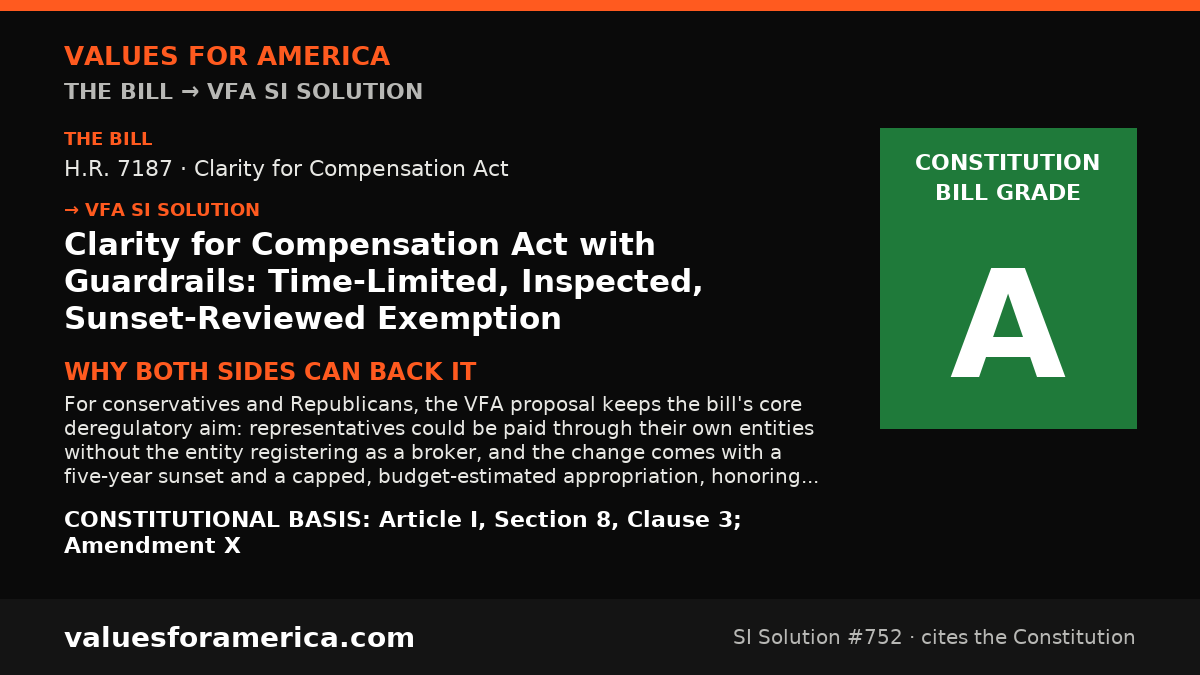
Clarity for Compensation Act with Guardrails: Time-Limited, Inspected, Sunset-Reviewed Exemption
SI-generated · passed automated checks (Constitution citation, source verification, independent SI critic) · not individually reviewed by a person · Report an error: hello@valuesforamerica.com
Brief for congressional offices →
Clarity for Compensation Act
Clarity for Compensation Act with Guardrails: Time-Limited, Inspected, Sunset-Reviewed Exemption
The bill aims to let registered representatives of SEC-registered brokers be paid through their own personal services entities without those entities having to register as brokers, by exempting qualifying entities from SEC broker regulation.
Constitutional concerns with the original
- The bill rests on Article I, Section 8, Clause 3, which supports regulating securities transactions across state lines. The bill uses that power to narrow a regulatory burden rather than create one, so the enumerated-powers risk is thin. The Tenth Amendment is not strained because the bill operates on a preexisting federal registration regime rather than commanding states.
- The main constitutional and policy risk is not power but oversight: an exemption written too loosely could let payment entities escape effective supervision. The official summary states the conditions and the records requirement, but the full bill text is not covered here, so the strength of those safeguards is unverified.
Solution text
Operative provisions
Source basis and limits
Basis: The Congress.gov official summary of H.R. 7187 (119th Congress), which states the bill exempts qualifying personal services entities from SEC broker regulation, lists the five conditions (broker approval and recordkeeping, no broker or dealer activity, broker supervision, written agreement, ownership by the representative or family), requires records production to the SEC and SRO on request, and records the latest action as placement on the Union Calendar, Calendar No. 691.
Check before relying on this: The full bill text and current law are not covered by the official summary, so the exact statutory language, any existing exemption or registration rules it amends, penalties, eligibility details, existing enforcement tools, and fiscal effects are unverified. The sunset, annual report, GAO study, antifraud confirmation, and broker-level accountability are new VFA proposals, not provisions of the bill. Whether the change reduces paperwork, affects small businesses, or changes any private right of action cannot be confirmed from the summary and should be verified against the bill text at the Congress.gov bill page and current securities law.
Bipartisan rationale
For conservatives and Republicans, the VFA proposal keeps the bill's core deregulatory aim: representatives could be paid through their own entities without the entity registering as a broker, and the change comes with a five-year sunset and a capped, budget-estimated appropriation, honoring fiscal restraint. For progressives and Democrats, it preserves investor protection by keeping every supervisory and recordkeeping condition stated in the official summary, adding SEC and SRO inspection reporting, an annual public report, a GAO study, and broker-level accountability for evasion. In VFA's assessment, each side gets its core priority: a narrower registration burden on one hand, unchanged stated safeguards plus sunlight on the other.
Constitutional citations
- → Article I, Section 8, Clause 3
- → Tenth Amendment
Article I, Section 8, Clause 3 Amendment X
Possible legislative path
In the House, members who favor reducing regulatory burdens on financial-services professionals would likely support it, while members concerned about any narrowing of SEC coverage of broker-adjacent entities would likely oppose it; in the Senate, support would plausibly come from members emphasizing capital-market competitiveness and opposition from members emphasizing investor-protection enforcement, with the sunset and GAO review offering a compromise path to a majority.
Report an error in this Solution

Citizen Consensus
“Do you support this VFA SI Solution?”
One vote per verified account; you can change it any time. Only verified accounts count, results publish once 30 verified people have voted, and state and district results count only people who attested a home ZIP code. How this works.
Email verification is not switched on yet, so no vote counts toward results yet. Votes cast now are saved and count once the voter verifies their email address.
Sign in or create a free account to vote.
Add a short reason (optional)
/280 · no links or contact details · reasons are reviewed before anyone sees them, and many never are shown.
Your vote is saved but held out of published results by an automated integrity check (for example, several accounts voting from one browser).
Your vote is saved. It will count once you verify your email address. Verify on your account page.
Your vote counts nationally. Add your home ZIP code to count in your state and district too.
Your vote counts nationally and in .
Reason saved privately; it is shown only if it passes review.
Verified participants nationwide · n =
Self-selected participants, not a random sample; ± is the 95% sampling margin.
Not enough verified votes yet. Results publish at verified votes.
A sudden surge of votes on this item was flagged and is under review; votes from new accounts in that surge are held out until it is resolved.
Related on VFA
Generated by VFA SI Solutions · 2026.11.05 16:03 UTC · ← Back to the Republic