SI-generated Constitutional Solution
Yosemite Fair Rent and Public Access Accountability Act
SI-generated · passed automated checks (Constitution citation, source verification, independent SI critic) · not individually reviewed by a person · Report an error: hello@valuesforamerica.com
Brief for congressional offices →
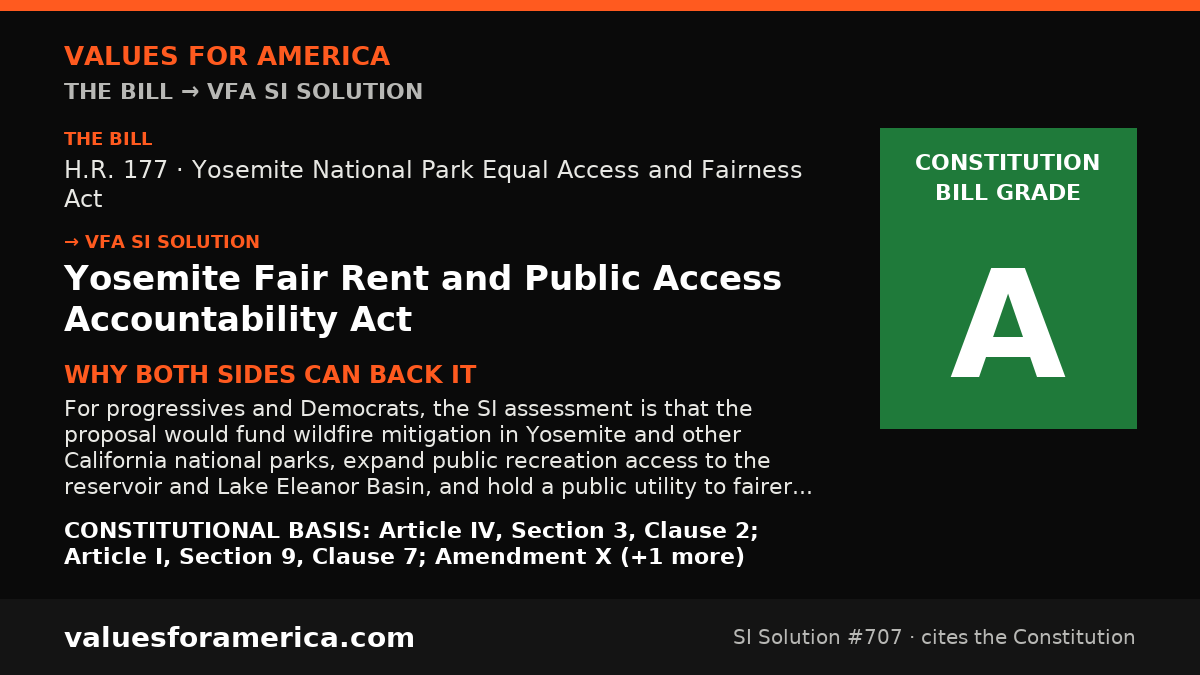
Yosemite National Park Equal Access and Fairness Act
Yosemite Fair Rent and Public Access Accountability Act
The bill aims to make San Francisco pay a higher annual rent for the Hetch Hetchy dam site inside Yosemite National Park, bar passing that cost to wholesale water and power customers, allow the rent to fund wildfire mitigation in Yosemite and other California national parks, and direct the National Park Service to manage the Hetch Hetchy Reservoir and Lake Eleanor Basin for public recreation and preservation.
Constitutional concerns with the original
- The rent increase and recreation mandate appear to rest on the Property Clause (Article IV, Section 3, Clause 2), but the official summary does not state whether the bill includes a sunset, spending cap, or audit, so fiscal accountability terms are unverified.
- Allowing Interior to spend collected rent on wildfire mitigation across multiple California parks, rather than through the regular appropriations process, raises a question under Article I, Section 9, Clause 7 that should be resolved by routing the money through an appropriated fund.
- The bar on recouping rent from wholesale customers touches a municipal utility's rate setting; it should be grounded expressly as a condition of the federal grant under Article IV, Section 3, Clause 2, so it does not operate as general rate regulation beyond the lease relationship, consistent with the Tenth Amendment.
Solution text
Operative provisions
Source basis and limits
Basis: The Congress.gov summary of H.R. 177, 119th Congress, supports these facts: the bill modifies the Raker Act, which allowed San Francisco to dam the Hetch Hetchy Valley in Yosemite; it raises rent from $30,000 to $2 million per year with an annual CPI-U adjustment; it bars the commission from recouping that rent from wholesale water or power customers; it allows Interior to use collected rent for wildfire mitigation in Yosemite and other California national parks; it directs the NPS to administer the Hetch Hetchy Reservoir and Lake Eleanor Basin for public recreation, benefit, and use while preserving scenic, historic, scientific, or otherwise important features; and the bill's latest recorded action is referral to the Subcommittee on Water, Wildlife and Fisheries.
Check before relying on this: The full bill text, the complete Raker Act, existing enforcement and appeal rights, current NPS management rules for the reservoir, and the exact fiscal effect of the rent increase are not covered by the official summary and remain unverified. The summary does not state whether the bill already contains a sunset, cap, audit, or reporting requirement, so all accountability terms here are proposed additions. The summary does not state current visitor access conditions, past public access to the valley, environmental review requirements, state-law limits on cost recovery, or the number of California parks eligible for mitigation funds; readers should verify those at the Congress.gov record.
Bipartisan rationale
For progressives and Democrats, the SI assessment is that the proposal would fund wildfire mitigation in Yosemite and other California national parks, expand public recreation access to the reservoir and Lake Eleanor Basin, and hold a public utility to fairer terms for occupying national parkland. For conservatives and Republicans, the SI assessment is that it would raise the rent from the current $30,000 to $2 million on the user of federal property, cap spending at the rent stream, sunset in five years, and route money through regular appropriations, all under the Property Clause rather than an expansion of federal rate regulation. Both sides gain from keeping the mechanism tied to the federal lease, which the Tenth Amendment respects by leaving other rate questions to state law.
Constitutional citations
- → Article IV, Section 3, Clause 2
- → Article I, Section 9, Clause 7
- → Tenth Amendment
- → Fifth Amendment Due Process
Article IV, Section 3, Clause 2 Article I, Section 9, Clause 7 Amendment X Amendment V
Possible legislative path
In the House, California members and public-lands advocates would likely support it, while members wary of imposing federal cost mandates on municipal utilities or raising fees on existing permit holders could oppose it; in the Senate, park and wildfire-state interests would likely favor it, with opposition most plausible from members who prefer that fee changes and spending move through full appropriations review.
Report an error in this Solution

Citizen Consensus
“Do you support this VFA SI Solution?”
One vote per verified account; you can change it any time. Only verified accounts count, results publish once 30 verified people have voted, and state and district results count only people who attested a home ZIP code. How this works.
Email verification is not switched on yet, so no vote counts toward results yet. Votes cast now are saved and count once the voter verifies their email address.
Sign in or create a free account to vote.
Add a short reason (optional)
/280 · no links or contact details · reasons are reviewed before anyone sees them, and many never are shown.
Your vote is saved but held out of published results by an automated integrity check (for example, several accounts voting from one browser).
Your vote is saved. It will count once you verify your email address. Verify on your account page.
Your vote counts nationally. Add your home ZIP code to count in your state and district too.
Your vote counts nationally and in .
Reason saved privately; it is shown only if it passes review.
Verified participants nationwide · n =
Self-selected participants, not a random sample; ± is the 95% sampling margin.
Not enough verified votes yet. Results publish at verified votes.
A sudden surge of votes on this item was flagged and is under review; votes from new accounts in that surge are held out until it is resolved.
Related on VFA
Generated by VFA SI Solutions · 2026.11.02 22:14 UTC · ← Back to the Republic