SI-generated Constitutional Solution
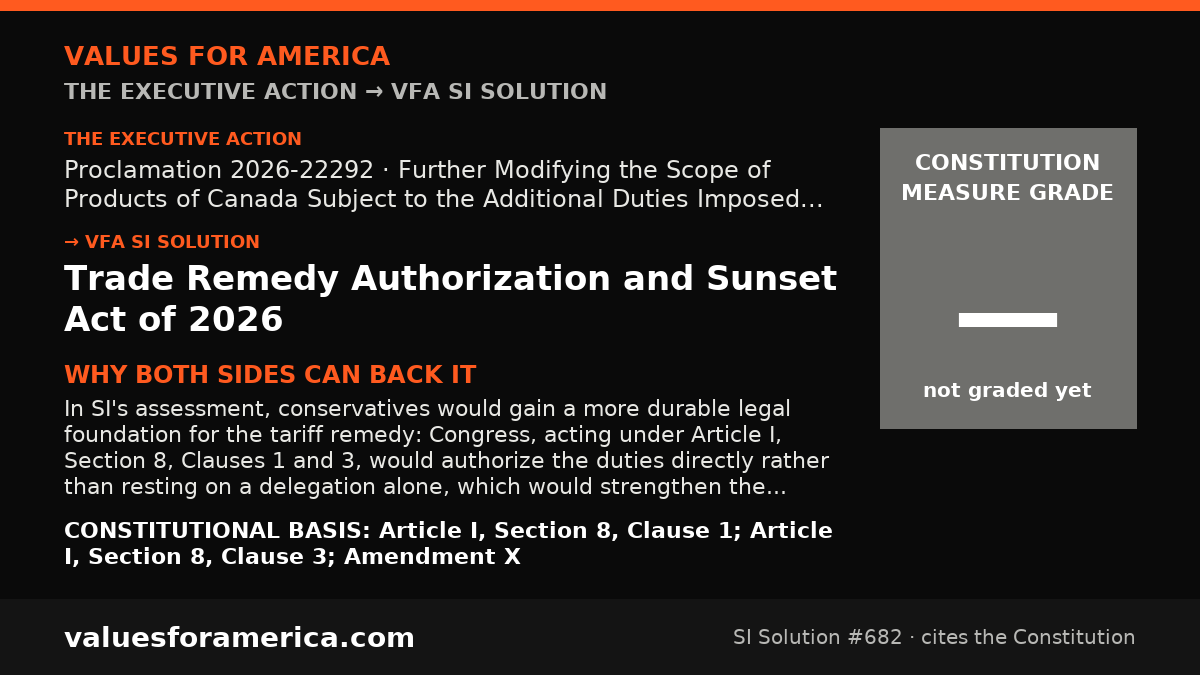
Trade Remedy Authorization and Sunset Act of 2026
SI-generated · passed automated checks (Constitution citation, source verification, independent SI critic) · not individually reviewed by a person · Report an error: hello@valuesforamerica.com
Further Modifying the Scope of Products of Canada Subject to the Additional Duties Imposed To Offset Canadian Discrimination Against the Commerce of the United States With Respect to Motor Vehicles
Proclamation
Trade Remedy Authorization and Sunset Act of 2026
The proclamation changes which Canadian products are covered by the 50 percent additional ad valorem duty first imposed under Proclamation 11048 to offset what the President found to be Canadian discrimination against U.S. motor vehicle commerce. Annex I, Part A removes certain products from the duty, and Annex I, Part B adds certain products to it, keeping the duty regime in place while adjusting its coverage.
Constitutional concerns with the original
- The power to lay duties on imports is a legislative power under Article I, Section 8, Clause 1, and the President acts only with a statutory delegation. Here the claimed hook is section 338 of the Tariff Act of 1930, which the proclamation quotes as allowing duties up to 50 percent ad valorem on the President's own public-interest finding. That delegation raises nondelegation and separation-of-powers questions under Article I, Section 8, Clause 1 and Article I, Section 8, Clause 3.
- Section 338 is quoted in the proclamation itself as allowing duties up to 50 percent ad valorem on the President's public-interest finding, but whether the factual findings of discrimination are adequately supported and reviewable is unclear from the document alone.
- Repeated unilateral modification of the covered product list (Proclamations 11048, 11065, and now 11076) without a congressional check concentrates trade-remedy power in one branch and leaves importers, downstream producers, and consumers with little notice or recourse.
- A full import prohibition remains available under section 338 if discrimination persists, which would rest on the same delegation and raise the same concern.
- The tariff power sits with Congress under Article I, Section 8, Clause 1, so a remedy of this size and duration is stronger when Congress enacts it directly rather than when the President relies on a delegation alone.
Solution text
Operative provisions
Source basis and limits
Basis: Proclamation 11076 of October 23, 2026 (Federal Register Doc. 2026-22292, Vol. 91, No. 209, pages 68861-68871). It supports these facts: the President found Canadian discrimination against U.S. motor vehicle commerce and imposed 50 percent ad valorem duties under 19 U.S.C. 1338, effective August 22, 2026 after a three-day suspension lapsed; prior proclamations 11048, 11056, and 11065 imposed, suspended, and modified the duties; the current proclamation removes certain products from the duty in Annex I, Part A and subjects certain products to it in Annex I, Part B; section 338 permits duties up to 50 percent and import exclusions; and section 604 of the Trade Act of 1974 permits conforming HTSUS changes.
Check before relying on this: The proclamation text available here ends mid-provision in paragraph (1), so the full contents of Annex I Parts A and B, later sections, and any severability or effective-date clauses were not reviewed and should be confirmed at the official source. The statement that the duties are offsetting the burden on U.S. commerce is attributed to senior executive branch officials and is not independently verified. Whether Canada's tariff scheme in fact meets the discrimination standard, whether any litigation is pending, and the current revenue yield of the duties are not stated in the document. The claim in the public argument that direct congressional authorization would strengthen the legal footing is a legal assessment, not a documented outcome.
Bipartisan rationale
In SI's assessment, conservatives would gain a more durable legal foundation for the tariff remedy: Congress, acting under Article I, Section 8, Clauses 1 and 3, would authorize the duties directly rather than resting on a delegation alone, which would strengthen the policy's footing against challenge. Conservatives would also gain deficit treatment for tariff revenue and a three-year sunset that forces a future up-or-down vote rather than an open-ended executive commitment. Progressives would gain a real exclusion process for importers and downstream producers, judicial review in the Court of International Trade, public reporting every 90 days on costs to manufacturers and consumers, a Government Accountability Office audit, and a hard congressional check before any escalation to import bans. Both sides would gain institutional integrity: the branch that pays political prices for trade policy would be the branch that votes on it. The strongest objection is that Congress moves slowly and the President needs speed in a trade dispute. The answer is that the bill would ratify the existing duties immediately and preserve them for three years, so speed is not lost. Only future escalation would require a vote.
Constitutional citations
- → Article I, Section 8, Clause 1
- → Article I, Section 8, Clause 3
- → Tenth Amendment
Article I, Section 8, Clause 1 Article I, Section 8, Clause 3 Amendment X
Possible legislative path
A majority coalition would likely start with members who support tariff protection for U.S. auto manufacturing and want the policy on stronger legal footing, plus members of either party who prioritize restoring Congress's role in trade policy. Likely supporters include auto-state members, import-dependent manufacturers seeking the exclusion process, and oversight committee members who value the reporting requirements and deficit treatment. Likely resistance comes from members who oppose tariffs on Canada on economic or trade-policy grounds and from members who prefer to preserve maximum presidential flexibility in trade disputes. The sunset clause and immediate ratification are the concessions aimed at the second group, while the exclusion process and audit speak to the first. No roll-call data is available for this draft, so this is a qualitative assessment only.
Report an error in this Solution

Citizen Consensus
“Do you support this VFA SI Solution?”
One vote per verified account; you can change it any time. Only verified accounts count, results publish once 30 verified people have voted, and state and district results count only people who attested a home ZIP code. How this works.
Email verification is not switched on yet, so no vote counts toward results yet. Votes cast now are saved and count once the voter verifies their email address.
Sign in or create a free account to vote.
Add a short reason (optional)
/280 · no links or contact details · reasons are reviewed before anyone sees them, and many never are shown.
Your vote is saved but held out of published results by an automated integrity check (for example, several accounts voting from one browser).
Your vote is saved. It will count once you verify your email address. Verify on your account page.
Your vote counts nationally. Add your home ZIP code to count in your state and district too.
Your vote counts nationally and in .
Reason saved privately; it is shown only if it passes review.
Verified participants nationwide · n =
Self-selected participants, not a random sample; ± is the 95% sampling margin.
Not enough verified votes yet. Results publish at verified votes.
A sudden surge of votes on this item was flagged and is under review; votes from new accounts in that surge are held out until it is resolved.
Generated by VFA SI Solutions · 2026.10.31 21:24 UTC · ← Back to the Republic