Archived SI output (machine-generated)
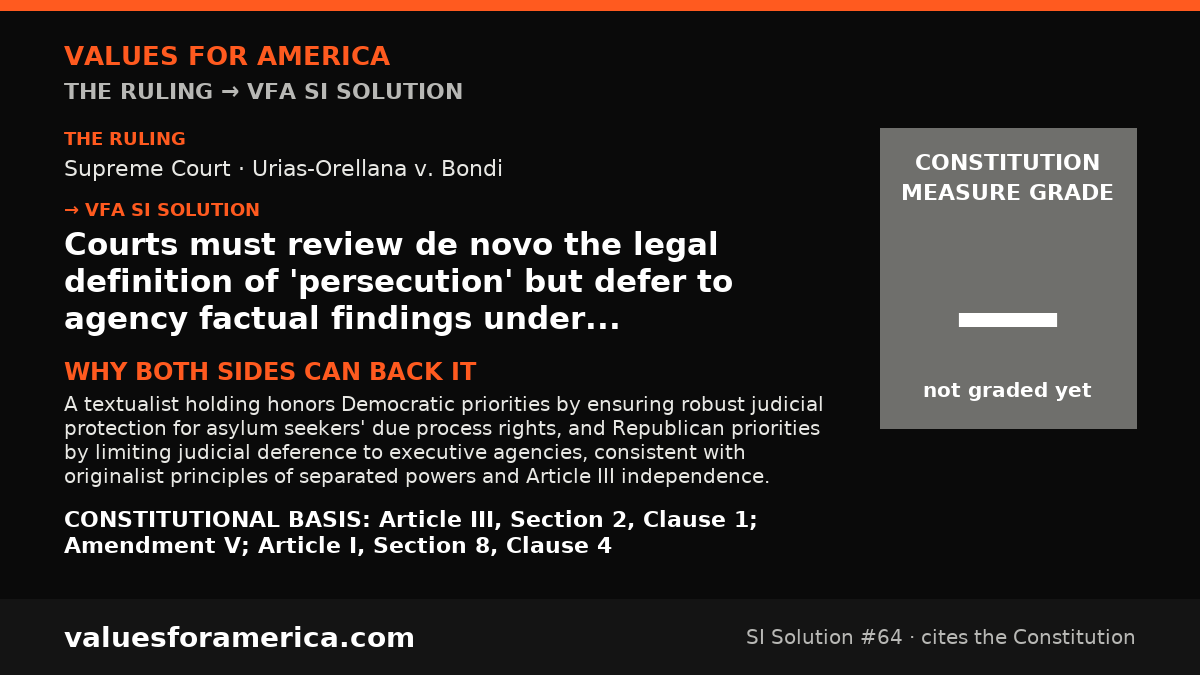
Courts must review de novo the legal definition of 'persecution' but defer to agency factual findings under substantial-evidence review.
Archived SI output (machine-generated) · No editorial review recorded
This historical SI draft was machine-generated by software and has no editorial review time on record. Verify its factual and legal claims against the original source before relying on it.
Urias-Orellana v. Bondi
Ketanji Brown Jackson
Courts must review de novo the legal definition of 'persecution' but defer to agency factual findings under substantial-evidence review.
Whether the Immigration and Nationality Act requires courts of appeals to apply substantial-evidence review to the Board of Immigration Appeals' determination that a given set of undisputed facts constitutes 'persecution' under 8 U.S.C. §1101(a)(42).
Constitutional concerns with the original
- The majority opinion relies on post-1900 precedent (INS v. Elias-Zacarias, 1992) and congressional amendments (1996) to interpret the standard of review, rather than the original meaning of Article III judicial power or the Due Process Clause of the Fifth Amendment.
- The opinion treats the mixed question of law and fact as a factual finding subject to deferential review, which may undermine the judiciary's independent constitutional duty to interpret laws and ensure due process in removal proceedings.
- No citation to Article I, Section 8, Clause 4 (naturalization power) or the Tenth Amendment is provided to anchor the scope of federal immigration authority or the limits of judicial deference.
Solution text
Operative provisions
Bipartisan rationale
A textualist holding honors Democratic priorities by ensuring robust judicial protection for asylum seekers' due process rights, and Republican priorities by limiting judicial deference to executive agencies, consistent with originalist principles of separated powers and Article III independence.
Constitutional citations
- → Article III, Section 2, Clause 1
- → Fifth Amendment Due Process Clause
- → Article I, Section 8, Clause 4
- → Federalist No. 78 (judicial duty to interpret laws independently)
Article III, Section 2, Clause 1 Amendment V Article I, Section 8, Clause 4
Report an error in this Solution

Citizen Consensus
“Do you support this VFA SI Solution?”
One vote per verified account; you can change it any time. Only verified accounts count, results publish once 30 verified people have voted, and state and district results count only people who attested a home ZIP code. How this works.
Email verification is not switched on yet, so no vote counts toward results yet. Votes cast now are saved and count once the voter verifies their email address.
Sign in or create a free account to vote.
Add a short reason (optional)
/280 · no links or contact details · reasons are reviewed before anyone sees them, and many never are shown.
Your vote is saved but held out of published results by an automated integrity check (for example, several accounts voting from one browser).
Your vote is saved. It will count once you verify your email address. Verify on your account page.
Your vote counts nationally. Add your home ZIP code to count in your state and district too.
Your vote counts nationally and in .
Reason saved privately; it is shown only if it passes review.
Verified participants nationwide · n =
Self-selected participants, not a random sample; ± is the 95% sampling margin.
Not enough verified votes yet. Results publish at verified votes.
A sudden surge of votes on this item was flagged and is under review; votes from new accounts in that surge are held out until it is resolved.
Generated by VFA SI Solutions · 2026.05.24 06:01 UTC · ← Back to the Republic