SI-generated Constitutional Solution

Archie Cavanaugh Migratory Bird Handicraft Certainty and Treaty Alignment Act

Mode: Bill Generated by VFA SI Solutions Drafted: 2026.10.27 Published: 2026.10.27

SI-generated · passed automated checks (Constitution citation, source verification, independent SI critic) · not individually reviewed by a person · Report an error: hello@valuesforamerica.com

Brief for congressional offices →

Real bill

Archie Cavanaugh Migratory Bird Treaty Clarification Act

External ID
HR/119/6021
Policy area
Native Americans
Latest action
2026-09-15
→ View original
VFA SI Solution · SI-generated

Archie Cavanaugh Migratory Bird Handicraft Certainty and Treaty Alignment Act

The bill aims to let Alaska Natives make and sell authentic handicrafts, clothing, and art containing nonedible migratory bird parts, without running afoul of the Migratory Bird Treaty Act, so long as the birds were not taken wastefully or illegally; it also asks the State and Interior Departments to clarify this with treaty partners.

Constitutional concerns with the original

  1. The commerce in protected migratory birds is governed by statute implementing four international treaties; a blanket carve-out must be reconciled with those treaties, or the United States could breach them.
  2. A broad possession-and-sale exemption without a verification mechanism could become a loophole for unlawful traffic in protected species, undermining faithful treaty implementation.
  3. Interior's mandate to modify regulations should preserve notice-and-comment rulemaking; directing an outcome wholesale risks shortcutting administrative process.

Solution text

This proposal keeps the goal of the original bill: authentic Alaska Native handicraft, clothing, and art containing nonedible migratory bird parts would no longer be blocked by the Migratory Bird Treaty Act, as long as the bird was not taken in a wasteful or illegal manner. It would add one safeguard the original lacks: a simple, no-fee federal certificate of authenticity for such items sold or shipped across state or national lines. The certificate would confirm the item is a genuine Alaska Native handicraft and that the bird part came from a lawful, non-wasteful taking. It would be issued by the U.S. Fish and Wildlife Service under a streamlined process developed with Alaska Native organizations. This certificate is a new proposed safeguard, not an existing legal requirement. The constitutional basis is explicit. Congress may regulate commerce among the states and with foreign nations under Article I, Section 8, Clause 3, and it may make laws necessary and proper for carrying its powers into effect under Article I, Section 8, Clause 18. Those powers work together with the treaty power in Article II, Section 2, Clause 2, which lets the President make treaties with advice and consent of the Senate; Congress may then legislate to implement them. A narrow exemption for traditional Alaska Native handicraft, paired with a certification designed to reduce illegal traffic in interstate and foreign commerce, is a faithful way to exercise those same powers rather than exceed them. This proposal also respects the Tenth Amendment as a matter of its own design: it would not displace state law or private property, and it would leave untouched any wildlife regulation that states choose to apply within their own borders. The bill would direct the Department of State to work with the Department of the Interior to adopt bilateral procedures with Canada, Mexico, Japan, and Russia, the four treaty parties named in the official summary, clarifying how each country will treat Alaska Native handicraft containing nonedible parts of listed species. Interior would then revise its regulations through ordinary notice-and-comment rulemaking, so the public, including Alaska Native makers, can comment. The rulemaking would define 'authentic Alaska Native handicraft' and 'nonedible part' with bright-line terms, and would state that items made from birds taken wastefully or illegally remain fully prohibited. The official record shows the underlying bill was received in the Senate and referred to the Committee on Environment and Public Works; no further action is recorded, and the treaty partners' positions on any such clarification are unknown. Enforcement would stay simple. The proposal would create a new penalty for knowingly selling or shipping a covered item without a certificate, or for falsely claiming one. The penalty levels would be set in this act itself, and Congress should calibrate them after checking the penalty provisions currently in the Migratory Bird Treaty Act, which this record does not supply. Legitimate makers would face no new paperwork beyond the free certificate. The certificate is designed to reduce illegal traffic by building verification into the exemption itself; whether it succeeds would be measured, not assumed. To honor fiscal restraint, the proposal would cap federal spending. The Fish and Wildlife Service would use existing permitting staff and systems for the certificate program, within a capped annual amount, and the State Department's treaty work would draw on existing diplomatic budgets for bilateral consultations. If the program costs more than the cap in any year, the Service would report to Congress rather than spend beyond it. The whole exemption, including the regulations, would sunset after five years unless Congress renews it, forcing a review of whether the treaty clarifications and the certificate program are working. Oversight would sit with the Government Accountability Office, which would report to Congress within four years on certificate use, any enforcement actions, and feedback from Alaska Native organizations and treaty partners. Compared with the original, this proposal would add the free certificate for items in commerce, require ordinary rulemaking rather than a raw regulatory mandate, set new penalty levels in the act itself, and add the five-year sunset and GAO review. It would keep the original's core protection for traditional Alaska Native art and its insistence that wasteful or illegal takings stay prohibited.

Operative provisions

funding source
Existing U.S. Fish and Wildlife Service permitting appropriations and existing Department of State diplomatic program funds; no new authorization.
funding amount
Capped at $2 million per year in total across both agencies, with a report to Congress if projected costs exceed the cap.
sunset years
5
oversight body
Government Accountability Office, reporting to Congress within four years, with implementation review by the Fish and Wildlife Service and the Department of the Interior.
enforcement mechanism
New penalties created by this act for knowingly selling or shipping covered items without the required certificate or with a false certificate; penalty levels would be set in the act after verifying existing Migratory Bird Treaty Act penalties in the U.S. Code. Lawful makers face no new fee.
effective date
The exemption would take effect on the date Interior publishes final implementing regulations, which must be issued within 18 months of enactment.

Source basis and limits

Basis: The Congress.gov official summary of H.R. 6021, which states the bill's purpose of exempting authentic Alaska Native handicraft containing nonedible migratory bird parts from the Migratory Bird Treaty Act, its bar on wasteful or illegal takings, the four treaty countries (Canada, Mexico, Japan, and Russia), the State-Interior bilateral procedures directive, and the Interior regulation-modification directive. It also states the latest action was receipt in the Senate, two readings, and referral to the Committee on Environment and Public Works.

Check before relying on this: The full bill text and current Migratory Bird Treaty Act provisions, including existing exemptions, permit rules, and penalty levels, were not available here, so readers should verify them at the Congress.gov bill page and in the U.S. Code. The constitutional basis of the 1918 Act is not stated in the official summary; the powers cited here are this proposal's legal reasoning, not sourced facts. The $2 million cap, the certificate program, the 18-month rulemaking deadline, the GAO review, the new penalty levels, and the five-year sunset are new proposals in this alternative, not facts from the official summary. Treaty-partner positions on such a clarification are unknown. The latest action shown may lag the official record.

Bipartisan rationale

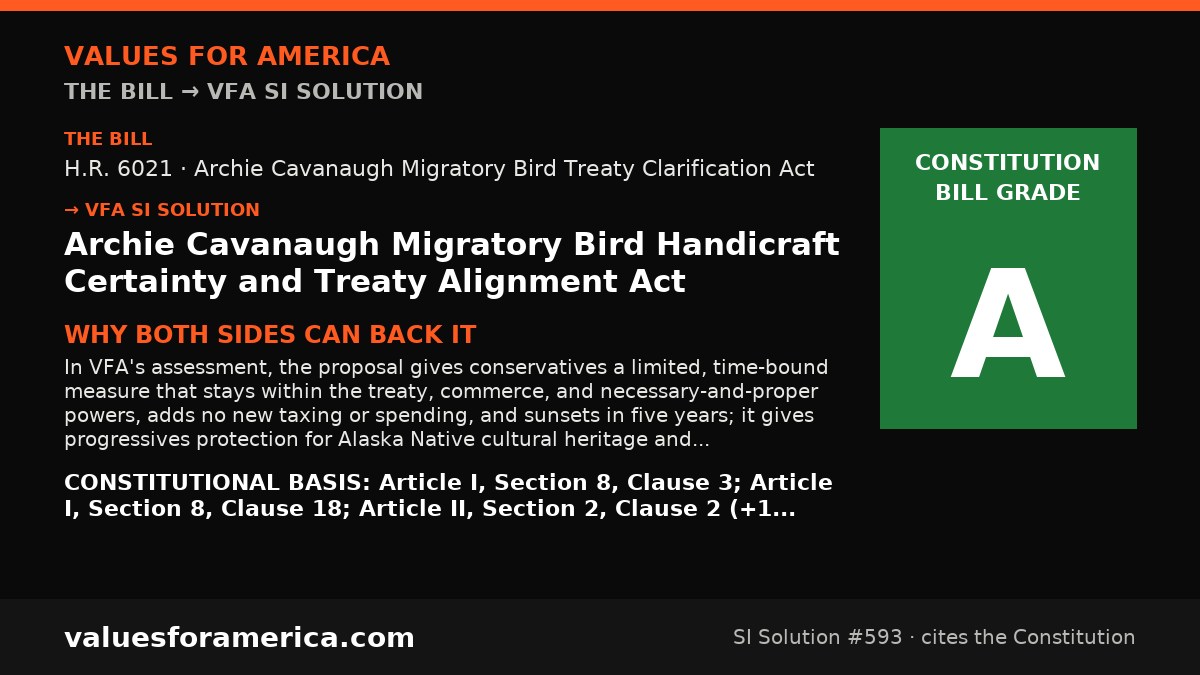
In VFA's assessment, the proposal gives conservatives a limited, time-bound measure that stays within the treaty, commerce, and necessary-and-proper powers, adds no new taxing or spending, and sunsets in five years; it gives progressives protection for Alaska Native cultural heritage and artisanship, anti-trafficking enforcement through certification, and notice-and-comment rulemaking with public input. Both sides gain certainty for lawful makers and a documented answer to the abuse concern.

Constitutional citations

  • → Article I, Section 8, Clause 3
  • → Article I, Section 8, Clause 18
  • → Article II, Section 2, Clause 2
  • → Tenth Amendment

Article I, Section 8, Clause 3 Article I, Section 8, Clause 18 Article II, Section 2, Clause 2 Amendment X

Possible legislative path

In the House, Alaska and Native-caucus members, sportsmen wary of loophole-driven traffic, and free-market members favoring small-business relief could support it, while members focused on strict treaty compliance might resist unless certification reassures them; in the Senate, the Environment and Public Works Committee could favor the rulemaking-first approach, with opposition most likely from those who doubt the treaty parties will accept any exemption or who prefer no federal role at all.

Report an error in this Solution
No account needed. Or email hello@valuesforamerica.com. How reports are handled.

Share card

1200×675 PNG for X, Threads, LinkedIn and messages. Free to share with a link back to this page.

Citizen Consensus

“Do you support this VFA SI Solution?”

One vote per verified account; you can change it any time. Only verified accounts count, results publish once 30 verified people have voted, and state and district results count only people who attested a home ZIP code. How this works.

Email verification is not switched on yet, so no vote counts toward results yet. Votes cast now are saved and count once the voter verifies their email address.

Add a short reason (optional)

/280 · no links or contact details · reasons are reviewed before anyone sees them, and many never are shown.

Your vote is saved but held out of published results by an automated integrity check (for example, several accounts voting from one browser).

Your vote is saved. It will count once you verify your email address. Verify on your account page.

Your vote counts nationally. Add your home ZIP code to count in your state and district too.

Your vote counts nationally and in .

Reason saved privately; it is shown only if it passes review.

A sudden surge of votes on this item was flagged and is under review; votes from new accounts in that surge are held out until it is resolved.

National, state and district results →

Generated by VFA SI Solutions · 2026.10.27 21:23 UTC · ← Back to the Republic