SI-generated Constitutional Solution
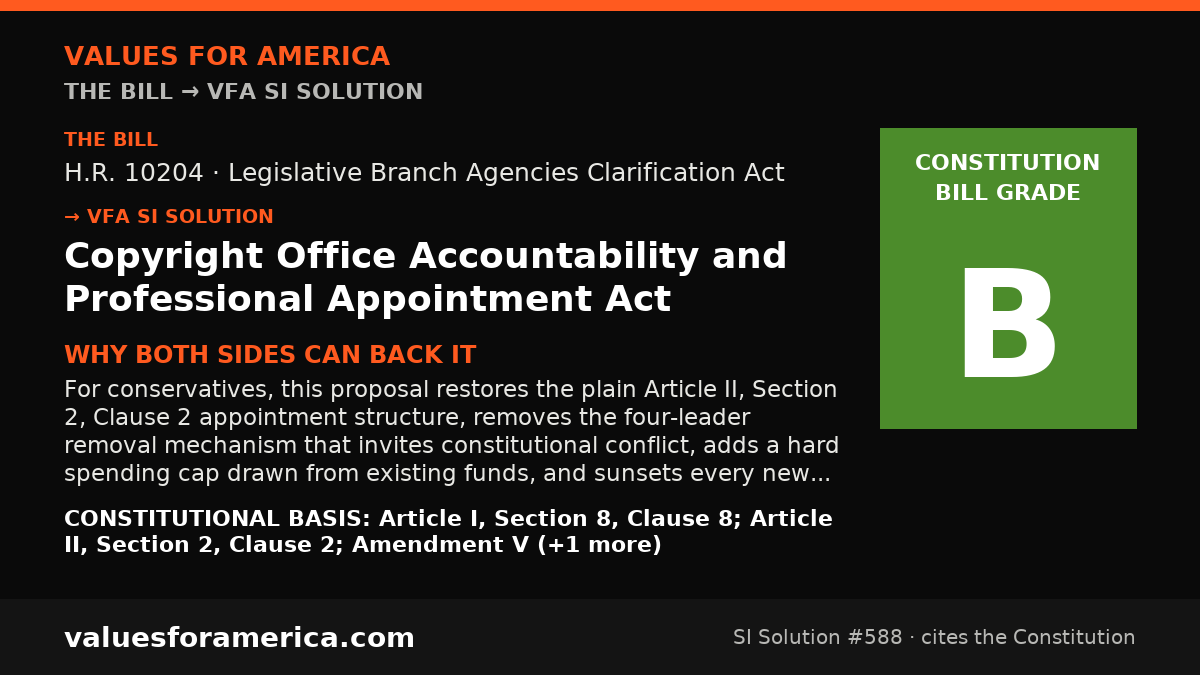
Copyright Office Accountability and Professional Appointment Act
SI-generated · passed automated checks (Constitution citation, source verification, independent SI critic) · not individually reviewed by a person · Report an error: hello@valuesforamerica.com
Brief for congressional offices →
Legislative Branch Agencies Clarification Act
Copyright Office Accountability and Professional Appointment Act
The bill seeks to professionalize and depoliticize the Library of Congress, the Government Publishing Office, and the Copyright Office by changing how their leaders are appointed and removed, making the Copyright Office more independent, and adding oversight and personnel-management reforms.
Constitutional concerns with the original
- Requiring removal of the Librarian and GPO Director only by a majority vote of the four House and Senate party leaders is an unusual removal mechanism that raises separation-of-powers questions; Article II, Section 2, Clause 2 governs advice-and-consent appointments, and Congress's power to structure legislative branch agencies does not plainly extend to displacing the Presidential role it has granted for those positions.
- Pre-clearing Register of Copyrights nominees through joint committee recommendations before Presidential nomination could intrude on Article II, Section 2, Clause 2 appointment authority by limiting the President's choice to a pre-screened list.
- The official summary does not state the bill's fiscal effects, so whether the new Office of Inspector General and GPO human capital management system are funded or capped is unverified.
- Transferring all Library of Congress supervisory authority over the Copyright Office to the Register is a large structural change whose compatibility with current law cannot be confirmed from the summary alone.
Solution text
Operative provisions
Source basis and limits
Basis: The Congress.gov summary of H.R. 10204 (119th Congress) states that the bill changes appointment and removal for the Librarian of Congress, the GPO Director, and the Register of Copyrights; makes the Register a Presidential appointee with Senate consent; limits the Register to a ten-year term with reappointment allowed; gives the Register supervisory authority over the Copyright Office and appointment of subordinate officers, employees, and the three Copyright Royalty Board administrative judges; creates a Copyright Office Inspector General appointed by the Register without regard to political affiliation; requires GPO to establish and maintain a human capital management system with requirements outlined in the bill; and states the latest action was receipt in the Senate. The current appointment route of Presidential appointment with Senate consent, and current Register appointment by the Librarian, are also stated in that summary.
Check before relying on this: The full bill text, the specific contents of the GPO human capital management system requirements, existing statutory provisions, eligibility rules, appeal rights, and fiscal effects are not covered by the summary and remain unverified. Readers should verify at the official Congress.gov bill page whether the original bill includes funding, cost estimates, or removal-cause standards, and should check the bill's current status in the Senate before relying on its stage. The one-reappointment cap, due-process notice periods, reporting duties, spending cap, and five-year sunset in this proposal are new safeguards this proposal adds, not provisions confirmed to exist in current law or in the original bill.
Bipartisan rationale
For conservatives, this proposal restores the plain Article II, Section 2, Clause 2 appointment structure, removes the four-leader removal mechanism that invites constitutional conflict, adds a hard spending cap drawn from existing funds, and sunsets every new authority in five years. For progressives, it preserves the original bill's core goals of a more independent Copyright Office led by an experienced Register and stronger Inspector General oversight, and it adds an Inspector General that reports to Congress. VFA's assessment is that the proposal keeps the original's central aims of Copyright Office independence and Inspector General accountability while changing the appointment and removal mechanisms to reduce constitutional risk, rather than keeping every detail of the original.
Constitutional citations
- → Article I, Section 8, Clause 8
- → Article II, Section 2, Clause 2
- → Fifth Amendment Due Process
- → Tenth Amendment
Article I, Section 8, Clause 8 Article II, Section 2, Clause 2 Amendment V Amendment X
Possible legislative path
In the House, members focused on congressional prerogatives and agency accountability would likely support it, while members defending the original bill's commission-appointment model could oppose the return to Presidential appointment; in the Senate, members who value the advice-and-consent role would likely favor it, while members attached to the committee pre-screening model could object, and appropriators may press on the funding cap before agreeing.
Report an error in this Solution

Citizen Consensus
“Do you support this VFA SI Solution?”
One vote per verified account; you can change it any time. Only verified accounts count, results publish once 30 verified people have voted, and state and district results count only people who attested a home ZIP code. How this works.
Email verification is not switched on yet, so no vote counts toward results yet. Votes cast now are saved and count once the voter verifies their email address.
Sign in or create a free account to vote.
Add a short reason (optional)
/280 · no links or contact details · reasons are reviewed before anyone sees them, and many never are shown.
Your vote is saved but held out of published results by an automated integrity check (for example, several accounts voting from one browser).
Your vote is saved. It will count once you verify your email address. Verify on your account page.
Your vote counts nationally. Add your home ZIP code to count in your state and district too.
Your vote counts nationally and in .
Reason saved privately; it is shown only if it passes review.
Verified participants nationwide · n =
Self-selected participants, not a random sample; ± is the 95% sampling margin.
Not enough verified votes yet. Results publish at verified votes.
A sudden surge of votes on this item was flagged and is under review; votes from new accounts in that surge are held out until it is resolved.
Related on VFA
Generated by VFA SI Solutions · 2026.10.27 21:21 UTC · ← Back to the Republic