SI-generated Constitutional Solution
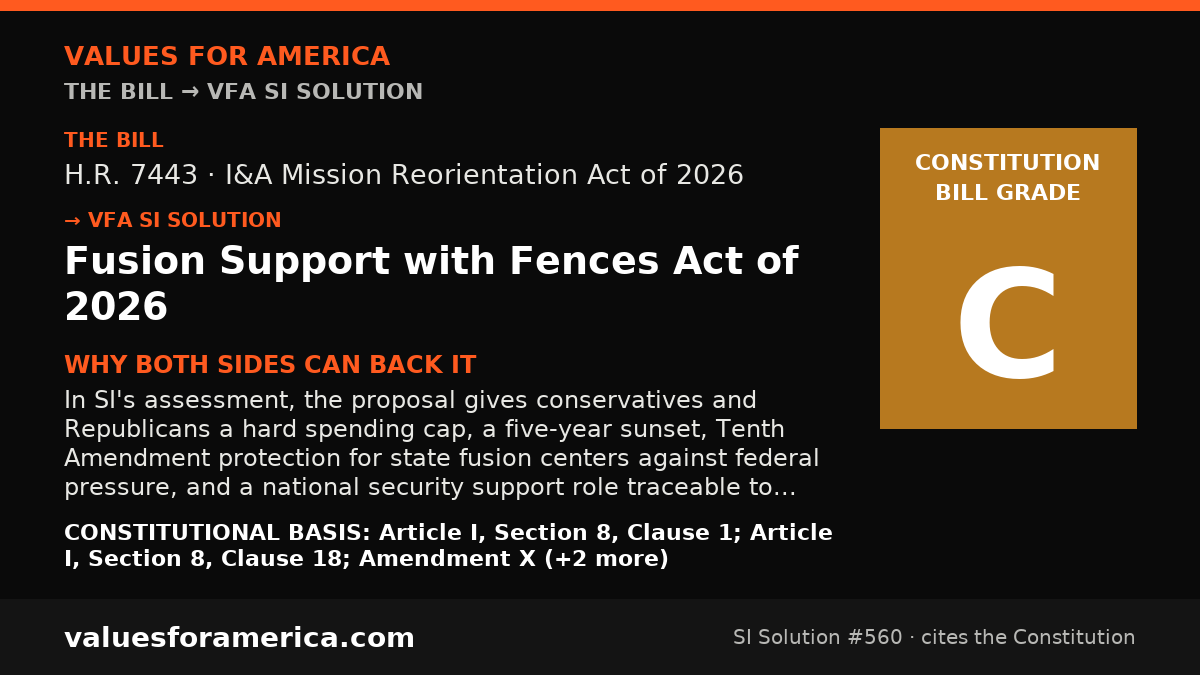
Fusion Support with Fences Act of 2026
SI-generated · passed automated checks (Constitution citation, source verification, independent SI critic) · not individually reviewed by a person · Report an error: hello@valuesforamerica.com
Brief for congressional offices →
I&A Mission Reorientation Act of 2026
Fusion Support with Fences Act of 2026
The bill wants the DHS Office of Intelligence and Analysis to support state, local, tribal, and territorial governments and private sector entities as fully as it supports other parts of the intelligence community, through two-way information sharing, forward-deployed intelligence capabilities, and sustained engagement with fusion centers.
Constitutional concerns with the original
- Two-way sharing with private sector entities could sweep in Americans' personal data without Fourth Amendment warrants or particularized suspicion; the official summary describes no privacy limits.
- Sustained federal engagement with fusion centers, which the official summary notes address criminal as well as terrorist activity, could pull federal intelligence resources into ordinary law enforcement that the Tenth Amendment reserves to the states.
- Information shared with partners could become de facto watchlisting of individuals without Fifth Amendment Due Process notice or a correction process.
- The official summary describes no budget cap, no sunset, and no oversight beyond a report to Congress on implementation, leaving cost and mission growth unchecked.
Solution text
Operative provisions
Source basis and limits
Basis: The Congress.gov summary of H.R. 7443, the I&A Mission Reorientation Act of 2026, supports the bill's purpose and mechanics: equal prioritization of support to state, local, tribal, and territorial governments and private sector entities, two-way information sharing, forward-deployed intelligence capabilities, robust fusion center engagement, the requirement that I&A support to DHS leadership not interfere with its partner duties, and a report to Congress on implementation after enactment. The summary also states the bill was received in the Senate and referred to the Committee on Homeland Security and Governmental Affairs as of September 16, 2026.
Check before relying on this: The full bill text, current law governing I&A, existing privacy and redress rights, the existence and size of an I&A budget line, fiscal effects, and any statutory conflicts are not covered by the official summary and should be verified at the Congress.gov bill page before drawing conclusions. The data-minimization standard, spending cap, sunset, annual reporting, redress process, and audit provisions described here are new proposals that would add to, not restate, whatever safeguards current law already provides. The summary does not state how many reports the original bill requires, so the proposal's annual reporting is an addition, not a description.
Bipartisan rationale
In SI's assessment, the proposal gives conservatives and Republicans a hard spending cap, a five-year sunset, Tenth Amendment protection for state fusion centers against federal pressure, and a national security support role traceable to Article I, Section 8, Clause 1 and Clause 18 rather than open-ended growth. It gives progressives and Democrats enforceable Fourth Amendment-style minimization of Americans' personal data, Fifth Amendment Due Process redress the proposal would newly create for people harmed by disclosures, independent audits by the Inspector General and Privacy Office, and public annual reporting. Both sides keep what the original bill seeks: equal intelligence support for state, local, tribal, territorial, and private sector partners. The strongest objection is that fences slow sharing when speed matters, and the answer is that the fences govern personal data only, while threat indicators without personal data would still move without delay.
Constitutional citations
- → Article I, Section 8, Clause 1
- → Article I, Section 8, Clause 18
- → Tenth Amendment
- → Fourth Amendment
- → Fifth Amendment Due Process
Article I, Section 8, Clause 1 Article I, Section 8, Clause 18 Amendment X Amendment IV Amendment V
Possible legislative path
In the House, members focused on homeland security support and state-local cooperation would likely favor it, while members most opposed to domestic intelligence activity or new DHS spending might resist it. In the Senate, the Homeland Security and Governmental Affairs Committee would likely find the IG audits and sunset congenial, though senators wary of fusion center data practices on either privacy or cost grounds could object.
Report an error in this Solution

Citizen Consensus
“Do you support this VFA SI Solution?”
One vote per verified account; you can change it any time. Only verified accounts count, results publish once 30 verified people have voted, and state and district results count only people who attested a home ZIP code. How this works.
Email verification is not switched on yet, so no vote counts toward results yet. Votes cast now are saved and count once the voter verifies their email address.
Sign in or create a free account to vote.
Add a short reason (optional)
/280 · no links or contact details · reasons are reviewed before anyone sees them, and many never are shown.
Your vote is saved but held out of published results by an automated integrity check (for example, several accounts voting from one browser).
Your vote is saved. It will count once you verify your email address. Verify on your account page.
Your vote counts nationally. Add your home ZIP code to count in your state and district too.
Your vote counts nationally and in .
Reason saved privately; it is shown only if it passes review.
Verified participants nationwide · n =
Self-selected participants, not a random sample; ± is the 95% sampling margin.
Not enough verified votes yet. Results publish at verified votes.
A sudden surge of votes on this item was flagged and is under review; votes from new accounts in that surge are held out until it is resolved.
Related on VFA
Generated by VFA SI Solutions · 2026.10.26 21:18 UTC · ← Back to the Republic