SI-generated Constitutional Solution
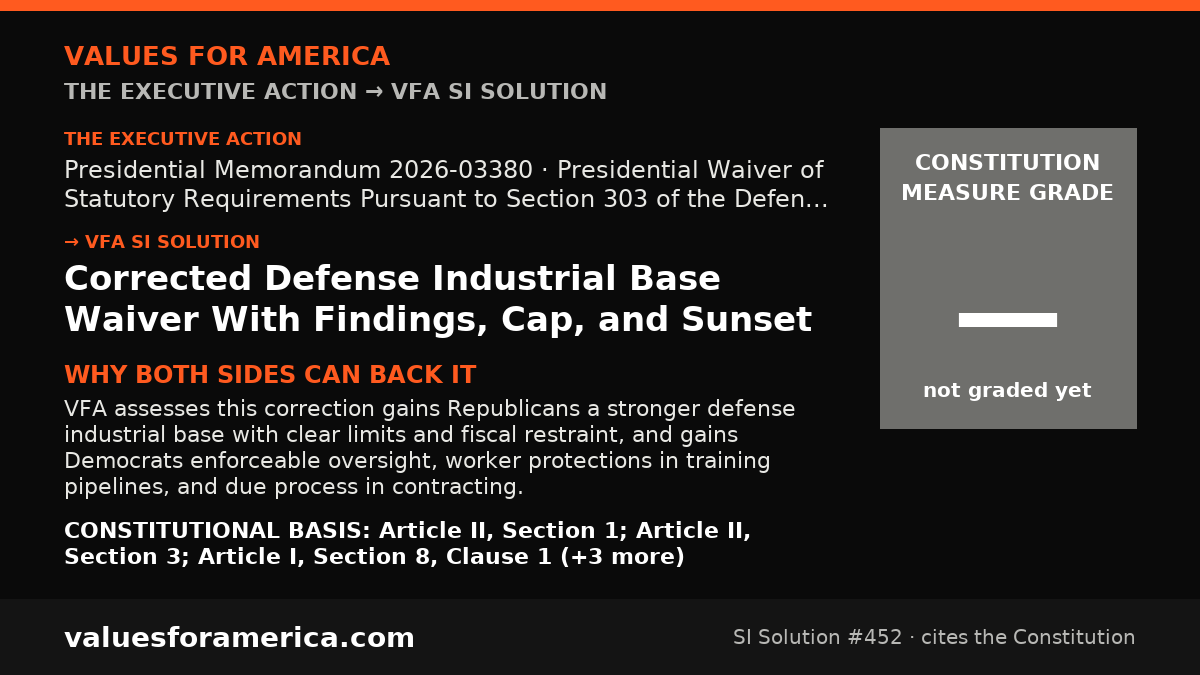
Corrected Defense Industrial Base Waiver With Findings, Cap, and Sunset
SI-generated · passed automated checks (Constitution citation, source verification, independent SI critic) · not individually reviewed by a person · Report an error: hello@valuesforamerica.com
Presidential Waiver of Statutory Requirements Pursuant to Section 303 of the Defense Production Act of 1950, as Amended
Presidential Memorandum
Corrected Defense Industrial Base Waiver With Findings, Cap, and Sunset
Avert shortfalls in critical defense supply chains that would impair national defense by waiving certain Defense Production Act procedural requirements for listed industrial sectors.
Constitutional concerns with the original
- Whether a broad waiver of section 303(a)(2)-(a)(6) exceeds Article II execution and intrudes on Article I control of appropriations and legislative conditions.
- Whether the memorandum states its statutory findings and scope with enough precision to permit judicial review and protect Fifth Amendment Due Process for contractors and workers.
- Whether indefinite duration and broad sector coverage risk Tenth Amendment and separation-of-powers concerns by displacing state and private industrial activity without a clear end point.
Solution text
Operative provisions
Source basis and limits
Basis: The official summary states Federal Register document 2026-03380, a Memorandum of February 13, 2026 published February 19, 2026, waives Defense Production Act section 303(a)(2)-(a)(6) under section 303(a)(7)(B) for listed defense supply chains based on a finding of shortfalls that would impair national defense.
Check before relying on this: The official text does not state funding levels, contract terms, duration, appeal rights, cost effects, or current-law eligibility rules, and those limits here are new SI safeguards that readers should verify against the Defense Production Act and current appropriations law at the official source.
Bipartisan rationale
VFA assesses this correction gains Republicans a stronger defense industrial base with clear limits and fiscal restraint, and gains Democrats enforceable oversight, worker protections in training pipelines, and due process in contracting. Both sides gain because Congress keeps control of the purse and the President keeps speed in a real shortfall, with courts open to check abuse. The bargain replaces open-ended waiver language with defined sectors, public reporting, and an end date.
Constitutional citations
- → Article II, Section 1
- → Article II, Section 3
- → Article I, Section 8, Clause 1
- → Article I, Section 8, Clause 12
- → Fifth Amendment Due Process
- → Tenth Amendment
Article II, Section 1 Article II, Section 3 Article I, Section 8, Clause 1 Article I, Section 8, Clause 12 Amendment V Amendment X
Possible legislative path
N/A — properly executive.
Report an error in this Solution

Citizen Consensus
“Do you support this VFA SI Solution?”
One vote per verified account; you can change it any time. Only verified accounts count, results publish once 30 verified people have voted, and state and district results count only people who attested a home ZIP code. How this works.
Email verification is not switched on yet, so no vote counts toward results yet. Votes cast now are saved and count once the voter verifies their email address.
Sign in or create a free account to vote.
Add a short reason (optional)
/280 · no links or contact details · reasons are reviewed before anyone sees them, and many never are shown.
Your vote is saved but held out of published results by an automated integrity check (for example, several accounts voting from one browser).
Your vote is saved. It will count once you verify your email address. Verify on your account page.
Your vote counts nationally. Add your home ZIP code to count in your state and district too.
Your vote counts nationally and in .
Reason saved privately; it is shown only if it passes review.
Verified participants nationwide · n =
Self-selected participants, not a random sample; ± is the 95% sampling margin.
Not enough verified votes yet. Results publish at verified votes.
A sudden surge of votes on this item was flagged and is under review; votes from new accounts in that surge are held out until it is resolved.
Generated by VFA SI Solutions · 2026.10.17 15:05 UTC · ← Back to the Republic