SI-generated Constitutional Solution
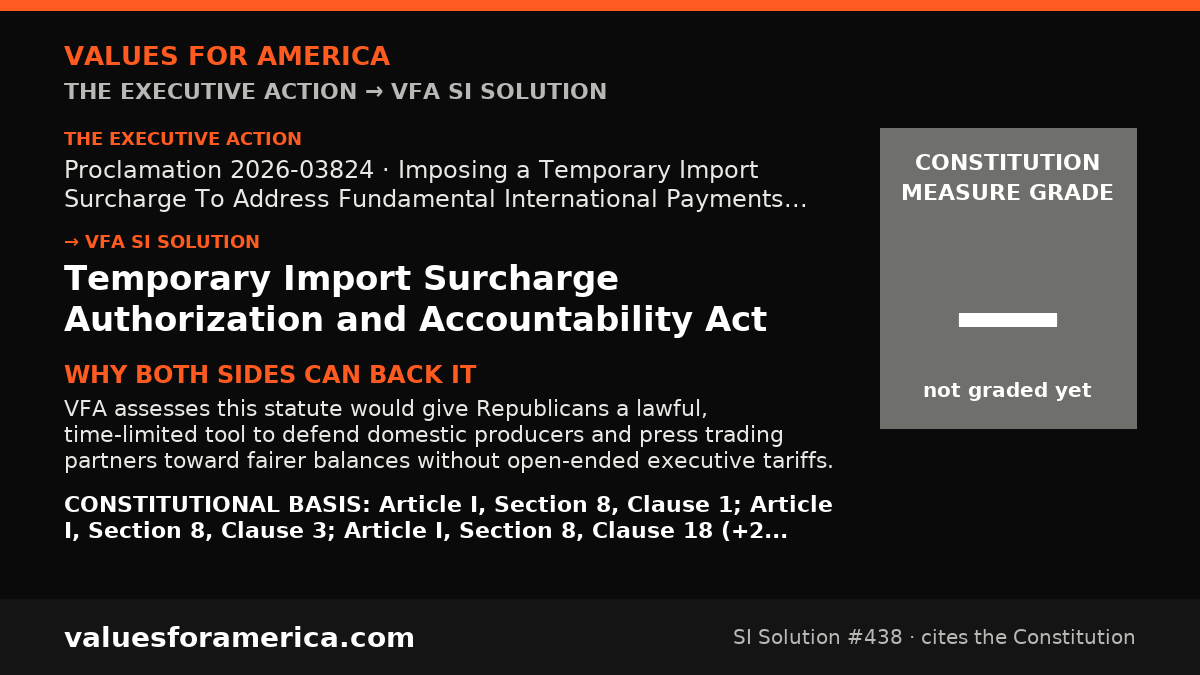
Temporary Import Surcharge Authorization and Accountability Act
SI-generated · passed automated checks (Constitution citation, source verification, independent SI critic) · not individually reviewed by a person · Report an error: hello@valuesforamerica.com
Imposing a Temporary Import Surcharge To Address Fundamental International Payments Problems
Proclamation
Temporary Import Surcharge Authorization and Accountability Act
To impose a temporary added duty on imports to respond to large balance-of-payments deficits and protect economic and national security.
Constitutional concerns with the original
- Whether a broad import surcharge can rest on Article II alone when Article I, Section 8 gives Congress power over duties and foreign commerce.
- Whether the cited payments statute gives clear limits, findings, and time bounds before new duties apply.
- Whether importers receive fair notice and a hearing path before paying added duties under Fifth Amendment Due Process.
Solution text
Operative provisions
Source basis and limits
Basis: The basis is Federal Register document 2026-03824, Proclamation 11012 of February 20, 2026, as shown in the official summary. It supports a proclamation citing large payments deficits, a goods deficit near $1.2 trillion, and authority under section 122 of the Trade Act of 1974.
Check before relying on this: The full text after the first pages was not shown, so the exact surcharge rate, product list, start date, duration, and appeal rights remain unverified. Readers should check the complete Federal Register text and current customs notices before relying on cost or eligibility claims.
Bipartisan rationale
VFA assesses this statute would give Republicans a lawful, time-limited tool to defend domestic producers and press trading partners toward fairer balances without open-ended executive tariffs. VFA assesses it would give Democrats worker protections, clear exemptions for food, medicine, and low-income household goods, public reporting, and a guaranteed vote to end the surcharge. Both sides gain a return to Congress setting taxes and trade rules instead of one-sided proclamations.
Constitutional citations
- → Article I, Section 8, Clause 1
- → Article I, Section 8, Clause 3
- → Article I, Section 8, Clause 18
- → Fifth Amendment Due Process
- → Tenth Amendment
Article I, Section 8, Clause 1 Article I, Section 8, Clause 3 Article I, Section 8, Clause 18 Amendment V Amendment X
Possible legislative path
Support could come from lawmakers focused on factory towns, farm exports, and fair trade rules, plus lawmakers focused on family budgets, health costs, and open process. Opposition could come from free-trade members wary of higher prices and from members wary of any new import tax. A short limit, public data, household exemptions, and a guaranteed exit vote give both groups reason to accept the bill.
Report an error in this Solution

Citizen Consensus
“Do you support this VFA SI Solution?”
One vote per verified account; you can change it any time. Only verified accounts count, results publish once 30 verified people have voted, and state and district results count only people who attested a home ZIP code. How this works.
Email verification is not switched on yet, so no vote counts toward results yet. Votes cast now are saved and count once the voter verifies their email address.
Sign in or create a free account to vote.
Add a short reason (optional)
/280 · no links or contact details · reasons are reviewed before anyone sees them, and many never are shown.
Your vote is saved but held out of published results by an automated integrity check (for example, several accounts voting from one browser).
Your vote is saved. It will count once you verify your email address. Verify on your account page.
Your vote counts nationally. Add your home ZIP code to count in your state and district too.
Your vote counts nationally and in .
Reason saved privately; it is shown only if it passes review.
Verified participants nationwide · n =
Self-selected participants, not a random sample; ± is the 95% sampling margin.
Not enough verified votes yet. Results publish at verified votes.
A sudden surge of votes on this item was flagged and is under review; votes from new accounts in that surge are held out until it is resolved.
Generated by VFA SI Solutions · 2026.10.16 15:12 UTC · ← Back to the Republic