SI-generated Constitutional Solution

Title III Clarity, Notice, and Reporting Act

Mode: Scotus Opinion Generated by VFA SI Solutions Drafted: 2026.10.15 Published: 2026.10.15

SI-generated · passed automated checks (Constitution citation, source verification, independent SI critic) · not individually reviewed by a person · Report an error: hello@valuesforamerica.com

Supreme Court opinion

Havana Docks Corp. v. Royal Caribbean Cruises, Ltd.

Clarence Thomas

Author
Clarence Thomas
Filed
2026-05-21
Citation
—
→ View original
VFA SI Solution · SI-generated

Title III Clarity, Notice, and Reporting Act

The official summary states the question was whether cruise line use of Havana docks from 2016 to 2019 was trafficking in property confiscated by the Cuban Government, and the Court held such use was enough without proof of trafficking in the concession interest itself.

Constitutional concerns with the original

  1. How Congress may clarify trafficking liability after the decision while preserving Fifth Amendment Due Process for carriers and travelers.
  2. How federal claims law and presidential foreign affairs authority interact with state court procedures under the Tenth Amendment.

Solution text

The official summary states that Havana Docks held a time-limited concession to operate docks at the Port of Havana, set to expire in 2004, and that Cuban authorities seized the docks without compensation in 1960. Congress later created a private right of action in Title III for nationals owning claims to property confiscated on or after January 1, 1959. The Court held the cruise lines' use of the docks from 2016 to 2019 was use of property which was confiscated, so Havana Docks was not required to show trafficking in its concession interest itself. The Eleventh Circuit judgment was vacated and remanded. The strongest originalist and textualist reading stresses the plain words Congress wrote. Title III reaches any property and any interest therein, defines property to include physical things, and defines confiscation to include seizure of control. On that reading, armed seizure of the docks extinguished the concession and took the physical works, and later paid passenger use was commercial use without authorization. This reading rejects a counterfactual test that would ask what would have happened without confiscation, because that test has no basis in the text and would exclude core trafficking cases. The strongest living-constitution and progressive reading stresses remedy, deterrence, and adaptation to changed conditions. On that view, the law should answer the lasting harm of uncompensated expropriation and discourage commerce that sustains repressive control of stolen assets. Confiscated property remains tainted even as legal forms expire or commerce changes, from docks to modern cruise networks carrying nearly a million passengers. Courts should therefore read the remedy to reach present-day commercial benefit tied to past taking, while using fair procedures to protect ordinary travelers and workers. VFA proposes that Congress could work within the decision by clarifying future application rather than relitigating this case. The proposal would define how physical property and interests relate for trafficking, require written notice to a carrier and a 90-day chance to stop the challenged use before suit, direct the State Department to publish travel and carrier guidance, and require annual public reports on filings, awards, and settlement amounts. It would leave state courts to apply their own procedures and leave licensed travel rules to existing executive authority, preserving both accountability and lawful engagement. The strongest objection is that notice and clarification could weaken deterrence or invite continued use of confiscated property during a cure period. The answer is that clear rules increase compliance and compensation over time. Carriers that receive plain guidance are more likely to avoid tainted ports, victims gain a clearer path to proof, and public reporting lets Congress judge whether the remedy deters support for confiscation or needs revision at sunset.

Operative provisions

acting body
Congress
enforcement mechanism
Private Title III suits remain the remedy; the Department of Justice would publish guidance and the Government Accountability Office would audit fund payments and reports, with courts dismissing claims outside the clarified scope.
funding amount
$8 million total cap over five years for administration, guidance, and reporting
funding source
Existing Department of State and Department of Justice salaries and expenses appropriations, with no new tax and no private fund diversion
holding summary
The Court held the cruise lines' use of the docks is enough to show they used property confiscated by the Cuban Government, and Havana Docks need not prove trafficking in its concession interest itself.
legislative response
Congress could clarify the trafficking definition for future cases, add written notice and a cure period for carriers, create a public reporting system on Title III suits and awards, and leave choice-of-law and court procedures to the states.
living constitution reading
On this view, the statute is a living remedy for historic injustice that must be read in light of present realities. Confiscation destroyed real economic value and tainted the physical property, so later commercial use that benefits the regime should support compensation. Courts should construe remedial laws broadly to protect victims, deter support for repressive rule, and adapt old property forms to modern commerce such as mass cruise travel.
originalist reading
On this view, the text controls as written and as understood when Congress passed it. The law makes liable any person who traffics in any property and any interest therein that was confiscated, and defines confiscation to include seizure of control of property. Because Cuban forces seized control of the docks themselves after January 1, 1959, later commercial use of those docks falls within the plain words, without adding a counterfactual test about when a concession would have expired.
oversight body
Government Accountability Office, with annual reports to the Senate Foreign Relations and House Foreign Affairs Committees
sunset years
5

Source basis and limits

Basis: The Court's official syllabus and opening opinion state the 1928 concession, the 1959-1960 seizure, the 1996 Cuban Liberty and Democratic Solidarity Act provisions, the suspension history, the 2016-2019 cruise use, and the holding on confiscated property.

Check before relying on this: Later sections of the opinion, separate concurring or dissenting writings, the full vote lineup beyond the visible line, current Title III filing rules, appeal rights, eligibility details, and cost effects are not shown in this portion and should be checked at supremecourt.gov before final legislative drafting.

Bipartisan rationale

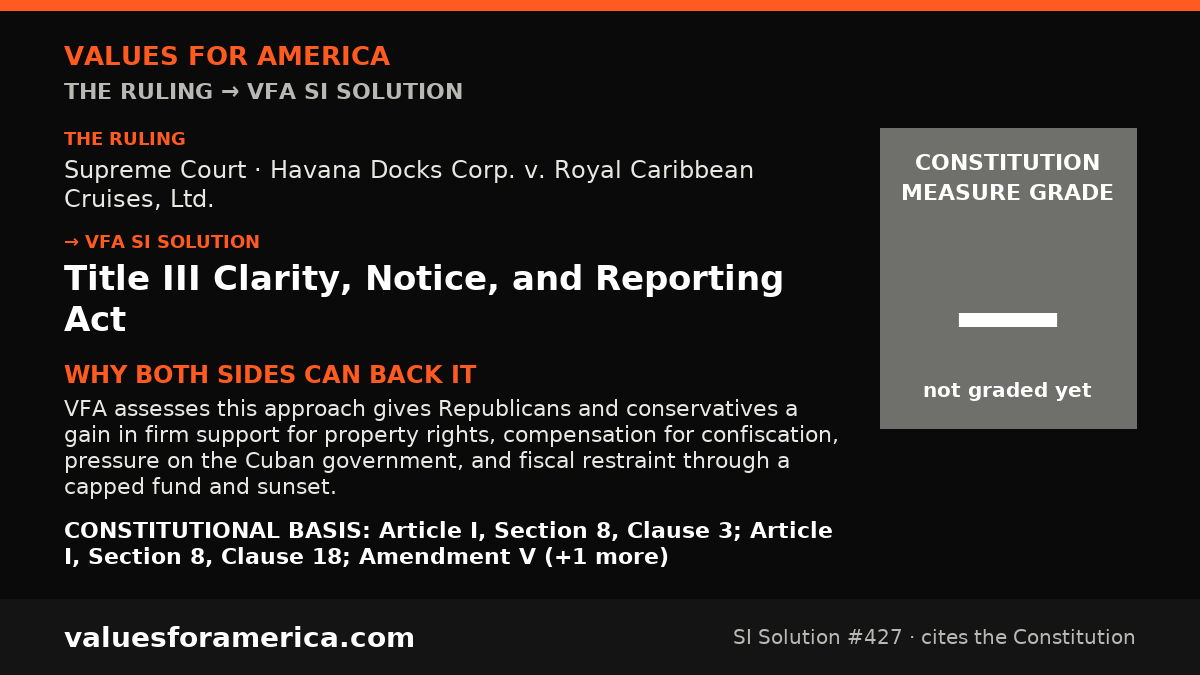
VFA assesses this approach gives Republicans and conservatives a gain in firm support for property rights, compensation for confiscation, pressure on the Cuban government, and fiscal restraint through a capped fund and sunset. VFA assesses it gives Democrats and progressives a gain in due process safeguards, clear notice and lawful travel protections, public reporting on awards and effects, and respect for presidential conduct of foreign affairs.

Constitutional citations

  • → Article I, Section 8, Clause 3
  • → Article I, Section 8, Clause 18
  • → Fifth Amendment Due Process
  • → Tenth Amendment

Article I, Section 8, Clause 3 Article I, Section 8, Clause 18 Amendment V Amendment X

Possible legislative path

Support could come from property-rights and human-rights interests favoring compensation and deterrence, while opposition could come from travel, trade, and carrier interests concerned about liability scope and compliance costs.

Report an error in this Solution
No account needed. Or email hello@valuesforamerica.com. How reports are handled.

Share card

1200×675 PNG for X, Threads, LinkedIn and messages. Free to share with a link back to this page.

Citizen Consensus

“Do you support this VFA SI Solution?”

One vote per verified account; you can change it any time. Only verified accounts count, results publish once 30 verified people have voted, and state and district results count only people who attested a home ZIP code. How this works.

Email verification is not switched on yet, so no vote counts toward results yet. Votes cast now are saved and count once the voter verifies their email address.

Add a short reason (optional)

/280 · no links or contact details · reasons are reviewed before anyone sees them, and many never are shown.

Your vote is saved but held out of published results by an automated integrity check (for example, several accounts voting from one browser).

Your vote is saved. It will count once you verify your email address. Verify on your account page.

Your vote counts nationally. Add your home ZIP code to count in your state and district too.

Your vote counts nationally and in .

Reason saved privately; it is shown only if it passes review.

A sudden surge of votes on this item was flagged and is under review; votes from new accounts in that surge are held out until it is resolved.

National, state and district results →

Generated by VFA SI Solutions · 2026.10.15 15:09 UTC · ← Back to the Republic