SI-generated Constitutional Solution
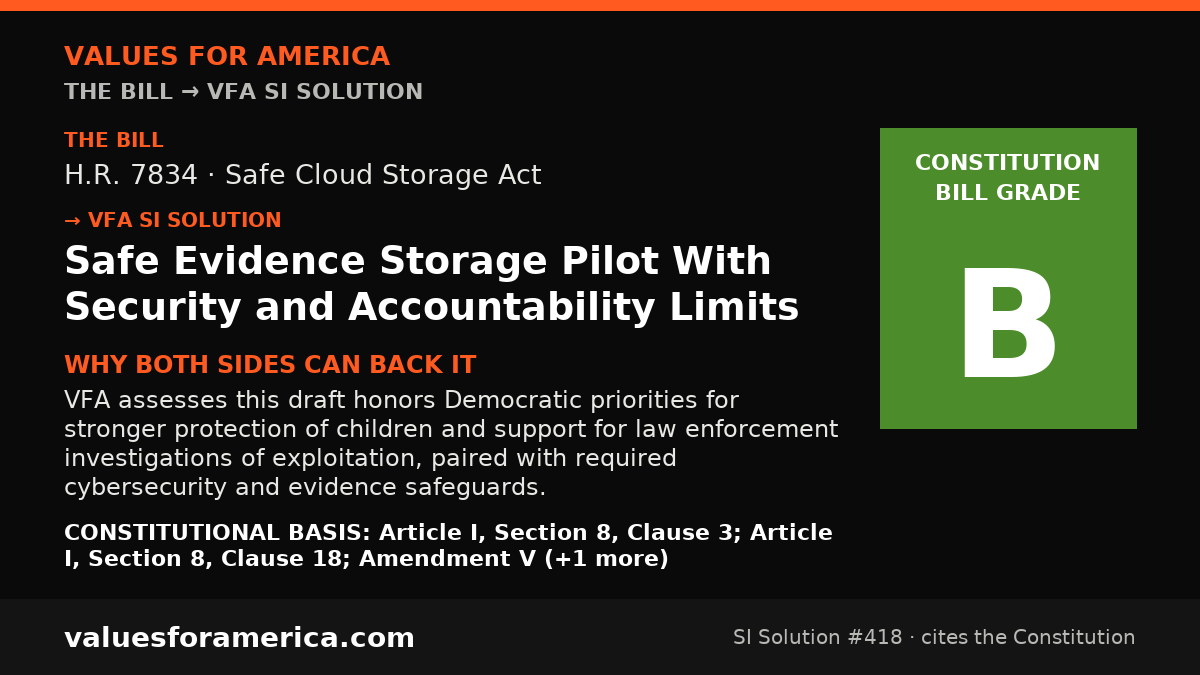
Safe Evidence Storage Pilot With Security and Accountability Limits
SI-generated · passed automated checks (Constitution citation, source verification, independent SI critic) · not individually reviewed by a person · Report an error: hello@valuesforamerica.com
Brief for congressional offices →
Safe Cloud Storage Act
Safe Evidence Storage Pilot With Security and Accountability Limits
Help law enforcement investigate online child sexual exploitation by allowing trusted storage vendors to hold and process related digital evidence without facing crushing lawsuits or prosecution for that authorized work.
Constitutional concerns with the original
- Extending liability limits to vendors working with federal, state, and local agencies must rest on a clear enumerated power and avoid displacing state criminal and civil law beyond what is necessary.
- Due process requires that stored material be handled as evidence with chain-of-custody and access controls so prosecutions and defense rights remain fair.
- Federalism requires that state and local agencies keep control over contracting choices and evidence retention decisions.
Solution text
Operative provisions
Source basis and limits
Basis: The Congress.gov summary of H.R. 7834 in the 119th Congress states the goal, the current role of the National Center for Missing and Exploited Children CyberTipline, the existing liability limit for vendors working with that center, the proposed extension to vendors under contract with federal, state, and local law enforcement, the misconduct exceptions, and the new cybersecurity and evidence storage duties.
Check before relying on this: The official summary does not include the full bill text, definitions, current law citations, contract terms, security standards, retention periods, appeal rights, cost effects, or statutory conflicts; readers should verify those points in the full bill text at the official Congress.gov page before relying on this draft.
Bipartisan rationale
VFA assesses this draft honors Democratic priorities for stronger protection of children and support for law enforcement investigations of exploitation, paired with required cybersecurity and evidence safeguards. It honors Republican priorities for limited federal power, clear liability limits tied to lawful contracts, fiscal restraint through a capped pilot, and protection of due process and state court authority through defined exceptions for misconduct.
Constitutional citations
- → Article I, Section 8, Clause 3
- → Article I, Section 8, Clause 18
- → Fifth Amendment Due Process
- → Tenth Amendment
Article I, Section 8, Clause 3 Article I, Section 8, Clause 18 Amendment V Amendment X
Possible legislative path
In each chamber, members focused on child safety and law enforcement support may favor the bill while members focused on states rights, civil liberties, and spending restraint may seek the added limits, with opposition possible over liability scope and federal standards for local agencies.
Report an error in this Solution

Citizen Consensus
“Do you support this VFA SI Solution?”
One vote per verified account; you can change it any time. Only verified accounts count, results publish once 30 verified people have voted, and state and district results count only people who attested a home ZIP code. How this works.
Email verification is not switched on yet, so no vote counts toward results yet. Votes cast now are saved and count once the voter verifies their email address.
Sign in or create a free account to vote.
Add a short reason (optional)
/280 · no links or contact details · reasons are reviewed before anyone sees them, and many never are shown.
Your vote is saved but held out of published results by an automated integrity check (for example, several accounts voting from one browser).
Your vote is saved. It will count once you verify your email address. Verify on your account page.
Your vote counts nationally. Add your home ZIP code to count in your state and district too.
Your vote counts nationally and in .
Reason saved privately; it is shown only if it passes review.
Verified participants nationwide · n =
Self-selected participants, not a random sample; ± is the 95% sampling margin.
Not enough verified votes yet. Results publish at verified votes.
A sudden surge of votes on this item was flagged and is under review; votes from new accounts in that surge are held out until it is resolved.
Related on VFA
Generated by VFA SI Solutions · 2026.10.15 15:05 UTC · ← Back to the Republic