Published Constitutional Solution
ALS Research Reauthorization with Transparent Safety Review
SI-generated · published by a VFA editor on 2026-10-04 · how publication works · Report an error: hello@valuesforamerica.com
Brief for congressional offices →
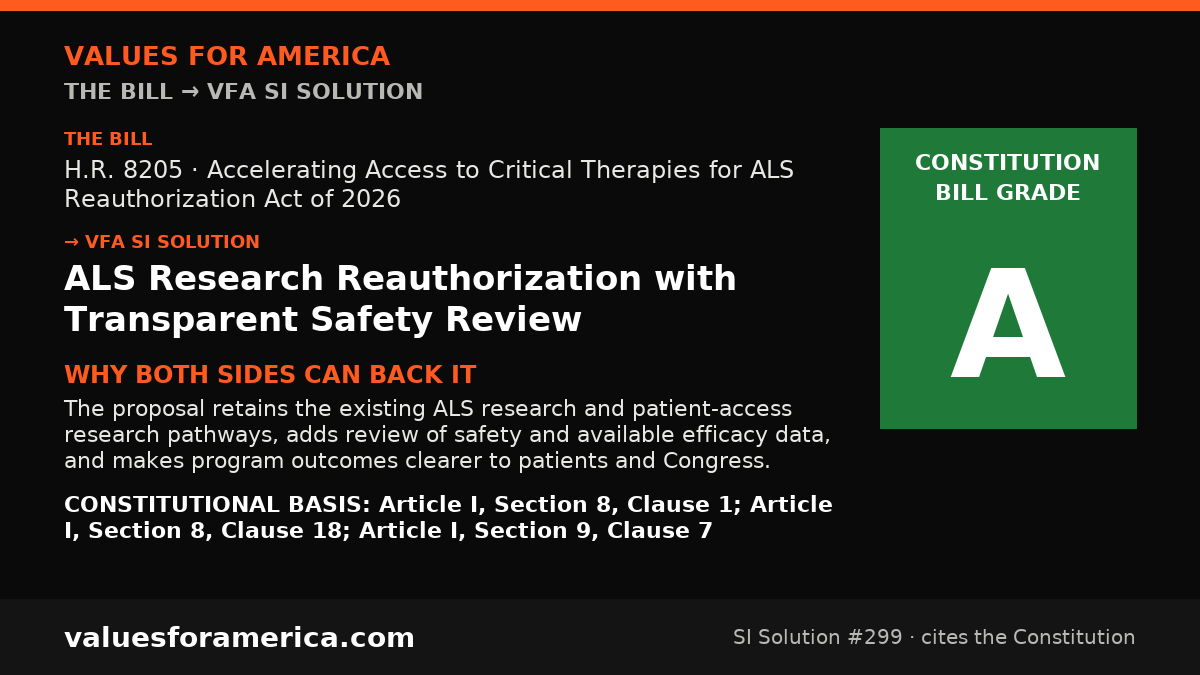
Accelerating Access to Critical Therapies for ALS Reauthorization Act of 2026
ALS Research Reauthorization with Transparent Safety Review
Extend the federal ALS research and expanded-access research programs authorized by Public Law 117-79 through fiscal year 2031, strengthen review and safety reporting for research grants, and require an updated FDA plan and report for rare neurodegenerative diseases. The legislation supports research involving investigational drugs; it does not guarantee a patient access to a drug.
Constitutional concerns with the original
This solution records no specific constitutional concern with the original action. Review the original text and cited provisions for legal analysis.
Solution text
Operative provisions
Source basis and limits
Basis: Public Law 117-79 §§2-5 and 7 establishes the ALS expanded-access research grants, partnership, FDA work, and $100 million yearly authorization through FY2026 (https://www.govinfo.gov/content/pkg/PLAW-117publ79/pdf/PLAW-117publ79.pdf). The House-engrossed H.R. 8205 §§2-4 extends the authorization and section 2 grant-award date to 2031, adds renewal data review and serious/unexpected safety reporting, includes qualifying combined phase 2/3 trials, and requires an updated FDA action plan and report (https://www.govinfo.gov/content/pkg/BILLS-119hr8205eh/html/BILLS-119hr8205eh.htm).
Check before relying on this: The annual deidentified program report and plain-language patient guide are VFA additions, not existing law or provisions of H.R. 8205. The $100 million figure is an authorization, not an appropriation or cost estimate; verify the final enrolled or enacted H.R. 8205 text and current appropriations before publication. Expanded access remains subject to existing FDA and grant eligibility rules and does not guarantee treatment to any patient.
Bipartisan rationale
The proposal retains the existing ALS research and patient-access research pathways, adds review of safety and available efficacy data, and makes program outcomes clearer to patients and Congress. It keeps the current $100 million annual authorization instead of raising it, requires separate annual appropriations, and adds no state mandate or new patient entitlement. Those choices address patient and research priorities alongside cost control and oversight concerns without predicting support from any particular member.
Constitutional citations
- → Article I, Section 8, Clause 1 (Spending and General Welfare Clause)
- → Article I, Section 8, Clause 18 (Necessary and Proper Clause)
- → Article I, Section 9, Clause 7 (Appropriations Clause)
Article I, Section 8, Clause 1 Article I, Section 8, Clause 18 Article I, Section 9, Clause 7
Possible legislative path
Members in both chambers who favor ALS research and patient access may support the extension and safety review, while members focused on spending and administrative burden may scrutinize the continued authorization and added annual report. No vote count or whip estimate is asserted.
Report an error in this Solution

Citizen Consensus
“Do you support this VFA SI Solution?”
One vote per verified account; you can change it any time. Only verified accounts count, results publish once 30 verified people have voted, and state and district results count only people who attested a home ZIP code. How this works.
Email verification is not switched on yet, so no vote counts toward results yet. Votes cast now are saved and count once the voter verifies their email address.
Sign in or create a free account to vote.
Add a short reason (optional)
/280 · no links or contact details · reasons are reviewed before anyone sees them, and many never are shown.
Your vote is saved but held out of published results by an automated integrity check (for example, several accounts voting from one browser).
Your vote is saved. It will count once you verify your email address. Verify on your account page.
Your vote counts nationally. Add your home ZIP code to count in your state and district too.
Your vote counts nationally and in .
Reason saved privately; it is shown only if it passes review.
Verified participants nationwide · n =
Self-selected participants, not a random sample; ± is the 95% sampling margin.
Not enough verified votes yet. Results publish at verified votes.
A sudden surge of votes on this item was flagged and is under review; votes from new accounts in that surge are held out until it is resolved.
Related on VFA
Generated by VFA SI Solutions · 2026.10.03 22:24 UTC · ← Back to the Republic