Archived SI output (machine-generated)
International Endangered Species Conservation Assistance Act of 2025
Archived SI output (machine-generated) · No editorial review recorded
This historical SI draft was machine-generated by software and has no editorial review time on record. Verify its factual and legal claims against the original source before relying on it.
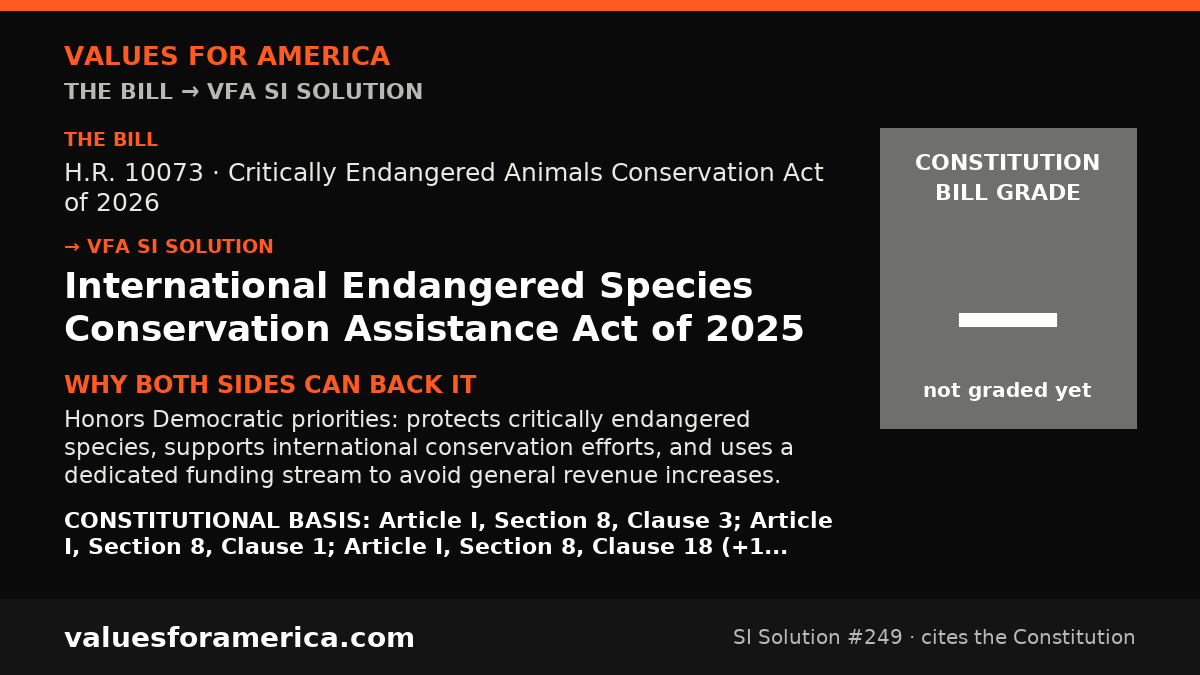
Critically Endangered Animals Conservation Act of 2026
International Endangered Species Conservation Assistance Act of 2025
To provide U.S. funding and technical assistance for the conservation of critically endangered species located in foreign countries, aiming to prevent their extinction and preserve global biodiversity.
Constitutional concerns with the original
- The original bill may exceed Congress's enumerated powers by funding foreign conservation without a clear link to U.S. commerce, treaties, or other delegated powers, potentially violating the Tenth Amendment.
- The General Welfare Clause (Article I, Section 8, Clause 1) is limited by the requirement that spending must be for the general welfare of the United States, not for general global welfare without a domestic nexus.
- Without a tie to interstate or foreign commerce, the Commerce Clause (Article I, Section 8, Clause 3) may not support direct grants to foreign countries for species conservation.
Solution text
Operative provisions
Bipartisan rationale
Honors Democratic priorities: protects critically endangered species, supports international conservation efforts, and uses a dedicated funding stream to avoid general revenue increases. Honors Republican priorities: limits federal spending to a narrow, commerce-linked surcharge, includes a sunset clause, requires measurable outcomes, prohibits land acquisition or property rights infringement, and ties assistance to direct U.S. economic and ecological interests, respecting the Tenth Amendment by not regulating states or private property without due process.
Constitutional citations
- → Article I, Section 8, Clause 3 (Commerce with foreign nations)
- → Article I, Section 8, Clause 1 (General Welfare, limited to spending that benefits the United States)
- → Article I, Section 8, Clause 18 (Necessary and Proper Clause to implement commerce and treaty obligations)
- → Tenth Amendment (reserving to states powers not delegated, here avoided by focusing on federal commerce power)
Article I, Section 8, Clause 3 Article I, Section 8, Clause 1 Article I, Section 8, Clause 18 Amendment X
Report an error in this Solution

Citizen Consensus
“Do you support this VFA SI Solution?”
One vote per verified account; you can change it any time. Only verified accounts count, results publish once 30 verified people have voted, and state and district results count only people who attested a home ZIP code. How this works.
Email verification is not switched on yet, so no vote counts toward results yet. Votes cast now are saved and count once the voter verifies their email address.
Sign in or create a free account to vote.
Add a short reason (optional)
/280 · no links or contact details · reasons are reviewed before anyone sees them, and many never are shown.
Your vote is saved but held out of published results by an automated integrity check (for example, several accounts voting from one browser).
Your vote is saved. It will count once you verify your email address. Verify on your account page.
Your vote counts nationally. Add your home ZIP code to count in your state and district too.
Your vote counts nationally and in .
Reason saved privately; it is shown only if it passes review.
Verified participants nationwide · n =
Self-selected participants, not a random sample; ± is the 95% sampling margin.
Not enough verified votes yet. Results publish at verified votes.
A sudden surge of votes on this item was flagged and is under review; votes from new accounts in that surge are held out until it is resolved.
Related on VFA
Generated by VFA SI Solutions · 2026.08.13 06:00 UTC · ← Back to the Republic