Archived SI output (machine-generated)
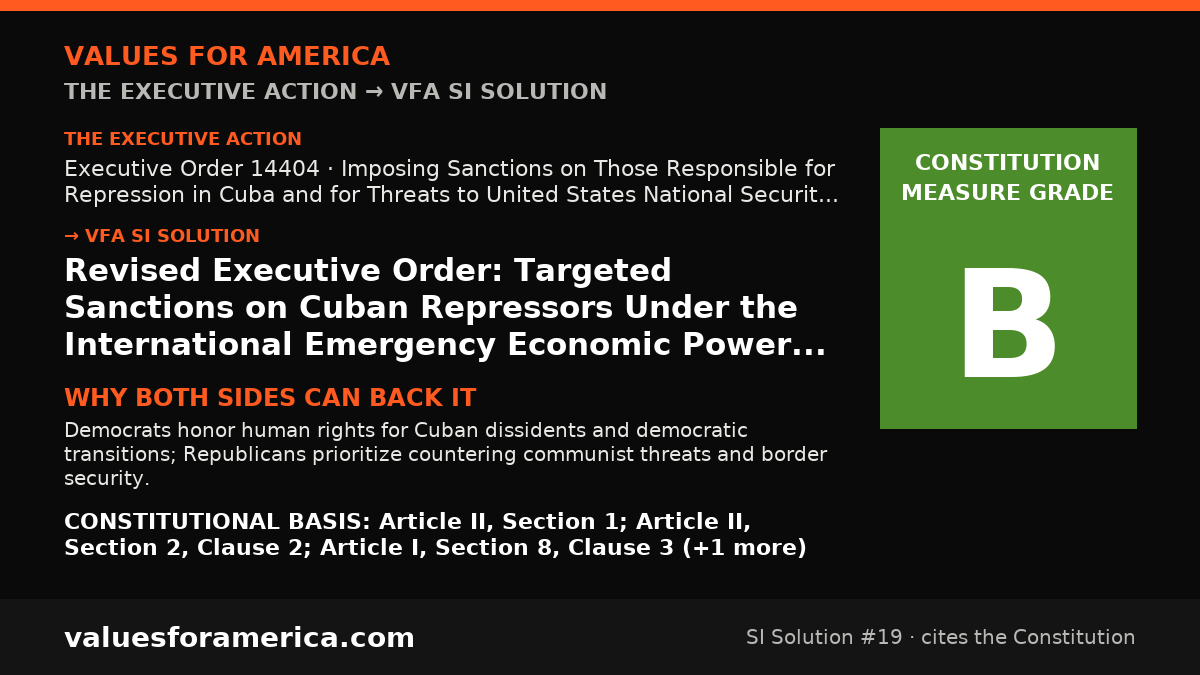
Revised Executive Order: Targeted Sanctions on Cuban Repressors Under the International Emergency Economic Powers Act
Archived SI output (machine-generated) · No editorial review recorded
This historical SI draft was machine-generated by software and has no editorial review time on record. Verify its factual and legal claims against the original source before relying on it.
Imposing Sanctions on Those Responsible for Repression in Cuba and for Threats to United States National Security and Foreign Policy
Executive Order
Revised Executive Order: Targeted Sanctions on Cuban Repressors Under the International Emergency Economic Powers Act
Impose economic, financial, and travel sanctions on Cuban government officials, entities, and individuals responsible for human rights repression and actions threatening U.S. national security and foreign policy.
Constitutional concerns with the original
- May imply standalone Article II authority without explicitly citing statutory hooks like IEEPA, risking overstep into Article I powers over foreign commerce.
- Lacks built-in sunset, oversight, or review limits on sanctions powers delegated by Congress.
Solution text
Operative provisions
Bipartisan rationale
Democrats honor human rights for Cuban dissidents and democratic transitions; Republicans prioritize countering communist threats and border security. Both sides value checks like sunset and congressional oversight to preserve Article I roles over endless executive emergencies.
Constitutional citations
- → Article II, Section 1 (executive power vesting)
- → Article II, Section 2, Clause 2 (foreign affairs authority)
- → Article I, Section 8, Clause 3 (foreign commerce delegation via IEEPA)
- → Article I, Section 8, Clause 18 (Necessary and Proper Clause for statutory implementation)
Article II, Section 1 Article II, Section 2, Clause 2 Article I, Section 8, Clause 3 Article I, Section 8, Clause 18
Report an error in this Solution

Citizen Consensus
“Do you support this VFA SI Solution?”
One vote per verified account; you can change it any time. Only verified accounts count, results publish once 30 verified people have voted, and state and district results count only people who attested a home ZIP code. How this works.
Email verification is not switched on yet, so no vote counts toward results yet. Votes cast now are saved and count once the voter verifies their email address.
Sign in or create a free account to vote.
Add a short reason (optional)
/280 · no links or contact details · reasons are reviewed before anyone sees them, and many never are shown.
Your vote is saved but held out of published results by an automated integrity check (for example, several accounts voting from one browser).
Your vote is saved. It will count once you verify your email address. Verify on your account page.
Your vote counts nationally. Add your home ZIP code to count in your state and district too.
Your vote counts nationally and in .
Reason saved privately; it is shown only if it passes review.
Verified participants nationwide · n =
Self-selected participants, not a random sample; ± is the 95% sampling margin.
Not enough verified votes yet. Results publish at verified votes.
A sudden surge of votes on this item was flagged and is under review; votes from new accounts in that surge are held out until it is resolved.
Related on VFA
Generated by VFA SI Solutions · 2026.05.14 00:29 UTC · ← Back to the Republic