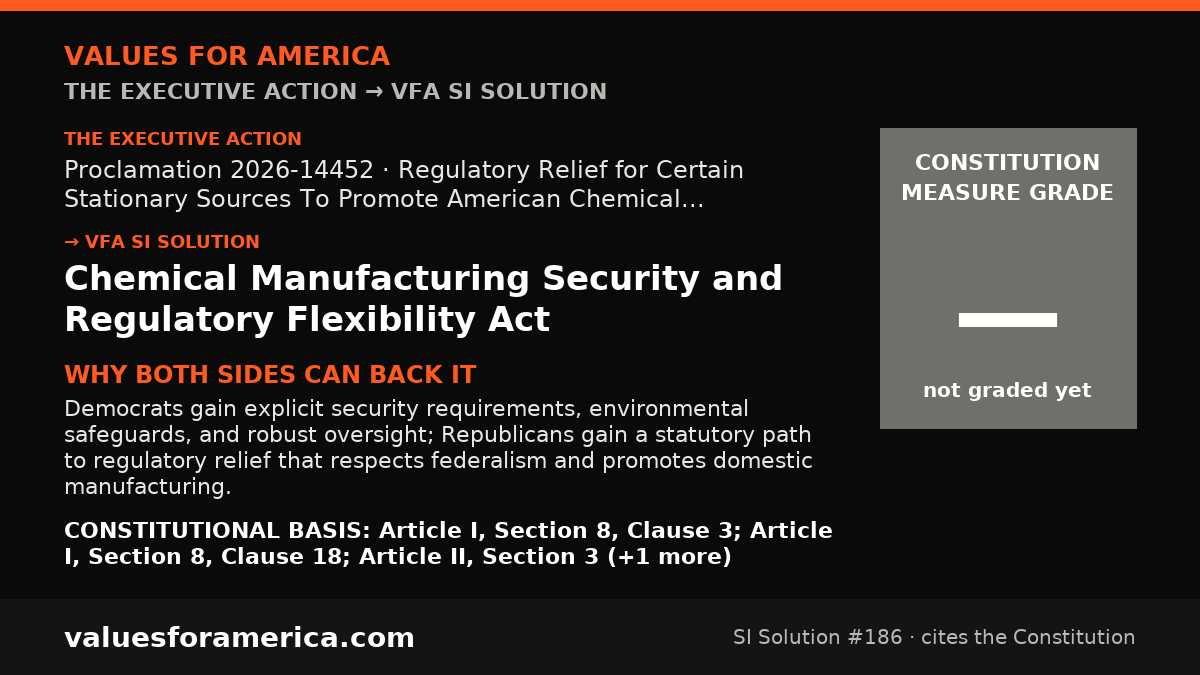
Chemical Manufacturing Security and Regulatory Flexibility Act
Mode: Executive ActionGenerated by VFA SI SolutionsDrafted: 2026.07.18
Archived SI output (machine-generated) · No editorial review recorded
This historical SI draft was machine-generated by software and has no editorial review time on record. Verify its factual and legal claims against the original source before relying on it.
Unilateral Presidential action
Regulatory Relief for Certain Stationary Sources To Promote American Chemical Manufacturing Security
Chemical Manufacturing Security and Regulatory Flexibility Act
Provide regulatory relief for certain stationary sources (chemical plants) to promote American chemical manufacturing security.
Constitutional concerns with the original
The President lacks Article II authority to unilaterally waive or modify statutory requirements under the Clean Air Act and other environmental laws without congressional delegation.
The action may violate the Take Care Clause (Article II, Section 3) by failing to faithfully execute laws enacted by Congress.
It encroaches on Congress's exclusive power to make laws under Article I, Section 1.
Solution text
SECTION 1. SHORT TITLE. This Act may be cited as the 'Chemical Manufacturing Security and Regulatory Flexibility Act'.
SEC. 2. FINDINGS AND PURPOSE. (a) Findings.—Congress finds that (1) the domestic chemical manufacturing industry is vital to national security and economic prosperity; (2) certain stationary sources face regulatory burdens that may impede their ability to implement security enhancements; (3) targeted, temporary regulatory relief can incentivize security investments without compromising public health or the environment. (b) Purpose.—The purpose of this Act is to authorize the President to grant temporary relief from certain environmental regulations for stationary sources that demonstrate a verifiable commitment to improving chemical security, subject to strict conditions and oversight.
SEC. 3. DEFINITIONS. In this Act: (1) 'Stationary source' has the meaning given in section 111(a) of the Clean Air Act (42 U.S.C. 7411(a)). (2) 'Security enhancement' means a physical, operational, or cybersecurity measure that reduces the risk of a chemical release, sabotage, or terrorist attack. (3) 'Regulatory relief' means a temporary waiver or modification of a requirement under the Clean Air Act, the Clean Water Act, or the Resource Conservation and Recovery Act, as specified in the application.
SEC. 4. AUTHORITY TO GRANT REGULATORY RELIEF. (a) In General.—The President may, upon application by the owner or operator of a stationary source, grant regulatory relief for a period not to exceed three years if the President determines that (1) the relief is necessary to implement a security enhancement; (2) the relief will not result in a significant increase in risk to public health or the environment; (3) the applicant has submitted a security plan approved by the Department of Homeland Security; and (4) the relief is consistent with the national interest. (b) Conditions.—The President shall impose conditions on any relief granted, including monitoring, reporting, and a requirement to maintain baseline compliance with all other applicable laws. (c) Limitation.—No relief may be granted for a stationary source that has been subject to a final enforcement action for a violation of environmental law within the preceding five years.
SEC. 5. OVERSIGHT AND REPORTING. (a) Comptroller General Review.—The Comptroller General shall conduct an annual review of the implementation of this Act and submit a report to Congress on the number of grants, their effects on security and the environment, and any recommendations. (b) Public Notice.—The President shall publish notice of each application and decision in the Federal Register, including a summary of the security plan and the basis for the determination.
SEC. 6. JUDICIAL REVIEW. Any person aggrieved by a grant or denial of regulatory relief under this Act may file a petition for review in the United States Court of Appeals for the District of Columbia Circuit within 60 days of the decision. The court shall set aside the decision if it is arbitrary, capricious, an abuse of discretion, or otherwise not in accordance with law.
SEC. 7. FUNDING. There is authorized to be appropriated from the general fund of the Treasury $50,000,000 for each of fiscal years 2026 through 2030 to carry out this Act.
SEC. 8. SUNSET. This Act shall expire on September 30, 2030, unless reauthorized by Congress.
SEC. 9. SEVERABILITY. If any provision of this Act is held invalid, the remainder shall not be affected.
Operative provisions
funding source
General fund of the Treasury
funding amount
$50,000,000 per fiscal year
sunset years
5
oversight body
Comptroller General (annual reports to Congress)
enforcement mechanism
Conditions on relief; revocation if conditions violated; judicial review for aggrieved parties
judicial review path
Petition to U.S. Court of Appeals for D.C. Circuit within 60 days; arbitrary-and-capricious standard
Bipartisan rationale
Democrats gain explicit security requirements, environmental safeguards, and robust oversight; Republicans gain a statutory path to regulatory relief that respects federalism and promotes domestic manufacturing. Both parties prefer this statutory framework over unilateral executive action because it preserves congressional authority, provides legal certainty, and ensures accountability through sunset and judicial review.
Constitutional citations
→ Article I, Section 8, Clause 3 (Commerce Clause)
→ Article I, Section 8, Clause 18 (Necessary and Proper Clause)
1200×675 PNG for X, Threads, LinkedIn and messages. Free to share with a link back to this page.
Citizen Consensus
“Do you support this VFA SI Solution?”
One vote per verified account; you can change it any time. Only verified accounts count, results publish
once 30 verified people have voted, and state and district results count only people
who attested a home ZIP code. How this works.
Email verification is not switched on yet, so no vote counts toward results yet. Votes cast now are
saved and count once the voter verifies their email address.