Archived SI output (machine-generated)
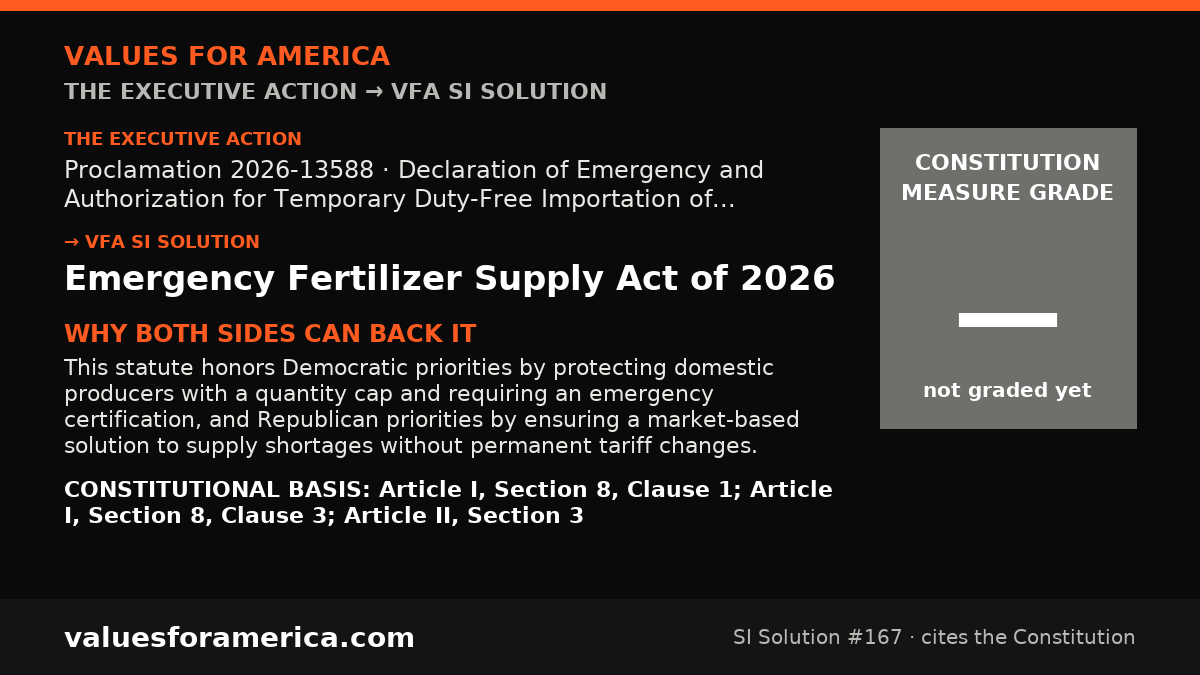
Emergency Fertilizer Supply Act of 2026
Archived SI output (machine-generated) · No editorial review recorded
This historical SI draft was machine-generated by software and has no editorial review time on record. Verify its factual and legal claims against the original source before relying on it.
Declaration of Emergency and Authorization for Temporary Duty-Free Importation of Phosphate Fertilizer From Morocco
Proclamation
Emergency Fertilizer Supply Act of 2026
To address a domestic shortage of phosphate fertilizer by temporarily allowing duty-free imports from Morocco, declared via emergency proclamation.
Constitutional concerns with the original
- The President lacks unilateral authority to modify tariff rates or waive duties under Article I, Section 8, Clause 1 (the Taxing and Spending Clause), which vests Congress with the power to lay and collect duties.
- The proclamation does not cite any statutory delegation from Congress authorizing the President to suspend duties on a specific product from a specific country for an emergency.
- The action may violate the Uniformity Clause (Article I, Section 8, Clause 1) by treating imports from Morocco differently from other nations without legislative authorization.
Solution text
Operative provisions
Bipartisan rationale
This statute honors Democratic priorities by protecting domestic producers with a quantity cap and requiring an emergency certification, and Republican priorities by ensuring a market-based solution to supply shortages without permanent tariff changes. Both parties benefit from institutional integrity: Congress retains its constitutional power over tariffs, and the executive gains a clear, time-limited delegation that avoids unilateral overreach.
Constitutional citations
- → Article I, Section 8, Clause 1 (Taxing and Spending Clause)
- → Article I, Section 8, Clause 3 (Commerce Clause)
- → Article II, Section 3 (Take Care Clause)
Article I, Section 8, Clause 1 Article I, Section 8, Clause 3 Article II, Section 3
Report an error in this Solution

Citizen Consensus
“Do you support this VFA SI Solution?”
One vote per verified account; you can change it any time. Only verified accounts count, results publish once 30 verified people have voted, and state and district results count only people who attested a home ZIP code. How this works.
Email verification is not switched on yet, so no vote counts toward results yet. Votes cast now are saved and count once the voter verifies their email address.
Sign in or create a free account to vote.
Add a short reason (optional)
/280 · no links or contact details · reasons are reviewed before anyone sees them, and many never are shown.
Your vote is saved but held out of published results by an automated integrity check (for example, several accounts voting from one browser).
Your vote is saved. It will count once you verify your email address. Verify on your account page.
Your vote counts nationally. Add your home ZIP code to count in your state and district too.
Your vote counts nationally and in .
Reason saved privately; it is shown only if it passes review.
Verified participants nationwide · n =
Self-selected participants, not a random sample; ± is the 95% sampling margin.
Not enough verified votes yet. Results publish at verified votes.
A sudden surge of votes on this item was flagged and is under review; votes from new accounts in that surge are held out until it is resolved.
Generated by VFA SI Solutions · 2026.07.03 06:00 UTC · ← Back to the Republic