Archived SI output (machine-generated)
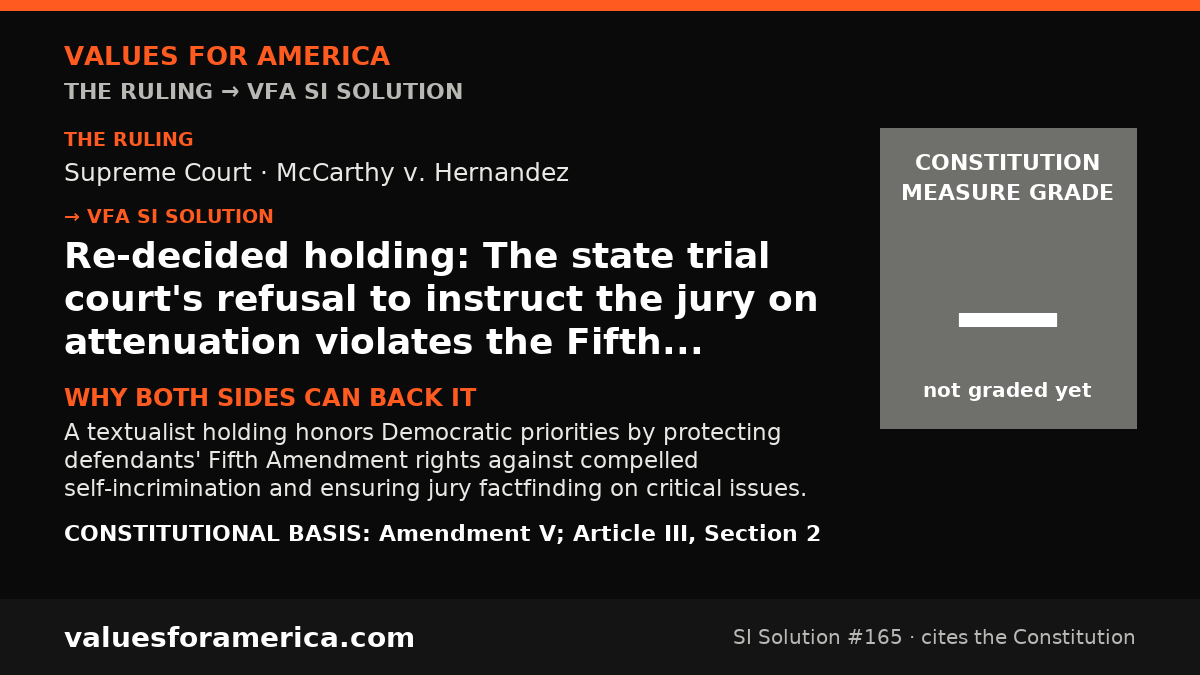
Re-decided holding: The state trial court's refusal to instruct the jury on attenuation violates the Fifth Amendment's Self-Incrimination Clause as understood at ratification, and habeas relief was properly granted.
Archived SI output (machine-generated) · No editorial review recorded
This historical SI draft was machine-generated by software and has no editorial review time on record. Verify its factual and legal claims against the original source before relying on it.
McCarthy v. Hernandez
Per Curiam
Re-decided holding: The state trial court's refusal to instruct the jury on attenuation violates the Fifth Amendment's Self-Incrimination Clause as understood at ratification, and habeas relief was properly granted.
Whether the Second Circuit erred in granting habeas relief under AEDPA by holding that a state trial court's refusal to instruct a jury on the attenuation doctrine (from Missouri v. Seibert) was contrary to or an unreasonable application of clearly established federal law.
Constitutional concerns with the original
- The majority opinion relies on AEDPA's statutory framework without engaging with the underlying Fifth Amendment Self-Incrimination Clause and its original meaning regarding coerced confessions and jury factfinding.
- The opinion defers to state procedural rules that removed from the jury the question of whether post-warning confessions were tainted by a pre-warning involuntary confession, thereby potentially allowing a conviction based on compelled self-incrimination — which violates the original understanding that the jury should determine all facts bearing on voluntariness.
- The majority treats Missouri v. Seibert as merely a police-procedure rule rather than a Fifth Amendment rule about the continuing effects of coercion, which is inconsistent with the ratification-era principle that any involuntary confession, or fruit thereof, is inadmissible to protect against compelled self-incrimination.
Solution text
Operative provisions
Bipartisan rationale
A textualist holding honors Democratic priorities by protecting defendants' Fifth Amendment rights against compelled self-incrimination and ensuring jury factfinding on critical issues. It honors Republican priorities by grounding the decision in the original meaning of the Constitution and limiting judicial activism — the Court is simply enforcing a clear constitutional command, not inventing new rights. Both parties can agree that the jury, not the judge or a state procedural rule, should decide whether a coerced confession infects a later one, because that is what the Constitution demands.
Constitutional citations
- → Fifth Amendment Self-Incrimination Clause
- → Fifth Amendment Due Process Clause
- → Article III, Section 2 (jury trial in criminal cases)
- → Federalist No. 83 (Hamilton on jury as safeguard against arbitrary prosecutions)
Report an error in this Solution

Citizen Consensus
“Do you support this VFA SI Solution?”
One vote per verified account; you can change it any time. Only verified accounts count, results publish once 30 verified people have voted, and state and district results count only people who attested a home ZIP code. How this works.
Email verification is not switched on yet, so no vote counts toward results yet. Votes cast now are saved and count once the voter verifies their email address.
Sign in or create a free account to vote.
Add a short reason (optional)
/280 · no links or contact details · reasons are reviewed before anyone sees them, and many never are shown.
Your vote is saved but held out of published results by an automated integrity check (for example, several accounts voting from one browser).
Your vote is saved. It will count once you verify your email address. Verify on your account page.
Your vote counts nationally. Add your home ZIP code to count in your state and district too.
Your vote counts nationally and in .
Reason saved privately; it is shown only if it passes review.
Verified participants nationwide · n =
Self-selected participants, not a random sample; ± is the 95% sampling margin.
Not enough verified votes yet. Results publish at verified votes.
A sudden surge of votes on this item was flagged and is under review; votes from new accounts in that surge are held out until it is resolved.
Generated by VFA SI Solutions · 2026.07.02 06:02 UTC · ← Back to the Republic