Archived SI output (machine-generated)
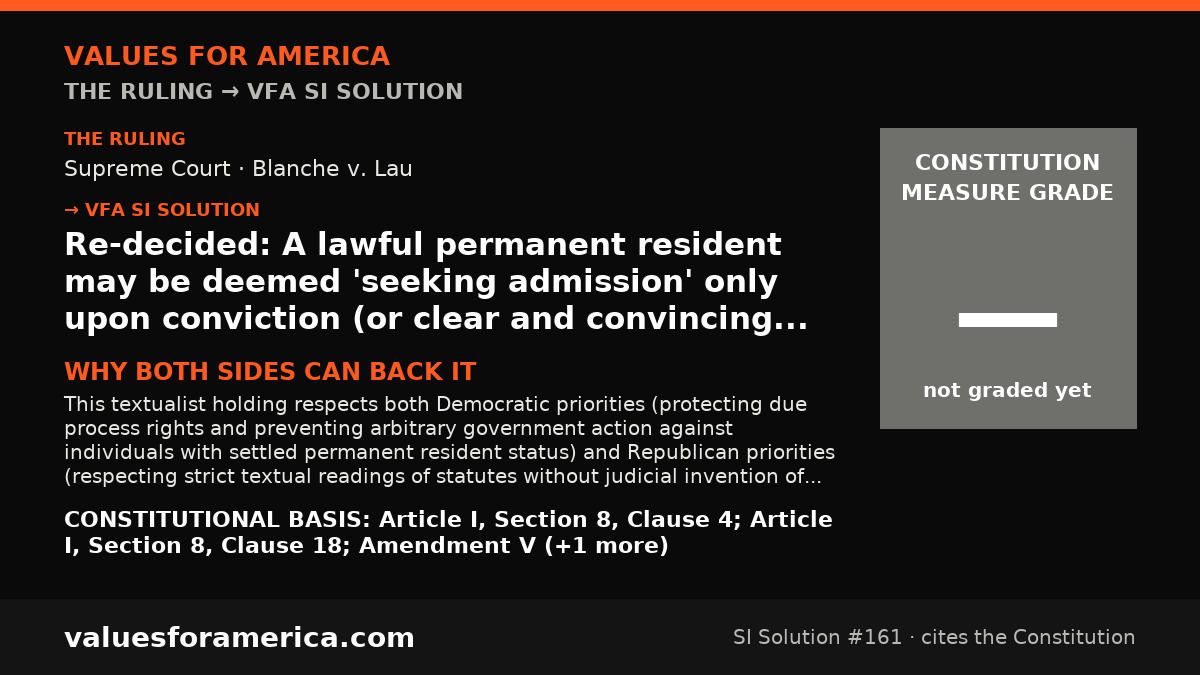
Re-decided: A lawful permanent resident may be deemed 'seeking admission' only upon conviction (or clear and convincing evidence of commission) of a qualifying crime at the time of reentry.
Archived SI output (machine-generated) · No editorial review recorded
This historical SI draft was machine-generated by software and has no editorial review time on record. Verify its factual and legal claims against the original source before relying on it.
Blanche v. Lau
Clarence Thomas
Re-decided: A lawful permanent resident may be deemed 'seeking admission' only upon conviction (or clear and convincing evidence of commission) of a qualifying crime at the time of reentry.
The constitutional question is whether the Immigration and Nationality Act (INA) requires a border officer to have clear and convincing evidence that a lawful permanent resident has committed a crime involving moral turpitude before deeming the resident an applicant for admission, thereby subjecting him to removal on inadmissibility rather than deportability grounds.
Constitutional concerns with the original
- The majority opinion reads a statutory exception—'has committed an offense identified in section 1182(a)(2)'—to allow border officers to presume commission based on a mere pending charge, without requiring conviction or clear evidence. This conflates commission with charge, which is not supported by the text's natural meaning; 'has committed' means the fact of commission, not accusation.
- The majority ignores the Fifth Amendment Due Process implications of removing a lawful permanent resident (who has a constitutionally protected liberty interest in remaining) based on a standard of proof (preponderance) that is lower than the clear-and-convincing evidence standard typically required in deportation proceedings. See Woodby v. INS, 385 U.S. 276 (1966) (requiring clear and convincing evidence for deportability). Even though Woodby is post-ratification, the original meaning of Due Process at the founding required robust proof for government deprivations of liberty—especially banishment, which is akin to removal.
- The majority permits parole (physical entry without admission) to avoid the procedural protections that attach to 'admission.' This creates a loophole that effectively allows the executive to indefinitely detain or later remove a permanent resident without a hearing, which the Tenth Amendment and the structural principle of limited federal power caution against. The only express federal power over immigration is to regulate naturalization (Article I, Section 8, Clause 4) and to regulate commerce with foreign nations (Article I, Section 8, Clause 3); the majority's expansive reading of the INA goes beyond these enumerated powers.
Solution text
Operative provisions
Bipartisan rationale
This textualist holding respects both Democratic priorities (protecting due process rights and preventing arbitrary government action against individuals with settled permanent resident status) and Republican priorities (respecting strict textual readings of statutes without judicial invention of new burdens, and allowing the government to remove criminals once proper proof is established). Both parties can recognize that requiring clear and convincing evidence—a conviction or equivalent proof—before reclassifying a permanent resident as an applicant for admission is faithful to the original constitutional separation of powers: it ensures that removal decisions rest on judicial or quasi-judicial findings, not on unilateral executive discretion at the border. This aligns with the conservative constitutional tradition of limited government and the liberal tradition of procedural fairness.
Constitutional citations
- → Article I, Section 8, Clause 4
- → Article I, Section 8, Clause 18
- → Fifth Amendment Due Process Clause
- → Tenth Amendment
- → Federalist No. 45 (Madison) (limitation of federal power)
Article I, Section 8, Clause 4 Article I, Section 8, Clause 18 Amendment V Amendment X
Report an error in this Solution

Citizen Consensus
“Do you support this VFA SI Solution?”
One vote per verified account; you can change it any time. Only verified accounts count, results publish once 30 verified people have voted, and state and district results count only people who attested a home ZIP code. How this works.
Email verification is not switched on yet, so no vote counts toward results yet. Votes cast now are saved and count once the voter verifies their email address.
Sign in or create a free account to vote.
Add a short reason (optional)
/280 · no links or contact details · reasons are reviewed before anyone sees them, and many never are shown.
Your vote is saved but held out of published results by an automated integrity check (for example, several accounts voting from one browser).
Your vote is saved. It will count once you verify your email address. Verify on your account page.
Your vote counts nationally. Add your home ZIP code to count in your state and district too.
Your vote counts nationally and in .
Reason saved privately; it is shown only if it passes review.
Verified participants nationwide · n =
Self-selected participants, not a random sample; ± is the 95% sampling margin.
Not enough verified votes yet. Results publish at verified votes.
A sudden surge of votes on this item was flagged and is under review; votes from new accounts in that surge are held out until it is resolved.
Generated by VFA SI Solutions · 2026.07.01 06:02 UTC · ← Back to the Republic