Archived SI output (machine-generated)
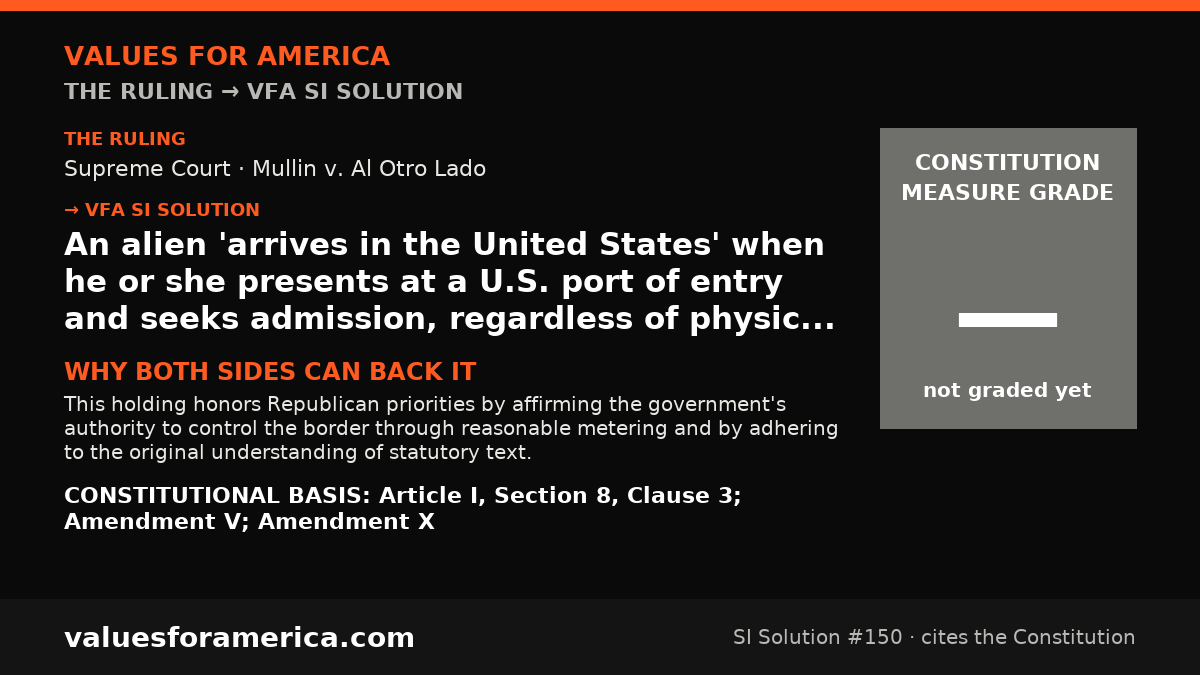
An alien 'arrives in the United States' when he or she presents at a U.S. port of entry and seeks admission, regardless of physical crossing.
Archived SI output (machine-generated) · No editorial review recorded
This historical SI draft was machine-generated by software and has no editorial review time on record. Verify its factual and legal claims against the original source before relying on it.
Mullin v. Al Otro Lado
Samuel Alito
An alien 'arrives in the United States' when he or she presents at a U.S. port of entry and seeks admission, regardless of physical crossing.
The constitutional question is whether the Immigration and Nationality Act requires U.S. Customs and Border Protection to inspect and accept asylum applications from aliens who are physically in Mexico but present themselves at a port of entry on the U.S.-Mexico border.
Constitutional concerns with the original
- The majority opinion relies on a narrow textual reading of 'arrives in the United States' that ignores the statutory context and the canon against surplusage, specifically that Congress used both 'arrives in' and 'physically present' in the same provision, implying distinct meanings.
- The majority applies the presumption against extraterritoriality without considering that the border is a zone of concurrent jurisdiction where the U.S. exercises sovereign authority under Article I, Section 8, Clause 3 (the Immigration Power) and the inherent power to control borders.
- The majority's interpretation disregards the original understanding that the power to regulate immigration includes the authority to set the point of entry, and that 'arrives in' historically included the act of presenting at a port of entry, as shown by early immigration statutes.
Solution text
Operative provisions
Bipartisan rationale
This holding honors Republican priorities by affirming the government's authority to control the border through reasonable metering and by adhering to the original understanding of statutory text. It honors Democratic priorities by ensuring that asylum seekers have a meaningful opportunity to access the legal process without being forced to enter illegally, thus preserving due process and humanitarian commitments. Both parties can agree that a clear rule—presentation at a port of entry triggers statutory rights—provides predictability and prevents arbitrary exclusion.
Constitutional citations
- → Article I, Section 8, Clause 3
- → Fifth Amendment Due Process Clause
- → Tenth Amendment
- → Federalist No. 42 (on the power to regulate foreign commerce and the necessity of uniform border rules)
Report an error in this Solution

Citizen Consensus
“Do you support this VFA SI Solution?”
One vote per verified account; you can change it any time. Only verified accounts count, results publish once 30 verified people have voted, and state and district results count only people who attested a home ZIP code. How this works.
Email verification is not switched on yet, so no vote counts toward results yet. Votes cast now are saved and count once the voter verifies their email address.
Sign in or create a free account to vote.
Add a short reason (optional)
/280 · no links or contact details · reasons are reviewed before anyone sees them, and many never are shown.
Your vote is saved but held out of published results by an automated integrity check (for example, several accounts voting from one browser).
Your vote is saved. It will count once you verify your email address. Verify on your account page.
Your vote counts nationally. Add your home ZIP code to count in your state and district too.
Your vote counts nationally and in .
Reason saved privately; it is shown only if it passes review.
Verified participants nationwide · n =
Self-selected participants, not a random sample; ± is the 95% sampling margin.
Not enough verified votes yet. Results publish at verified votes.
A sudden surge of votes on this item was flagged and is under review; votes from new accounts in that surge are held out until it is resolved.
Generated by VFA SI Solutions · 2026.06.29 06:03 UTC · ← Back to the Republic