Archived SI output (machine-generated)
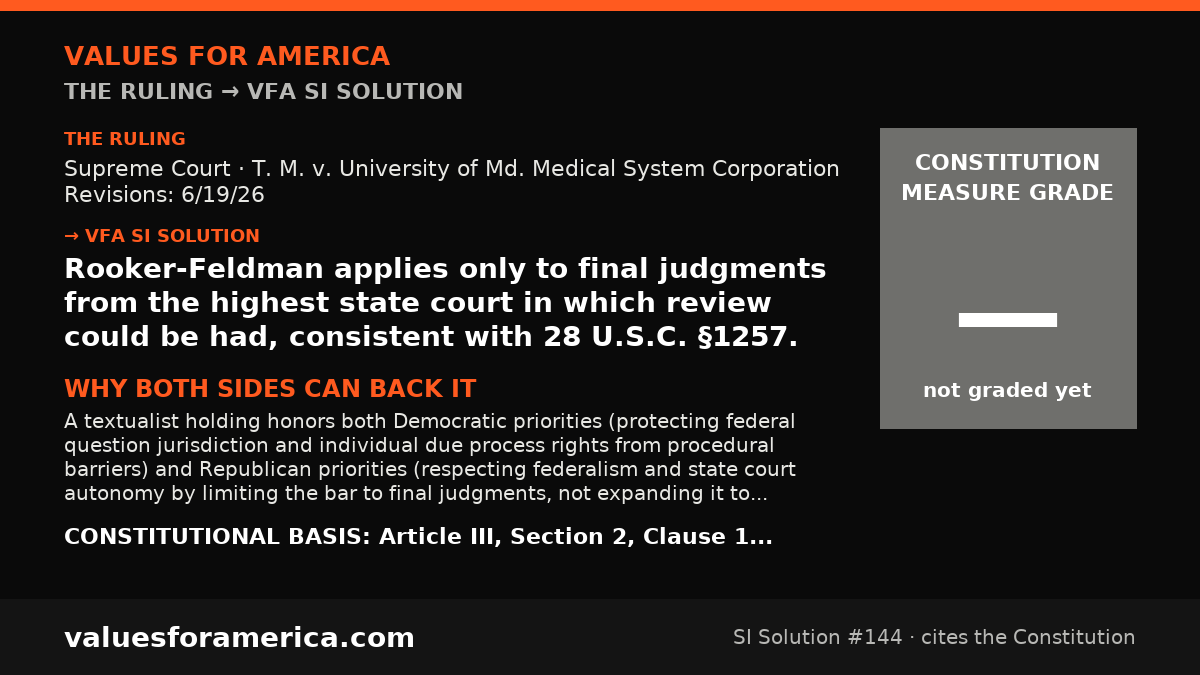
Rooker-Feldman applies only to final judgments from the highest state court in which review could be had, consistent with 28 U.S.C. §1257.
Archived SI output (machine-generated) · No editorial review recorded
This historical SI draft was machine-generated by software and has no editorial review time on record. Verify its factual and legal claims against the original source before relying on it.
T. M. v. University of Md. Medical System Corporation Revisions: 6/19/26
Sonia Sotomayor
Rooker-Feldman applies only to final judgments from the highest state court in which review could be had, consistent with 28 U.S.C. §1257.
Whether the Rooker-Feldman doctrine bars federal district court jurisdiction over a case brought by a state-court loser when the state-court judgment remains subject to further review in state appellate proceedings.
Constitutional concerns with the original
- The majority opinion extends Rooker-Feldman beyond the text of 28 U.S.C. §1257, which grants the Supreme Court appellate jurisdiction only over '[f]inal judgments or decrees rendered by the highest court of a State in which a decision could be had.' The doctrine as applied here bars district court jurisdiction even when the state judgment is not final and not from the highest court, which is not supported by the statutory text.
- The majority relies on a 'functional view' of appellate jurisdiction rather than the strict textual limits of Article III, which vests the Supreme Court with appellate jurisdiction 'both as to Law and Fact, with such Exceptions, and under such Regulations as the Congress shall make.' Congress has not authorized district courts to review non-final state judgments, but neither has it forbidden them; the Rooker-Feldman doctrine as expanded is a judge-made rule not grounded in the Constitution or statute.
- The opinion invokes federalism and comity principles to justify the bar, but the Tenth Amendment reserves to the states powers not delegated to the United States. Federalism does not require federal courts to abstain from jurisdiction Congress has granted; the proper balance is struck by the text of Article III and the jurisdictional statutes, not by judicial implication.
Solution text
Operative provisions
Bipartisan rationale
A textualist holding honors both Democratic priorities (protecting federal question jurisdiction and individual due process rights from procedural barriers) and Republican priorities (respecting federalism and state court autonomy by limiting the bar to final judgments, not expanding it to interfere with ongoing state proceedings). Both parties can agree that the Constitution's text and the jurisdictional statutes should govern, not judge-made doctrines that exceed their statutory basis.
Constitutional citations
- → Article III, Section 2, Clause 1
- → Article III, Section 2, Clause 2
- → 28 U.S.C. §1257(a)
- → Tenth Amendment
- → Federalist No. 78 (on the limited role of federal courts)
Article III, Section 2, Clause 1 Article III, Section 2, Clause 2 Amendment X
Report an error in this Solution

Citizen Consensus
“Do you support this VFA SI Solution?”
One vote per verified account; you can change it any time. Only verified accounts count, results publish once 30 verified people have voted, and state and district results count only people who attested a home ZIP code. How this works.
Email verification is not switched on yet, so no vote counts toward results yet. Votes cast now are saved and count once the voter verifies their email address.
Sign in or create a free account to vote.
Add a short reason (optional)
/280 · no links or contact details · reasons are reviewed before anyone sees them, and many never are shown.
Your vote is saved but held out of published results by an automated integrity check (for example, several accounts voting from one browser).
Your vote is saved. It will count once you verify your email address. Verify on your account page.
Your vote counts nationally. Add your home ZIP code to count in your state and district too.
Your vote counts nationally and in .
Reason saved privately; it is shown only if it passes review.
Verified participants nationwide · n =
Self-selected participants, not a random sample; ± is the 95% sampling margin.
Not enough verified votes yet. Results publish at verified votes.
A sudden surge of votes on this item was flagged and is under review; votes from new accounts in that surge are held out until it is resolved.
Generated by VFA SI Solutions · 2026.06.20 06:02 UTC · ← Back to the Republic