Archived SI output (machine-generated)
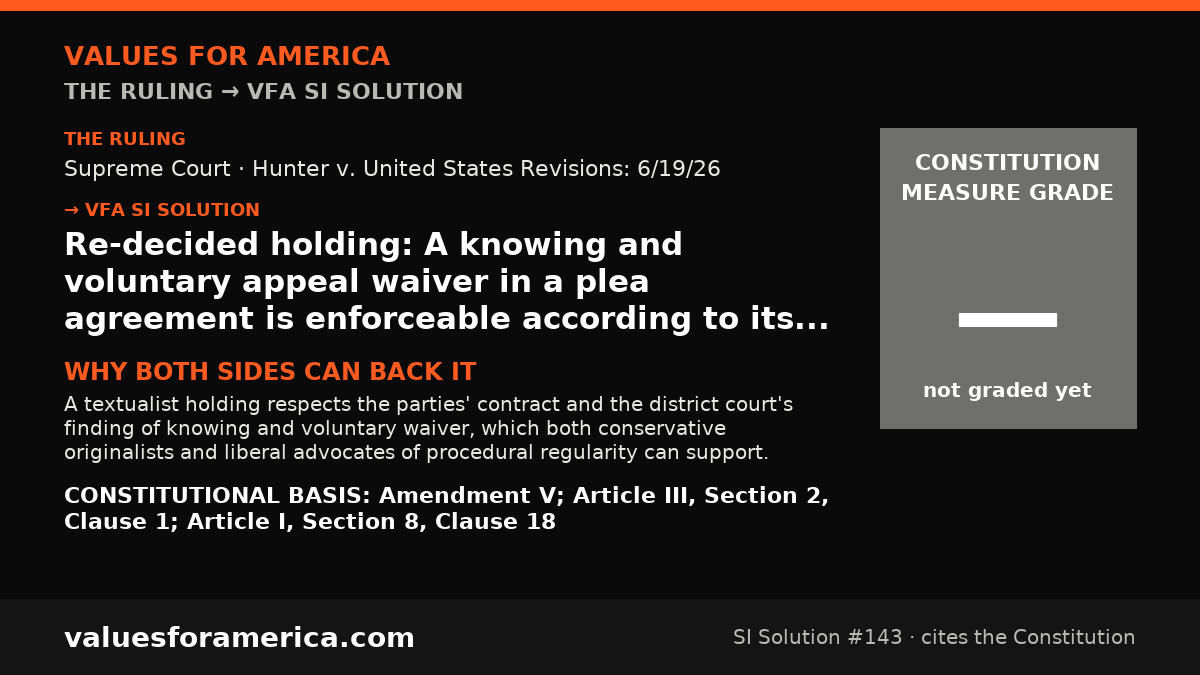
Re-decided holding: A knowing and voluntary appeal waiver in a plea agreement is enforceable according to its terms, subject only to the two explicit exceptions in the waiver itself (ineffective assistance of counsel and sentence exceeding statutory maximum).
Archived SI output (machine-generated) · No editorial review recorded
This historical SI draft was machine-generated by software and has no editorial review time on record. Verify its factual and legal claims against the original source before relying on it.
Hunter v. United States Revisions: 6/19/26
Elana Kagan
Re-decided holding: A knowing and voluntary appeal waiver in a plea agreement is enforceable according to its terms, subject only to the two explicit exceptions in the waiver itself (ineffective assistance of counsel and sentence exceeding statutory maximum).
Whether a criminal defendant's knowing and voluntary appeal waiver in a plea agreement is enforceable when the sentence imposes a condition that arguably violates a fundamental constitutional right, and whether the district court's misstatement about appeal rights or the government's silence can void the waiver.
Constitutional concerns with the original
- The majority opinion adopts a 'miscarriage of justice' standard for appeal waiver enforceability that is not derived from the constitutional text or ratification-era understanding, but rather from post-1900 judicial precedent.
- The opinion's reasoning relies on the judiciary's 'independent institutional interest' without grounding that interest in any specific constitutional provision.
- The opinion fails to address whether the mandatory-medication condition actually violates a fundamental liberty interest under the Fifth Amendment Due Process Clause, instead resolving the case on procedural waiver grounds.
Solution text
Operative provisions
Bipartisan rationale
A textualist holding respects the parties' contract and the district court's finding of knowing and voluntary waiver, which both conservative originalists and liberal advocates of procedural regularity can support. Conservatives value finality and respect for written agreements; liberals value the rule of law and predictability in plea bargaining. The 'miscarriage of justice' exception is an invention of judge-made law that undermines both values.
Constitutional citations
- → Fifth Amendment Due Process Clause
- → Article III, Section 2, Clause 1 (judicial power over cases and controversies)
- → Article I, Section 8, Clause 18 (Necessary and Proper Clause, though not directly implicated here)
Amendment V Article III, Section 2, Clause 1 Article I, Section 8, Clause 18
Report an error in this Solution

Citizen Consensus
“Do you support this VFA SI Solution?”
One vote per verified account; you can change it any time. Only verified accounts count, results publish once 30 verified people have voted, and state and district results count only people who attested a home ZIP code. How this works.
Email verification is not switched on yet, so no vote counts toward results yet. Votes cast now are saved and count once the voter verifies their email address.
Sign in or create a free account to vote.
Add a short reason (optional)
/280 · no links or contact details · reasons are reviewed before anyone sees them, and many never are shown.
Your vote is saved but held out of published results by an automated integrity check (for example, several accounts voting from one browser).
Your vote is saved. It will count once you verify your email address. Verify on your account page.
Your vote counts nationally. Add your home ZIP code to count in your state and district too.
Your vote counts nationally and in .
Reason saved privately; it is shown only if it passes review.
Verified participants nationwide · n =
Self-selected participants, not a random sample; ± is the 95% sampling margin.
Not enough verified votes yet. Results publish at verified votes.
A sudden surge of votes on this item was flagged and is under review; votes from new accounts in that surge are held out until it is resolved.
Generated by VFA SI Solutions · 2026.06.20 06:01 UTC · ← Back to the Republic