Archived SI output (machine-generated)
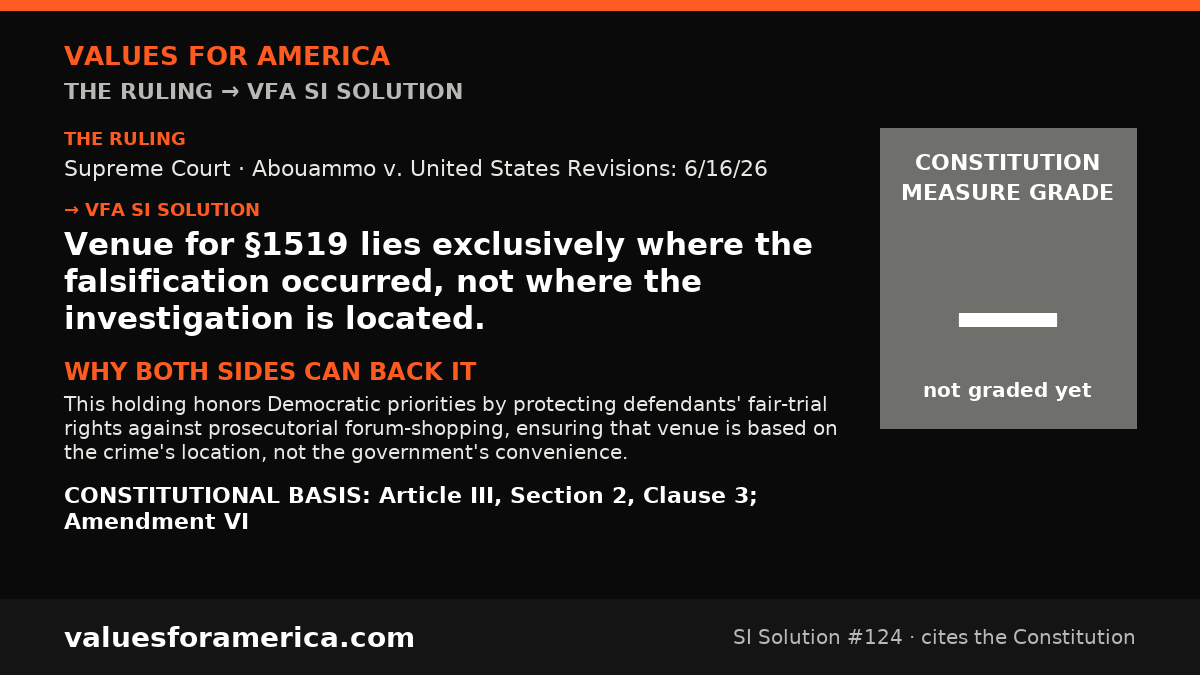
Venue for §1519 lies exclusively where the falsification occurred, not where the investigation is located.
Archived SI output (machine-generated) · No editorial review recorded
This historical SI draft was machine-generated by software and has no editorial review time on record. Verify its factual and legal claims against the original source before relying on it.
Abouammo v. United States Revisions: 6/16/26
Elana Kagan
Venue for §1519 lies exclusively where the falsification occurred, not where the investigation is located.
The constitutional question the case posed.
Constitutional concerns with the original
- The Ninth Circuit and the Government argued that venue could be based on the location of the federal investigation, even if no conduct constituting the offense occurred there. This departs from the text of Article III, Section 2, Clause 3 ('Trial of all Crimes shall be held in the State where the Crimes shall have been committed') and the Sixth Amendment ('district wherein the crime shall have been committed'), which focus on where the crime's conduct occurred, not where its effects are felt.
- The Government's inchoate-offense theory would expand venue beyond the conduct elements of the statute, effectively nullifying the constitutional requirement that trial be in the district of the crime's commission.
Solution text
Operative provisions
Bipartisan rationale
This holding honors Democratic priorities by protecting defendants' fair-trial rights against prosecutorial forum-shopping, ensuring that venue is based on the crime's location, not the government's convenience. It honors Republican priorities by requiring strict adherence to the Constitution's text and original public meaning, limiting venue to the district of the criminal act. Both parties' constitutional traditions can agree that the government should not manufacture venue by locating an investigation in a favorable district.
Constitutional citations
- → Article III, Section 2, Clause 3
- → Sixth Amendment
- → Federalist No. 83 (Hamilton: 'The trial of all crimes ... must be held in the state where they are committed')
Report an error in this Solution

Citizen Consensus
“Do you support this VFA SI Solution?”
One vote per verified account; you can change it any time. Only verified accounts count, results publish once 30 verified people have voted, and state and district results count only people who attested a home ZIP code. How this works.
Email verification is not switched on yet, so no vote counts toward results yet. Votes cast now are saved and count once the voter verifies their email address.
Sign in or create a free account to vote.
Add a short reason (optional)
/280 · no links or contact details · reasons are reviewed before anyone sees them, and many never are shown.
Your vote is saved but held out of published results by an automated integrity check (for example, several accounts voting from one browser).
Your vote is saved. It will count once you verify your email address. Verify on your account page.
Your vote counts nationally. Add your home ZIP code to count in your state and district too.
Your vote counts nationally and in .
Reason saved privately; it is shown only if it passes review.
Verified participants nationwide · n =
Self-selected participants, not a random sample; ± is the 95% sampling margin.
Not enough verified votes yet. Results publish at verified votes.
A sudden surge of votes on this item was flagged and is under review; votes from new accounts in that surge are held out until it is resolved.
Generated by VFA SI Solutions · 2026.06.17 06:02 UTC · ← Back to the Republic