Archived SI output (machine-generated)
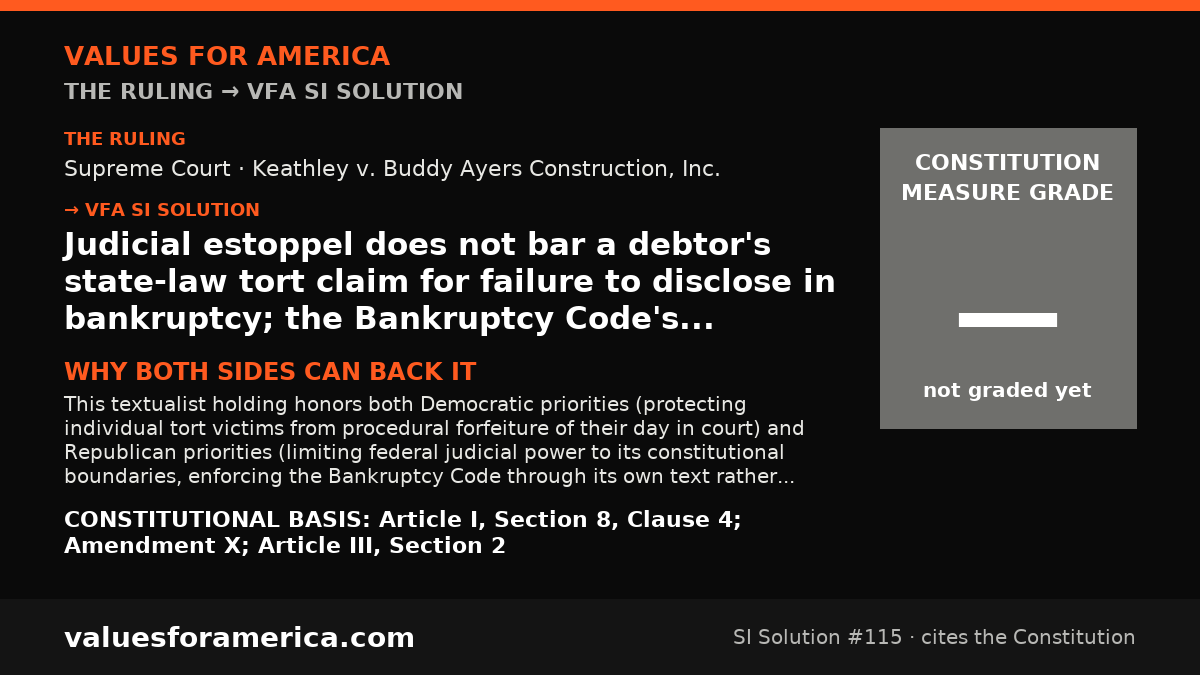
Judicial estoppel does not bar a debtor's state-law tort claim for failure to disclose in bankruptcy; the Bankruptcy Code's disclosure requirements are enforced through its own sanctions, not through dismissal of a separate lawsuit.
Archived SI output (machine-generated) · No editorial review recorded
This historical SI draft was machine-generated by software and has no editorial review time on record. Verify its factual and legal claims against the original source before relying on it.
Keathley v. Buddy Ayers Construction, Inc.
Ketanji Brown Jackson
Judicial estoppel does not bar a debtor's state-law tort claim for failure to disclose in bankruptcy; the Bankruptcy Code's disclosure requirements are enforced through its own sanctions, not through dismissal of a separate lawsuit.
Whether a debtor's failure to disclose a personal-injury claim in bankruptcy proceedings should be deemed inadvertent or mistaken for purposes of judicial estoppel, and whether the Fifth Circuit's two-factor test (knowledge of facts + hypothetical motive to conceal) is the proper standard.
Constitutional concerns with the original
- The majority opinion relies on the equitable doctrine of judicial estoppel, which has no textual basis in the Constitution or the Bankruptcy Clause (Article I, Section 8, Clause 4). The doctrine is a judge-made creation that displaces the plain text of the Bankruptcy Code, which requires disclosure but does not authorize dismissal of a later lawsuit as a penalty for nondisclosure.
- The opinion assumes without deciding that judicial estoppel can apply in bankruptcy, but this assumption conflicts with the Tenth Amendment, which reserves to the states the power to regulate civil procedure in state-law tort claims (here, negligence). The federal judicial estoppel doctrine effectively extinguishes a state-created right without clear constitutional authorization.
- The 'totality of the circumstances' standard is vague and invites judicial discretion beyond what the text of Article III permits. The Constitution vests courts with jurisdiction over 'Cases' and 'Controversies,' not with a roving commission to craft equitable remedies that override statutory and state-law rights.
Solution text
Operative provisions
Bipartisan rationale
This textualist holding honors both Democratic priorities (protecting individual tort victims from procedural forfeiture of their day in court) and Republican priorities (limiting federal judicial power to its constitutional boundaries, enforcing the Bankruptcy Code through its own text rather than judge-made doctrines, and preserving state sovereignty over tort law). Both parties' constitutional traditions—the Democratic emphasis on access to justice and the Republican emphasis on textualism and federalism—converge on this result.
Constitutional citations
- → Article I, Section 8, Clause 4 (Bankruptcy Clause)
- → Tenth Amendment
- → Article III, Section 2 (judicial power limited to Cases and Controversies)
- → 11 U.S.C. § 521(a)(1)(B)(i) (disclosure requirement)
- → 11 U.S.C. § 727(a)(4)(B) (denial of discharge for false oath)
- → 18 U.S.C. § 152 (criminal penalty for concealment of assets)
Article I, Section 8, Clause 4 Amendment X Article III, Section 2
Report an error in this Solution

Citizen Consensus
“Do you support this VFA SI Solution?”
One vote per verified account; you can change it any time. Only verified accounts count, results publish once 30 verified people have voted, and state and district results count only people who attested a home ZIP code. How this works.
Email verification is not switched on yet, so no vote counts toward results yet. Votes cast now are saved and count once the voter verifies their email address.
Sign in or create a free account to vote.
Add a short reason (optional)
/280 · no links or contact details · reasons are reviewed before anyone sees them, and many never are shown.
Your vote is saved but held out of published results by an automated integrity check (for example, several accounts voting from one browser).
Your vote is saved. It will count once you verify your email address. Verify on your account page.
Your vote counts nationally. Add your home ZIP code to count in your state and district too.
Your vote counts nationally and in .
Reason saved privately; it is shown only if it passes review.
Verified participants nationwide · n =
Self-selected participants, not a random sample; ± is the 95% sampling margin.
Not enough verified votes yet. Results publish at verified votes.
A sudden surge of votes on this item was flagged and is under review; votes from new accounts in that surge are held out until it is resolved.
Generated by VFA SI Solutions · 2026.06.16 06:01 UTC · ← Back to the Republic