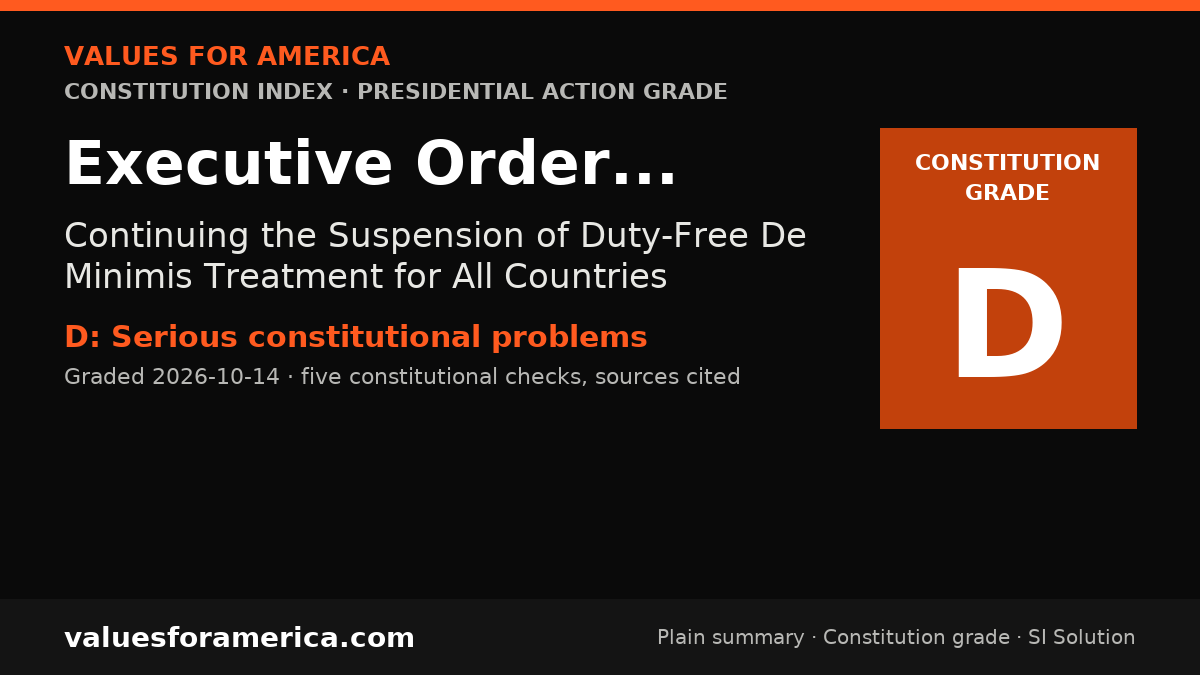
Executive Order 14388 explained · Executive Order · No disposition noted
Continuing the Suspension of Duty-Free De Minimis Treatment for All Countries
Signed: 2026-02-20 Published: 2026-04-09 Federal Register document: R1-2026-03829
Agencies: Executive Office of the President
What Executive Order 14388 says
Federal Register, Volume 91 Issue 68 (Thursday, April 9, 2026) [Federal Register Volume 91, Number 68 (Thursday, April 9, 2026)] [Presidential Documents] [Pages 17839-17844] From the Federal Register Online via the Government Publishing Office [www.gpo.gov] [FR Doc No: R1-2026-03829] Presidential Documents Federal Register / Vol. 91, No. 68 / Thursday, April 9, 2026 / Presidential Documents ___________________________________________________________________ Title 3-- The President [[Page 17839]] Executive Order 14388 of February 20, 2026 Continuing the Suspension of Duty-Free De Minimis Treatment for All Countries Republication [Editorial Note: Executive Order 14388 was originally published on pages 9433 through 9436 in the issue of Wednesday, February 25, 2026. In that publication, the document did not include the accompanying annex. The corrected document is republished in its entirety with the accompanying annex.] By the authority vested in me as President by the Constitution and the laws of the United States of America, including the International Emergency Economic Powers Act (50 U.S.C. 1701 et seq.) (IEEPA), the National Emergencies Act (50 U.S.C. 1601 et seq.), section 604 of the Trade Act of 1974, as amended (19 U.S.C. 2483), and section 301 of title 3, United States Code, it is hereby ordered: Section 1. Background. In several Executive Orders, including Executive...
Opening of the official text; read it in full in the Federal Register.
Constitution Index
“VFA Constitution grade”
Serious constitutional problems
Graded 2026-10-14
SI-generated grade · five published checks · not individually reviewed by a person · methodology
Executive Order 14388 continues the suspension of duty-free de minimis treatment for imports, relying on the International Emergency Economic Powers Act (IEEPA) and declared national emergencies. While the President has some authority over tariffs and trade, the order stretches beyond enumerated powers by using emergency powers to impose broad, ongoing duties without clear congressional authorization, infringes on individual sovereignty by burdening low-value personal imports without compelling justification, and fails the decentralization test by consolidating trade policy at the federal level when states or individuals could handle de minimis imports. The due process concerns are minor, but the cumulative constitutional tensions warrant a D grade.
-
✗ Concern · Enumerated powers
The President cites IEEPA (50 U.S.C. 1701 et seq.) and the Trade Act of 1974 as authority, but the Constitution vests Congress with the power to regulate foreign commerce (Article I, Section 8, Clause 3) and to lay and collect duties (Article I, Section 8, Clause 1). While Congress has delegated some tariff authority to the President, using IEEPA—designed for national emergencies—to impose ongoing… -
✓ Passes · Bill of Rights
The order does not directly infringe any of the first ten amendments. It imposes duties on imports, which does not restrict speech, religion, assembly, press, petition, arms, quartering, search and seizure, self-incrimination, due process (beyond procedural issues), fair trial, jury, cruel and unusual punishment, unenumerated rights, or reserved powers. The Bill of Rights is not implicated by this… -
✗ Concern · Individual sovereignty
The order restricts individuals from importing low-value goods (under $800) without paying duties, which burdens personal property and economic liberty. The government's justification—addressing national emergencies related to illicit drugs and trade deficits—is not compelling for de minimis personal imports, as the connection is tenuous. The burden is on the government to show a compelling intere… -
✗ Concern · Decentralization
The order fails the decentralization test. (1) Individuals could handle de minimis imports without government involvement by simply allowing duty-free treatment, as was the prior norm. (2) Local communities or counties could manage small-scale imports without state involvement. (3) States could handle de minimis imports without federal involvement, as states have police powers over commerce within… -
✓ Passes · Due process and takings
The order does not bypass due process or take property without just compensation. It imposes duties through a published executive order with notice in the Federal Register, and importers have the opportunity to comply. There is no deprivation of property without a hearing, as duties are a routine tax on imports. The Takings Clause (Fifth Amendment) is not implicated because duties are not a taking…
Report an error in this grade
What should happen instead
“VFA SI Solution”
De Minimis Duty Enforcement and Border Security Act of 2026
Suspend duty-free de minimis treatment (under $800 value) for all low-value imports to boost customs revenue, curb fentanyl and counterfeit smuggling via mail, and protect U.S. manufacturing from cheap foreign goods.
Bipartisan rationale: Democrats gain fentanyl interdiction, consumer protection from counterfeits, and union jobs in customs; Republicans secure America First trade fairness, manufacturing revival, and revenue without tax hikes; both sides uphold Article I legislative primacy over fleeting executive orders for durable policy.
Article I, Section 8, Clause 1 Article I, Section 8, Clause 3 Article I, Section 8, Clause 18
Report an error in this Solution

For journalists and bloggers
“Embed this grade”
Free to use with the link back. The badge and card update when the grade changes. Embed terms →
