Executive Order 14435 explained · Executive Order · No disposition noted
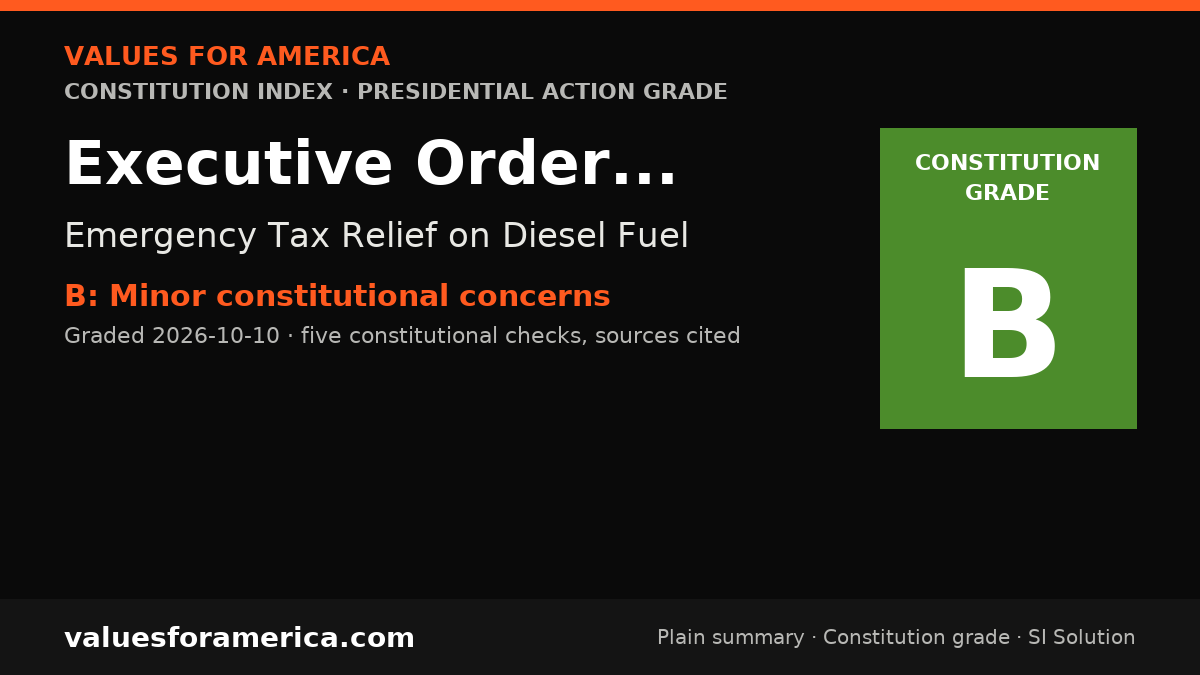
Emergency Tax Relief on Diesel Fuel
Signed: 2026-10-05 Published: 2026-10-09 Federal Register document: 2026-20855
Agencies: Executive Office of the President
What Executive Order 14435 says
Federal Register, Volume 91 Issue 195 (Friday, October 9, 2026) [Federal Register Volume 91, Number 195 (Friday, October 9, 2026)] [Presidential Documents] [Pages 64747-64749] From the Federal Register Online via the Government Publishing Office [www.gpo.gov] [FR Doc No: 2026-20855] [[Page 64745]] Vol. 91 Friday, No. 195 October 9, 2026 Part II The President ----------------------------------------------------------------------- Executive Order 14435--Emergency Tax Relief on Diesel Fuel Presidential Documents Federal Register / Vol. 91 , No. 195 / Friday, October 9, 2026 / Presidential Documents ___________________________________________________________________ Title 3-- The President [[Page 64747]] Executive Order 14435 of October 5, 2026 Emergency Tax Relief on Diesel Fuel By the authority vested in me as President by the Constitution and the laws of the United States of America, it is hereby ordered: Section 1. Purpose and Policy. Farmers and truckers are essential to the American way of life. Restricted global diesel supply has led to rising prices, and these key industries have been particularly hard hit. While my Administration has already undertaken historic efforts to ensure fuel affordability for our citizens, it is clear that further temporary relief is necessary. To that end, today I am directing the Secretary of the Treasury (Secretary) to use his authority to...
Opening of the official text; read it in full in the Federal Register.
Constitution Index
“VFA Constitution grade”
Minor constitutional concerns
Graded 2026-10-10
SI-generated grade · five published checks · not individually reviewed by a person · methodology
Executive Order 14435 is mostly sound but has minor constitutional tensions. It relies on existing statutory authority for tax deferral, which is within the President's delegated powers, but the directive to 'explore avenues, including legislation, to eliminate the obligation to pay' deferred taxes raises concerns about executive overreach into Congress's exclusive power over taxation. The order also encourages state action, which respects federalism, but the consultation with the Secretary of War (a historical office) is an anomaly that does not affect constitutionality.
-
✓ Passes · Enumerated powers
The President's authority to direct the Secretary of the Treasury to defer tax payments is grounded in existing statutory law (26 U.S.C. 7508A), which Congress enacted under its Article I, Section 8, Clause 1 power to lay and collect taxes. The order does not create new taxes or alter tax rates; it merely exercises delegated discretion. However, Section 4's directive to 'explore avenues, including… -
✓ Passes · Bill of Rights
The order does not infringe any right protected by the first ten amendments. It provides tax relief and encourages coordination with states and industry stakeholders. No speech, religion, assembly, press, petition, arms, quartering, search and seizure, self-incrimination, due process, takings, fair trial, jury, cruel and unusual punishment, unenumerated rights, or reserved powers are implicated. T… -
✓ Passes · Individual sovereignty
The order reduces tax burdens on farmers and truckers, thereby expanding their economic freedom. It does not restrict any individual's person, property, speech, labor, or belief. The directive to the IRS to not impose penalties for using dyed diesel on highways temporarily relaxes a restriction, which is a benefit to individuals. No compelling governmental justification is needed because no restri… -
✓ Passes · Decentralization
The order passes all four questions of the decentralization test. (1) Individuals and families cannot handle federal tax policy on their own; this is a matter of national economic policy. (2) Local communities cannot address global diesel supply issues or federal tax codes. (3) States cannot unilaterally defer federal excise taxes. (4) The action does not consolidate decision-making upward unneces… -
✓ Passes · Due process and takings
The order does not bypass due process or take property without just compensation. It provides tax relief, which is a benefit, not a deprivation. The order is implemented consistent with applicable law and subject to appropriations. No property is taken; rather, tax obligations are deferred. The Fifth Amendment's Takings Clause is not implicated.
Report an error in this grade
What should happen instead
“VFA SI Solution”
No Solution yet
A sourced, Constitution-cited alternative appears here once one passes the SI Editorial Standard.

For journalists and bloggers
“Embed this grade”
Free to use with the link back. The badge and card update when the grade changes. Embed terms →
