Executive Order 14434 explained · Executive Order · No disposition noted
Inaugurating the Era of Super Intelligence
Signed: 2026-09-29 Published: 2026-10-02 Federal Register document: 2026-20321
Agencies: Executive Office of the President
Federal Register notes (as of 2026-10-19): See: EO 14252, March 27, 2025; EO 14292, May 5, 2025
What Executive Order 14434 says
Federal Register, Volume 91 Issue 190 (Friday, October 2, 2026) [Federal Register Volume 91, Number 190 (Friday, October 2, 2026)] [Presidential Documents] [Pages 63129-63130] From the Federal Register Online via the Government Publishing Office [www.gpo.gov] [FR Doc No: 2026-20321] Presidential Documents Federal Register / Vol. 91 , No. 190 / Friday, October 2, 2026 / Presidential Documents [[Page 63129]] Executive Order 14434 of September 29, 2026 Inaugurating the Era of Super Intelligence By the authority vested in me as President by the Constitution and the laws of the United States of America, it is hereby ordered: Section 1. Purpose. America stands at the forefront of a new technological revolution in intelligence. The modern field of artificial intelligence was born in the United States, where American scientists first gave the field its name and laid the foundations for its development. Seventy years later, powered by our Nation's unmatched culture of innovation, world-leading companies and research institutions, and entrepreneurial spirit, America is once again pushing the technological frontier forward. The extraordinary technologies being pioneered by American innovators far exceed what was envisioned when the term ``Artificial Intelligence'' first came into use. The capabilities of today's frontier systems do much more than imitate or automate discrete aspects of...
Opening of the official text; read it in full in the Federal Register.
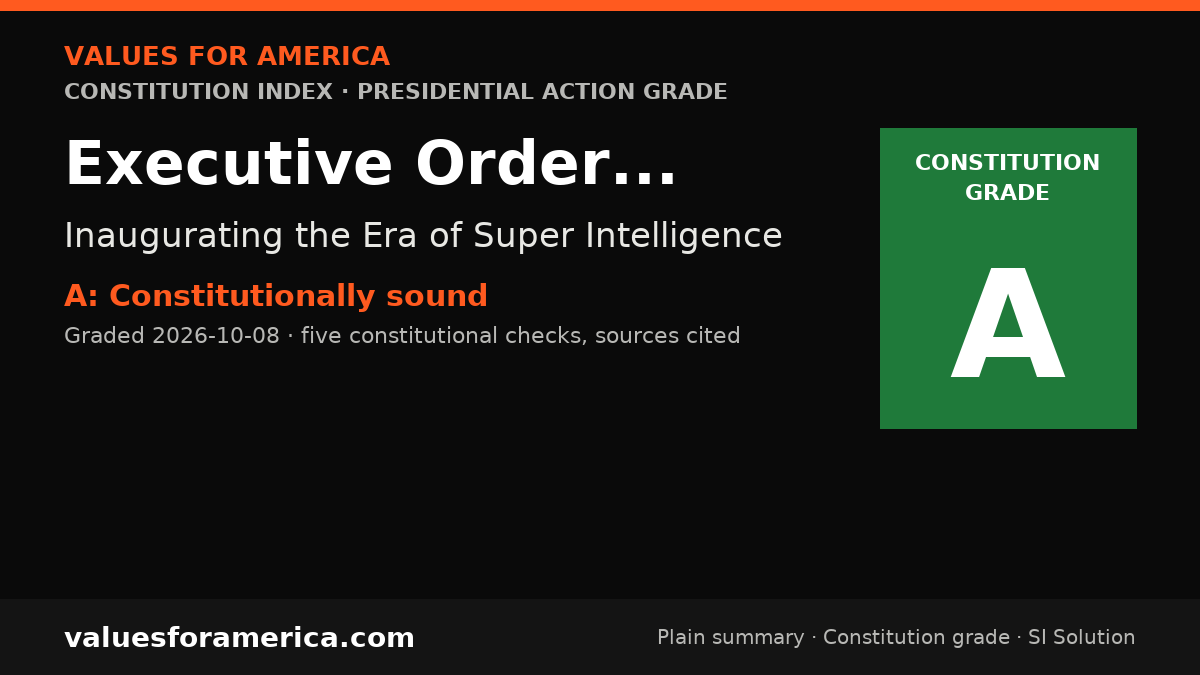
Constitution Index
“VFA Constitution grade”
Constitutionally sound
Graded 2026-10-08
SI-generated grade · five published checks · not individually reviewed by a person · methodology
Executive Order 14434 is an internal SI terminology directive for executive branch non-statutory documents, grounded in Article II supervision of the executive branch. It creates no private obligation, preemption, surveillance, taking, or speech restriction, and defers to Congress on any statutory definition change.
-
✓ Passes · Enumerated powers
Under Article II, Section 1 vesting of executive power and Article II, Section 3 direction to take care that laws be executed, the President may direct subordinate officers on internal communications and administration. The order is limited to the maximum extent permitted by law, respects existing statutes per Sec. 3(a) referencing 15 U.S.C. 9401(3), and requests future legislation rather than rew… -
✓ Passes · Bill of Rights
No provision restricts speech, religion, press, assembly, petition under First Amendment; no search under Fourth Amendment; no compelled testimony under Fifth Amendment; no trial, jury, or punishment issues under Fifth, Sixth, Seventh, Eighth Amendments. The order governs only word choice in non-statutory executive documents and expressly preserves existing rights in Sec. 4(c) stating it creates n… -
✓ Passes · Individual sovereignty
No restriction on person, property, labor, belief, or private speech. Private persons and companies may continue to describe the technology defined in 15 U.S.C. 9401(3) as artificial intelligence in full or by any other term. The burden test is satisfied because government imposes no burden on the individual. -
✓ Passes · Decentralization
The directive applies only to internal executive branch correspondence, websites, and reports per Sec. 2(a). It does not preempt state law, commandeer local governments, or regulate private conduct. Individuals, localities, and states remain free to use any terminology they choose. No decision-making is moved to a higher level than necessary; it manages the President's own branch. -
✓ Passes · Due process and takings
No person is deprived of life, liberty, or property under Fifth Amendment and Fourteenth Amendment due process. No hearing or notice is required for internal style guidance. No property is taken and no compensation issue arises under Fifth Amendment Takings Clause. Sec. 2(b) expressly preserves existing regulations, contracts, grants, and historical documents.
Report an error in this grade
What should happen instead
“VFA SI Solution”
No Solution yet
A sourced, Constitution-cited alternative appears here once one passes the SI Editorial Standard.

For journalists and bloggers
“Embed this grade”
Free to use with the link back. The badge and card update when the grade changes. Embed terms →
