Executive Order 14430 explained · Executive Order · No disposition noted
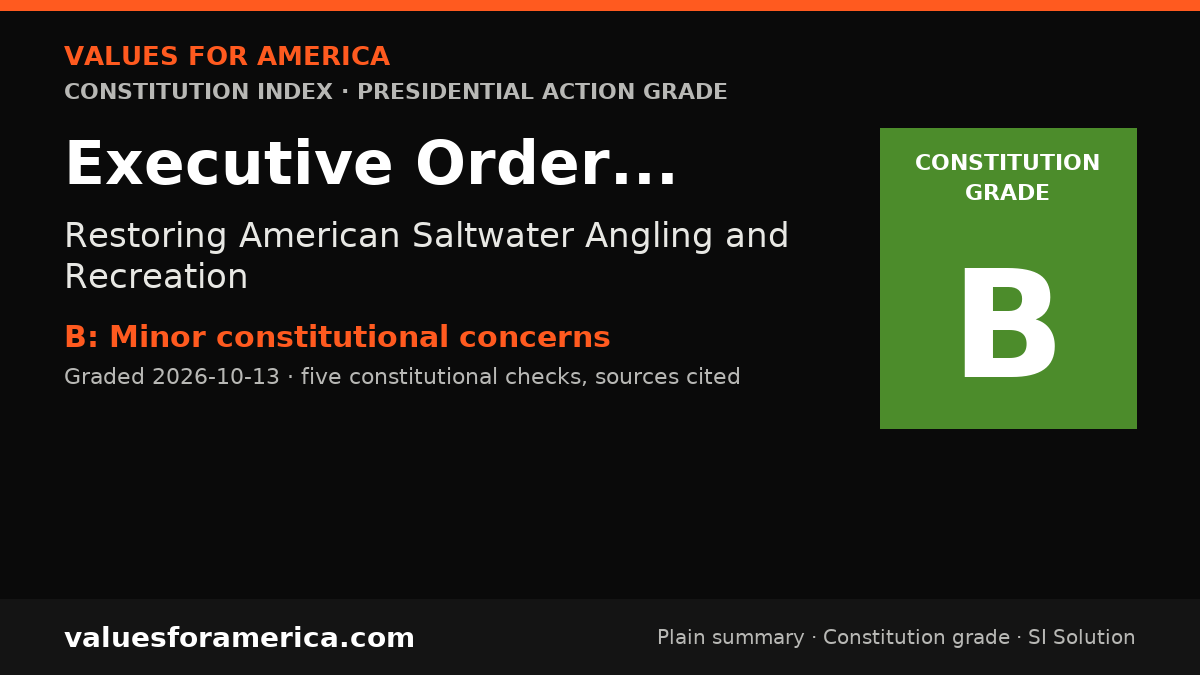
Restoring American Saltwater Angling and Recreation
Signed: 2026-09-17 Published: 2026-09-22 Federal Register document: 2026-19417
Agencies: Executive Office of the President
Federal Register notes (as of 2026-10-19): See: EO 14313, July 3, 2025; EO 14276, April 17, 2025
What Executive Order 14430 says
Federal Register, Volume 91 Issue 182 (Tuesday, September 22, 2026) [Federal Register Volume 91, Number 182 (Tuesday, September 22, 2026)] [Presidential Documents] [Pages 60293-60297] From the Federal Register Online via the Government Publishing Office [www.gpo.gov] [FR Doc No: 2026-19417] Presidential Documents Federal Register / Vol. 91, No. 182 / Tuesday, September 22, 2026 / Presidential Documents [[Page 60293]] Executive Order 14430 of September 17, 2026 Restoring American Saltwater Angling and Recreation By the authority vested in me as President by the Constitution and the laws of the United States of America, it is hereby ordered: Section 1. Purpose and Policy. (a) America's outdoor recreation sector generates over $1.2 trillion annually and supports over 5 million jobs. To ensure America's recreational fishing remains strong, Federal fisheries management must appropriately prioritize both recreational and commercial fishing. From saltwater anglers and offshore boaters to charter operators, the recreational fishing industry is a strong driver of our Nation's outdoor economy. Aligning both with the Make America Beautiful Again (MABA) Commission, established under Executive Order 14313 of July 3, 2025 (Establishing the President's Make America Beautiful Again Commission), and with Executive Order 14276 of April 17, 2025 (Restoring American Seafood Competitiveness), this...
Opening of the official text; read it in full in the Federal Register.
Constitution Index
“VFA Constitution grade”
Minor constitutional concerns
Graded 2026-10-13
SI-generated grade · five published checks · not individually reviewed by a person · methodology
Executive Order 14430 is largely consistent with the Constitution. It operates within the federal government's enumerated powers over interstate commerce and federal waters, does not infringe on the Bill of Rights, and generally respects state-federal partnerships. However, the order's directive to consider mandatory electronic reporting by recreational anglers raises minor concerns regarding individual sovereignty and potential Fourth Amendment implications, and its centralization of data collection and management decisions at the federal level, while permissible, does not fully embrace the principle of decentralization.
-
✓ Passes · Enumerated powers
The executive order addresses fisheries management, which falls under the federal government's authority over interstate commerce and federal waters. The order cites the Magnuson-Stevens Fishery Conservation and Management Act (16 U.S.C. 1801 et seq.), which is a valid exercise of Congress's power under Article I, Section 8, Clause 3 (Commerce Clause). The President's direction to agencies to revi… -
✓ Passes · Bill of Rights
The order does not directly infringe on any of the first ten amendments. It does not restrict speech, religion, assembly, press, or petition. It does not involve searches or seizures in the traditional sense, though the mandatory electronic reporting provision could raise Fourth Amendment concerns if it were to compel anglers to provide personal data without a warrant or reasonable suspicion. Howe… -
✗ Concern · Individual sovereignty
The order's directive to consider mandatory electronic reporting by recreational anglers (Section 3(c)) imposes a potential burden on individuals' freedom to engage in recreational fishing without government intrusion. While the government has a legitimate interest in managing fisheries, the burden is on the government to justify such a restriction. The order does not provide a compelling justific… -
✗ Concern · Decentralization
The order fails the decentralization test in part. (1) Individuals and families can engage in recreational fishing without government involvement, but federal management of fisheries is necessary for conservation and interstate commerce. (2) Local communities and states can manage some fisheries, but interstate and federal waters require federal coordination. (3) States can handle some data collec… -
✓ Passes · Due process and takings
The order does not bypass due process or take property without just compensation. It directs agencies to follow applicable law, including the Magnuson-Stevens Act, which provides for notice-and-comment rulemaking and other procedural safeguards. The order does not authorize any taking of private property. It also does not deprive individuals of life, liberty, or property without due process, as an…
Report an error in this grade
What should happen instead
“VFA SI Solution”
No Solution yet
A sourced, Constitution-cited alternative appears here once one passes the SI Editorial Standard.

For journalists and bloggers
“Embed this grade”
Free to use with the link back. The badge and card update when the grade changes. Embed terms →
