Executive Order 14428 explained · Executive Order · No disposition noted
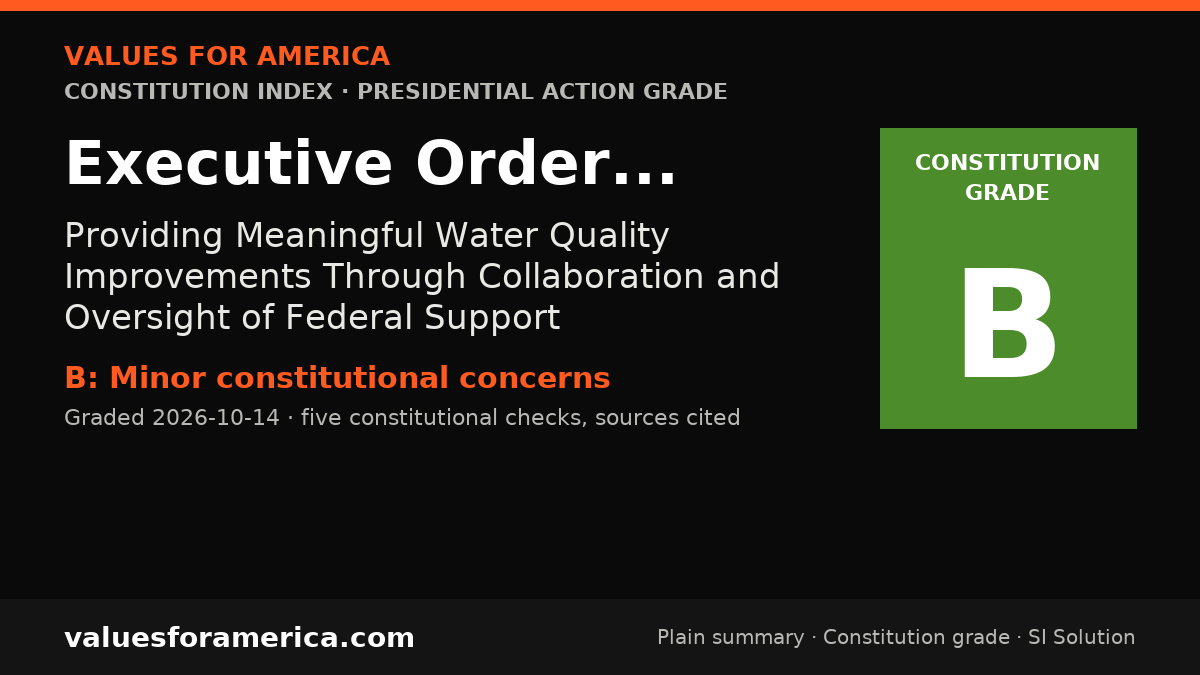
Providing Meaningful Water Quality Improvements Through Collaboration and Oversight of Federal Support
Signed: 2026-09-16 Published: 2026-09-21 Federal Register document: 2026-19335
Agencies: Executive Office of the President
Federal Register notes (as of 2026-10-19): Revokes: EO 13508, May 12, 2009
What Executive Order 14428 says
Federal Register, Volume 91 Issue 181 (Monday, September 21, 2026) [Federal Register Volume 91, Number 181 (Monday, September 21, 2026)] [Presidential Documents] [Pages 59975-59977] From the Federal Register Online via the Government Publishing Office [www.gpo.gov] [FR Doc No: 2026-19335] Presidential Documents Federal Register / Vol. 91 , No. 181 / Monday, September 21, 2026 / Presidential Documents [[Page 59975]] Executive Order 14428 of September 16, 2026 Providing Meaningful Water Quality Improvements Through Collaboration and Oversight of Federal Support By the authority vested in me as President by the Constitution and the laws of the United States of America, and in furtherance of the purposes of the Clean Water Act of 1972, as amended (33 U.S.C. 1251 et seq.), it is hereby ordered: Section 1. Purpose and Policy. The Chesapeake Bay is the largest estuary in the United States and serves a critically important economic purpose to the communities it directly and indirectly touches. In managing the Chesapeake Bay, as with other resources, governmental actors should prioritize environmental protection and economic objectives. Executive Order 13508 of May 12, 2009 (Chesapeake Bay Protection and Restoration), which has been in effect for 17 years, instituted a broad mandate for States and municipalities to contribute to improving the environmental health of the Chesapeake Bay...
Opening of the official text; read it in full in the Federal Register.
Constitution Index
“VFA Constitution grade”
Minor constitutional concerns
Graded 2026-10-14
SI-generated grade · five published checks · not individually reviewed by a person · methodology
Executive Order 14428 revokes a prior executive order and directs federal agencies to prioritize direct water quality projects and coordinate with states to address stormwater fees. It operates within existing statutory authority under the Clean Water Act and does not itself impose new restrictions on individuals or states. However, it raises minor concerns by encouraging the repeal of state and local stormwater fees, which may intrude on state and local fiscal decisions, and by potentially redirecting federal funds in ways that could affect existing programs. Overall, the order is mostly sound but has minor federalism tensions.
-
✓ Passes · Enumerated powers
The President's authority to issue this order derives from Article II of the Constitution, which vests executive power in the President, and from statutory authority under the Clean Water Act (33 U.S.C. 1251 et seq.). The order directs federal agencies to prioritize funding and coordinate with states on water quality, which falls within the scope of federal spending and interstate commerce powers … -
✓ Passes · Bill of Rights
The order does not infringe on any of the first ten amendments. It does not restrict speech, religion, assembly, press, petition, arms, quartering, search and seizure, self-incrimination, due process, takings, fair trial, jury, cruel and unusual punishment, unenumerated rights, or reserved powers. The order's provisions are administrative and fiscal in nature, not punitive or restrictive of indivi… -
✓ Passes · Individual sovereignty
The order does not restrict what individuals can do with their person, property, speech, labor, or belief. It does not impose new taxes or fees on individuals; rather, it encourages the repeal of existing stormwater fees. While it may influence state and local fiscal policies, it does not directly coerce individuals. The burden of justification for any restriction is not triggered because no indiv… -
✗ Concern · Decentralization
The order fails the decentralization test because it consolidates decision-making at the federal level regarding state and local stormwater fees. While the order does not mandate specific state actions, it directs federal agencies to 'take measures to encourage the repeal or rescission of stormwater management fees imposed by States or localities.' This is a federal attempt to influence state and … -
✓ Passes · Due process and takings
The order does not bypass due process or take property without just compensation. It does not impose new taxes or fees, nor does it seize property. It encourages the repeal of existing fees, which would reduce burdens on individuals. The order does not affect any person's procedural or substantive due process rights, and it does not implicate the Takings Clause of the Fifth Amendment.
Report an error in this grade
What should happen instead
“VFA SI Solution”
No Solution yet
A sourced, Constitution-cited alternative appears here once one passes the SI Editorial Standard.

For journalists and bloggers
“Embed this grade”
Free to use with the link back. The badge and card update when the grade changes. Embed terms →
