Executive Order 14423 explained · Executive Order · No disposition noted
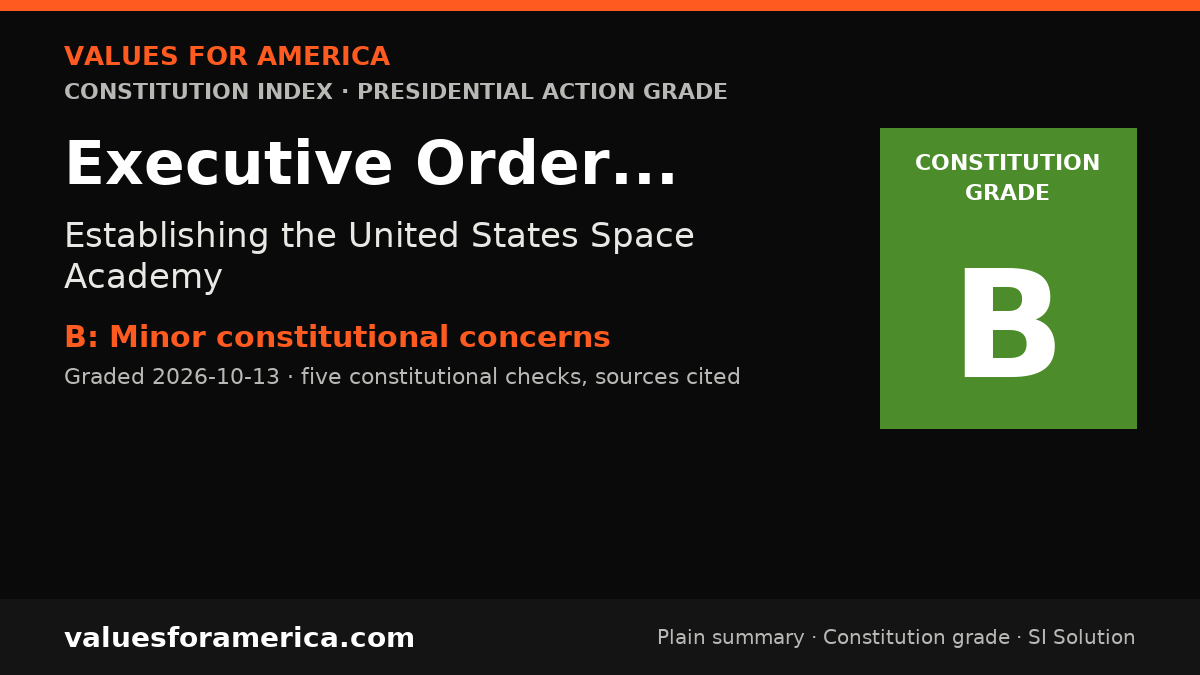
Establishing the United States Space Academy
Signed: 2026-08-28 Published: 2026-09-03 Federal Register document: 2026-18141
Agencies: Executive Office of the President
What Executive Order 14423 says
Federal Register, Volume 91 Issue 170 (Thursday, September 3, 2026) [Federal Register Volume 91, Number 170 (Thursday, September 3, 2026)] [Presidential Documents] [Pages 56737-56739] From the Federal Register Online via the Government Publishing Office [www.gpo.gov] [FR Doc No: 2026-18141] [[Page 56735]] Vol. 91 Thursday, No. 170 September 3, 2026 Part II The President ----------------------------------------------------------------------- Executive Order 14423--Establishing the United States Space Academy Presidential Documents Federal Register / Vol. 91 , No. 170 / Thursday, September 3, 2026 / Presidential Documents ___________________________________________________________________ Title 3-- The President [[Page 56737]] Executive Order 14423 of August 28, 2026 Establishing the United States Space Academy By the authority vested in me as President by the Constitution and the laws of the United States of America, it is hereby ordered: Section 1. Purpose and Policy. Space is a critical domain for American national security, economic growth, scientific discovery, and technological innovation. American superiority in space depends on the strength, skill, and character of those who explore, secure, and build the industries critical to it. To continue to lead the world in space exploration and technology, while securing and defending our national interests in space, the Nation...
Opening of the official text; read it in full in the Federal Register.
Constitution Index
“VFA Constitution grade”
Minor constitutional concerns
Graded 2026-10-13
SI-generated grade · five published checks · not individually reviewed by a person · methodology
Executive Order 14423 establishes a commission to study and propose the creation of a federal Space Academy. The order itself is largely procedural and does not directly infringe on constitutional rights or exceed federal authority. However, the proposed academy, if implemented, could raise significant constitutional concerns regarding federal involvement in education, potential compulsory service obligations, and the consolidation of educational decision-making at the federal level. The order's reliance on existing authorities and its requirement for legislative action for major changes mitigate some concerns, but the potential for future overreach warrants a 'B' grade.
-
✓ Passes · Enumerated powers
The order establishes a commission to study and propose the creation of a federal academy. This falls within the President's executive power to organize and manage the executive branch, and to recommend legislation (Article II, Section 3). The proposed academy, if established, would likely be justified under Congress's power to provide for the common defense and general welfare (Article I, Section… -
✓ Passes · Bill of Rights
The order does not directly infringe on any of the first ten amendments. It establishes a commission to study a proposed academy. The proposed academy's potential requirements, such as citizenship prerequisites and service obligations, could implicate equal protection and involuntary servitude concerns (Thirteenth Amendment), but these are not enacted by this order. The order itself is purely advi… -
✓ Passes · Individual sovereignty
The order does not restrict individual liberty. It creates a commission to study a proposed academy. The proposed academy's service obligations could be seen as a form of compelled service, but the order does not implement them. The order itself is a study, not a restriction on individual action. The burden of justification would apply to any future implementation, but at this stage, no restrictio… -
✗ Concern · Decentralization
The order fails the decentralization test because it proposes a federal academy, which consolidates educational decision-making at the federal level. While the order itself is a study, its purpose is to establish a federal institution. Education is traditionally a state and local concern, and the Tenth Amendment reserves powers not delegated to the United States to the states and the people. The p… -
✓ Passes · Due process and takings
The order does not bypass due process or take property. It establishes a commission to study a proposed academy. Any future implementation would require legislative action and would be subject to due process requirements. The order explicitly states it does not create any enforceable rights, and it is subject to appropriations and applicable law. No property is taken, and no one is deprived of lif…
Report an error in this grade
What should happen instead
“VFA SI Solution”
No Solution yet
A sourced, Constitution-cited alternative appears here once one passes the SI Editorial Standard.

For journalists and bloggers
“Embed this grade”
Free to use with the link back. The badge and card update when the grade changes. Embed terms →
