Executive Order 14421 explained · Executive Order · No disposition noted
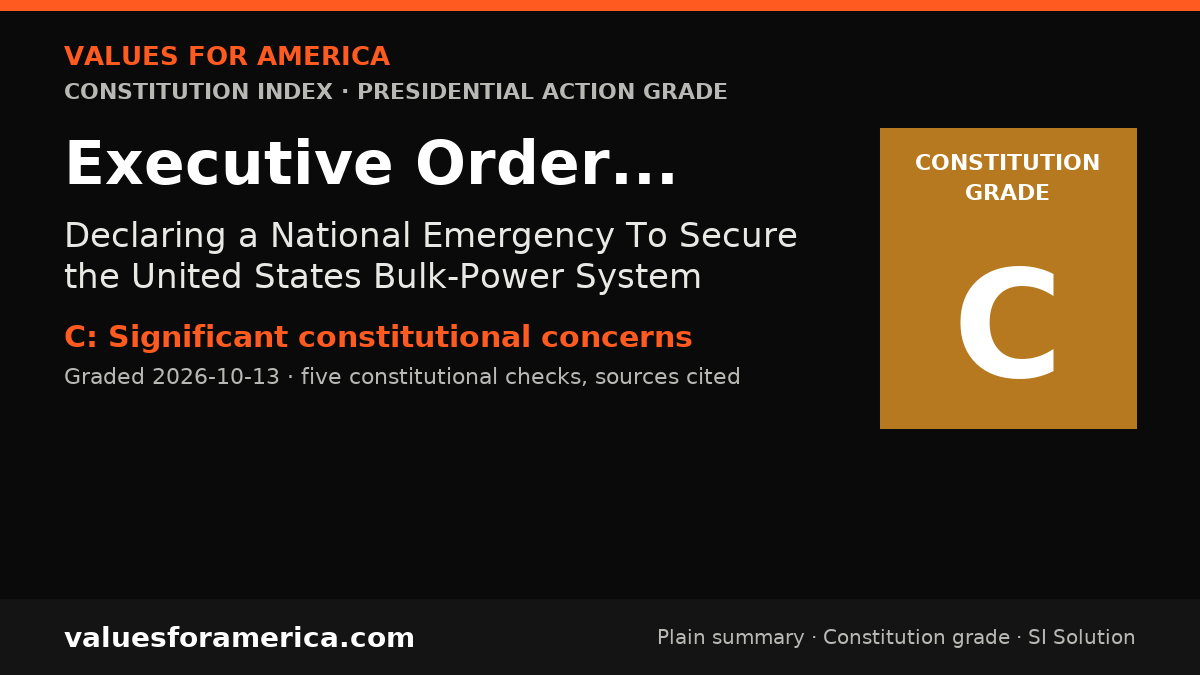
Declaring a National Emergency To Secure the United States Bulk-Power System
Signed: 2026-08-26 Published: 2026-08-31 Federal Register document: 2026-17843
Agencies: Executive Office of the President
What Executive Order 14421 says
Federal Register, Volume 91 Issue 167 (Monday, August 31, 2026) [Federal Register Volume 91, Number 167 (Monday, August 31, 2026)] [Presidential Documents] [Pages 55995-55999] From the Federal Register Online via the Government Publishing Office [www.gpo.gov] [FR Doc No: 2026-17843] Presidential Documents Federal Register / Vol. 91 , No. 167 / Monday, August 31, 2026 / Presidential Documents [[Page 55995]] Executive Order 14421 of August 26, 2026 Declaring a National Emergency To Secure the United States Bulk-Power System By the authority vested in me as President by the Constitution and the laws of the United States of America, including the International Emergency Economic Powers Act (50 U.S.C. 1701 et seq.) (IEEPA), the National Emergencies Act (50 U.S.C. 1601 et seq.) (NEA), and section 301 of title 3, United States Code, I hereby determine and order: Section 1. National Emergency. As President of the United States, my highest duty is protecting the national security, foreign policy, and economy of this country. Certain foreign actors are increasingly creating and exploiting vulnerabilities in the United States bulk-power system, which provides the electricity that supports our national defense, vital emergency services, critical infrastructure, and economy. During my first term, I found that the bulk- power system could be a target of those seeking to commit malicious...
Opening of the official text; read it in full in the Federal Register.
Constitution Index
“VFA Constitution grade”
Significant constitutional concerns
Graded 2026-10-13
SI-generated grade · five published checks · not individually reviewed by a person · methodology
The executive order asserts broad authority under IEEPA and the National Emergencies Act to restrict transactions involving foreign-produced bulk-power system electric equipment. While the federal government has clear authority over foreign commerce and national security, the order delegates sweeping discretionary powers to the Secretary of Energy, including the ability to impose conditions on pre-existing equipment, without clear statutory limits or adequate due process protections. The order also raises concerns about the potential for overbroad application that could infringe on property rights and individual sovereignty, and it centralizes decision-making at the federal level without demonstrating that state or local action would be insufficient. The order is not a direct violation of the Bill of Rights, but it requires structural and procedural improvements to align with constitutional principles.
-
✓ Passes · Enumerated powers
The federal government has explicit authority over foreign commerce under Article I, Section 8, Clause 3, and the President has statutory authority under the International Emergency Economic Powers Act (50 U.S.C. 1701 et seq.) and the National Emergencies Act (50 U.S.C. 1601 et seq.) to regulate transactions with foreign entities that pose a national security threat. The order's focus on foreign-p… -
✓ Passes · Bill of Rights
The order does not directly infringe on the First, Second, Third, Fourth, Fifth, Sixth, Seventh, Eighth, or Ninth Amendments. It regulates commercial transactions involving foreign equipment, which is not protected speech or assembly. The order does not involve searches or seizures, criminal trials, or cruel and unusual punishment. The Tenth Amendment is not violated because the federal government… -
✗ Concern · Individual sovereignty
The order restricts the ability of individuals and businesses to acquire, import, transfer, or install certain foreign-produced equipment, and it allows the Secretary of Energy to impose conditions on the continued use of equipment already acquired. While the government has a compelling interest in national security, the order grants the Secretary broad discretion to determine what constitutes an … -
✗ Concern · Decentralization
The order centralizes decision-making at the federal level, with the Secretary of Energy and other federal agencies determining which transactions are prohibited and which equipment is pre-qualified. This fails the decentralization test because (1) individuals and businesses cannot handle the national security risk on their own, (2) local communities and states cannot effectively address a foreign… -
✗ Concern · Due process and takings
The order allows the Secretary of Energy to impose conditions on the continued use of equipment acquired before the order, including requirements to disconnect, replace, or remove such equipment. This could result in a taking of private property without just compensation, as the order does not provide for compensation or a clear process for affected parties to challenge the Secretary's determinati…
Report an error in this grade
What should happen instead
“VFA SI Solution”
No Solution yet
A sourced, Constitution-cited alternative appears here once one passes the SI Editorial Standard.

For journalists and bloggers
“Embed this grade”
Free to use with the link back. The badge and card update when the grade changes. Embed terms →
