Executive Order 14420 explained · Executive Order · No disposition noted
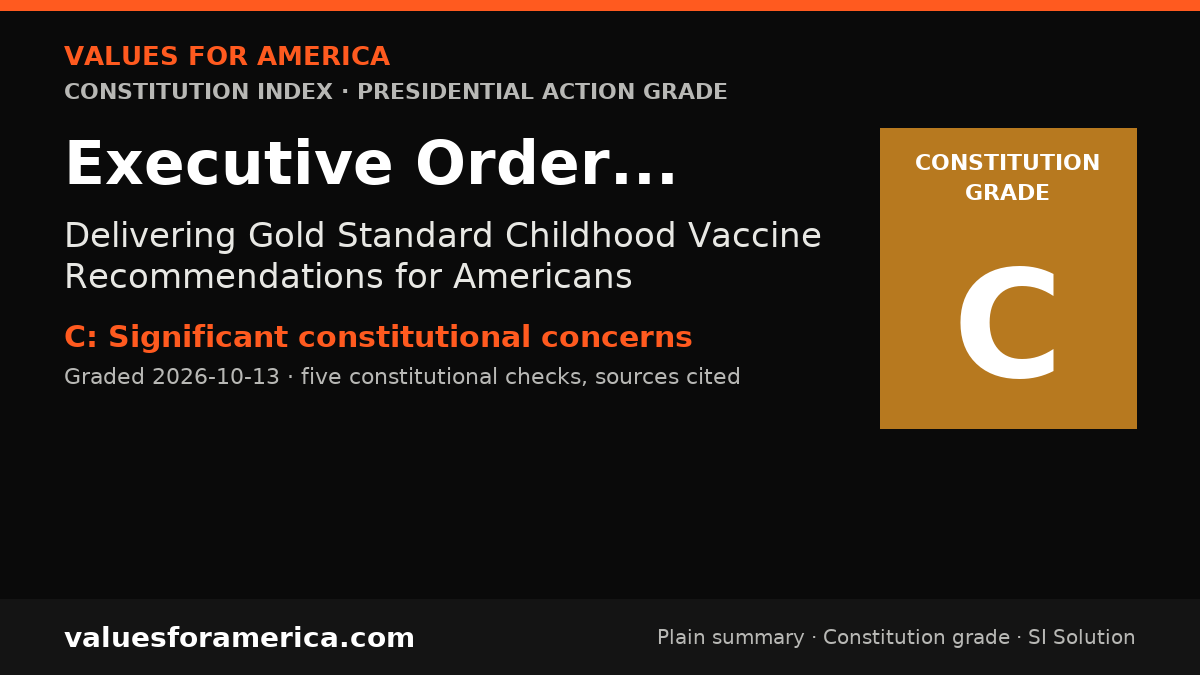
Delivering Gold Standard Childhood Vaccine Recommendations for Americans
Signed: 2026-08-10 Published: 2026-08-14 Federal Register document: 2026-16730
Agencies: Executive Office of the President
Federal Register notes (as of 2026-10-19): See: EO 14407, May 29, 2026
What Executive Order 14420 says
Federal Register, Volume 91 Issue 156 (Friday, August 14, 2026) [Federal Register Volume 91, Number 156 (Friday, August 14, 2026)] [Presidential Documents] [Pages 53173-53175] From the Federal Register Online via the Government Publishing Office [www.gpo.gov] [FR Doc No: 2026-16730] [[Page 53171]] Vol. 91 Friday, No. 156 August 14, 2026 Part XXX The President ----------------------------------------------------------------------- Executive Order 14420--Delivering Gold Standard Childhood Vaccine Recommendations for Americans Presidential Documents Federal Register / Vol. 91 , No. 156 / Friday, August 14, 2026 / Presidential Documents ___________________________________________________________________ Title 3-- The President [[Page 53173]] Executive Order 14420 of August 10, 2026 Delivering Gold Standard Childhood Vaccine Recommendations for Americans By the authority vested in me as President by the Constitution and the laws of the United States of America, it is hereby ordered: Section 1. Purpose and Policy. Pursuant to the Presidential Memorandum of December 5, 2025 (Aligning United States Core Childhood Vaccine Recommendations with Best Practices from Peer, Developed Countries), the Department of Health and Human Services (HHS) completed a scientific assessment, which identified a set of consensus vaccines that are consistently recommended in all peer countries and found...
Opening of the official text; read it in full in the Federal Register.
Constitution Index
“VFA Constitution grade”
Significant constitutional concerns
Graded 2026-10-13
SI-generated grade · five published checks · not individually reviewed by a person · methodology
Executive Order 14420 presents significant constitutional issues. While it does not directly mandate vaccines, it directs the Attorney General to challenge state vaccine laws and conditions federal funding on compliance with federal views on exemptions. This encroaches on state police powers under the Tenth Amendment and raises concerns under the First Amendment's Free Exercise Clause and the Fifth Amendment's Due Process Clause. The order's advisory recommendations are permissible, but its coercive enforcement mechanisms overstep federal authority.
-
✗ Concern · Enumerated powers
The President cites no specific enumerated power for directing the Attorney General to challenge state vaccine laws or conditioning federal funding on state compliance with federal exemption policies. The federal government's power over public health is limited to interstate commerce (Article I, Section 8, Clause 3), taxing and spending (Article I, Section 8, Clause 1), and federal enclaves. State… -
✗ Concern · Bill of Rights
Section 4(a) and (b) direct the Attorney General to challenge state laws that fail to provide religious exemptions from vaccine mandates. While this ostensibly protects religious freedom under the First Amendment, it simultaneously pressures states to adopt specific exemption policies, potentially infringing on states' rights and the free exercise of those who oppose exemptions on religious ground… -
✓ Passes · Individual sovereignty
The order explicitly states a policy of 'maximal parental choice over childhood vaccines' and 'personal autonomy and informed consent.' It does not mandate any vaccine for any individual. Instead, it seeks to expand exemptions and reduce the number of recommended vaccines. This respects individual sovereignty over medical decisions. However, the federal pressure on states to provide exemptions cou… -
✗ Concern · Decentralization
The order fails the decentralization test. (1) Individuals and families can make vaccine decisions without government involvement, but the order addresses state-level mandates. (2) Local communities can set school vaccination requirements, but the order targets state laws. (3) States have historically handled vaccine mandates for school attendance under their police powers. (4) The order consolida… -
✗ Concern · Due process and takings
Section 4(b) conditions federal funding on state compliance with federal views on exemptions. This raises concerns under the Fifth Amendment's Due Process Clause because it may deprive states of property (federal funds) without a clear, non-arbitrary standard. The order does not provide states with a fair hearing or notice before funding is withheld. Additionally, by directing the Attorney General…
Report an error in this grade
What should happen instead
“VFA SI Solution”
Childhood Vaccine Evidence and Accountability Act of 2026
To ensure that childhood vaccine recommendations are held to a 'gold standard' of scientific evidence, transparency, and conflict-of-interest review, while preserving public trust in vaccine policy and protecting public health.
Bipartisan rationale: Democrats support the statute because it codifies evidence-based decision-making, strengthens conflict-of-interest protections, and provides predictable public health funding. Republicans support it because it limits arbitrary executive action, creates a transparent and accountable review process, protects due process rights, and prevents federal overreach into state public health authority. Both parties gain institutional integrity by having Congress set the framework rather than leaving vaccine policy to a unilateral executive order that could swing with each administration.
Article I, Section 8, Clause 3 Article I, Section 8, Clause 18 Amendment V Amendment X
Report an error in this Solution

For journalists and bloggers
“Embed this grade”
Free to use with the link back. The badge and card update when the grade changes. Embed terms →
