Executive Order 14416 explained · Executive Order · No disposition noted
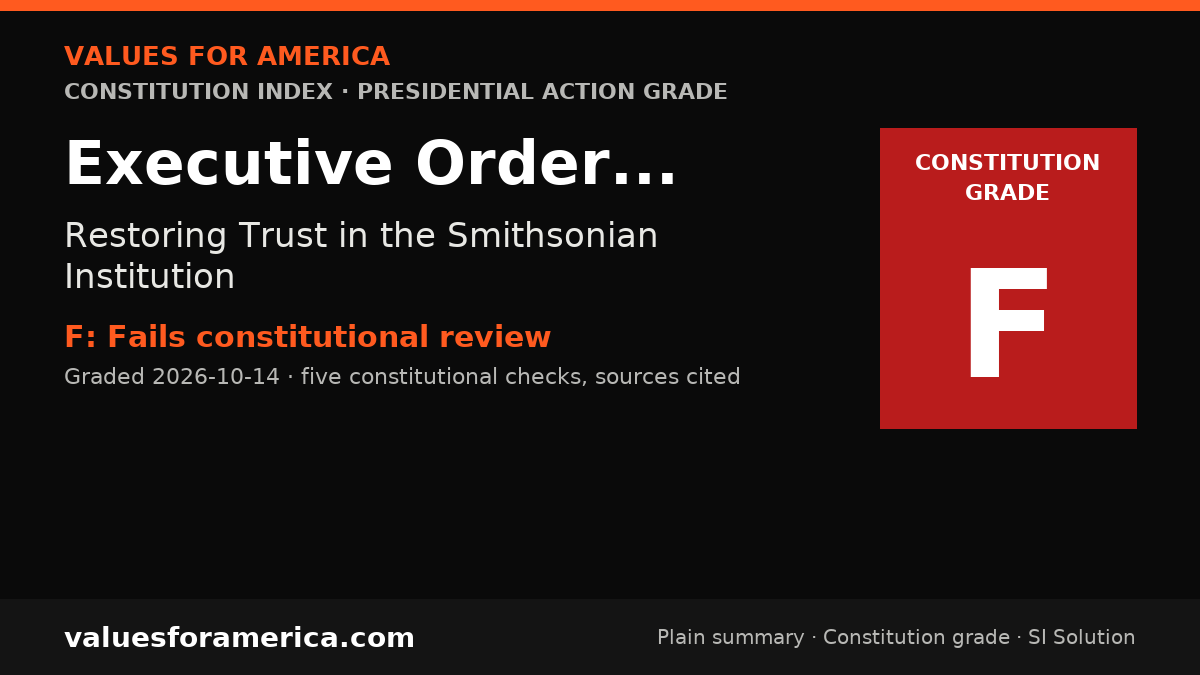
Restoring Trust in the Smithsonian Institution
Signed: 2026-07-24 Published: 2026-07-29 Federal Register document: 2026-15357
Agencies: Executive Office of the President
Federal Register notes (as of 2026-10-19): See: EO 14253, March 27, 2025
What Executive Order 14416 says
Federal Register, Volume 91 Issue 144 (Wednesday, July 29, 2026) [Federal Register Volume 91, Number 144 (Wednesday, July 29, 2026)] [Presidential Documents] [Pages 47925-47926] From the Federal Register Online via the Government Publishing Office [www.gpo.gov] [FR Doc No: 2026-15357] [[Page 47923]] Vol. 91 Wednesday, No. 144 July 29, 2026 Part II The President ----------------------------------------------------------------------- Executive Order 14416--Restoring Trust in the Smithsonian Institution Presidential Documents Federal Register / Vol. 91 , No. 144 / Wednesday, July 29, 2026 / Presidential Documents ___________________________________________________________________ Title 3-- The President [[Page 47925]] Executive Order 14416 of July 24, 2026 Restoring Trust in the Smithsonian Institution By the authority vested in me as President by the Constitution and the laws of the United States of America, it is hereby ordered: Section 1. Policy. On March 27, 2025, I issued Executive Order 14253 (Restoring Truth and Sanity to American History). Pursuant to that order, the Domestic Policy Council recently completed a months-long review of the Smithsonian Institution and its National Museum of American History (Museum) and issued its findings in the report entitled Saving America's Story: How Ideological Capture at the Smithsonian Institution's National Museum of American...
Opening of the official text; read it in full in the Federal Register.
Constitution Index
“VFA Constitution grade”
Fails constitutional review
Graded 2026-10-14
SI-generated grade · five published checks · not individually reviewed by a person · methodology
This executive order directly violates the First Amendment by compelling government-mandated signage that criticizes and seeks to alter the content of a private institution's museum exhibits. It also exceeds the President's enumerated powers by attempting to direct the Smithsonian Institution, which is a trust instrumentality of the United States created by Congress, not an executive branch agency subject to presidential control. The order's attempt to use National Park Service property to post ideological warnings and counter-exhibits constitutes a content-based restriction on speech and an unconstitutional condition on the use of public property.
-
✗ Concern · Enumerated powers
The President has no enumerated constitutional authority to direct the content of museum exhibits at the Smithsonian Institution. The Smithsonian is a trust instrumentality established by Congress (20 U.S.C. § 41 et seq.), governed by its own Board of Regents, not an executive department. The President's authority under Article II is limited to executing laws, not dictating the historical narrativ… -
✗ Concern · Bill of Rights
This order violates the First Amendment's Free Speech Clause. The government cannot compel its own signage on public sidewalks to criticize and attempt to alter the content of a museum's exhibits. This is a content-based restriction on speech—the government is using its control over NPS-maintained walkways to impose a specific ideological viewpoint (that the museum's exhibits are 'inaccurate' and … -
✗ Concern · Individual sovereignty
The order restricts the individual sovereignty of museum visitors and curators by subjecting them to government-mandated ideological signage that prescribes what is 'accurate' history. Visitors have a right to form their own opinions about historical exhibits without government-compelled counter-speech on public property. Curators and museum staff have a right to exercise professional judgment in … -
✗ Concern · Decentralization
This action fails the decentralization test on multiple grounds. (1) An individual or family could choose to visit or not visit the museum without government signage; the government's intervention is unnecessary. (2) A local community or county could not handle this because the Smithsonian is a national institution. (3) A state could not handle this because the Smithsonian is a federal entity. (4)… -
✗ Concern · Due process and takings
The order violates procedural due process by imposing a policy based on a report (the 'Report') that was not subject to public comment, hearing, or judicial review. The Smithsonian Institution is not an executive agency and has not been afforded any opportunity to contest the findings of the report or the order's directives. The order also raises takings concerns by effectively commandeering NPS-m…
Report an error in this grade
What should happen instead
“VFA SI Solution”
Smithsonian Transparency and Historical Integrity Act of 2026
The Executive Order aims to restore public trust in the Smithsonian Institution by ensuring that exhibits and programs reflect an accurate, balanced, and patriotic presentation of American history, free from what the President views as divisive narratives or ideological bias.
Bipartisan rationale: Democrats gain protections for academic freedom and due process, preventing political firings and ensuring ideological diversity is not suppressed. Republicans gain a transparent, congressionally authorized process that replaces unilateral executive control, preserving institutional integrity and fiscal accountability. Both parties prefer a statutory framework over a contested Executive Order because it provides clear standards, bipartisan ownership, and judicial review that respects the separation of powers.
Article I, Section 8, Clause 1 Article I, Section 8, Clause 8 Amendment I Amendment V Amendment X
Report an error in this Solution

For journalists and bloggers
“Embed this grade”
Free to use with the link back. The badge and card update when the grade changes. Embed terms →
