Executive Order 14411 explained · Executive Order · No disposition noted
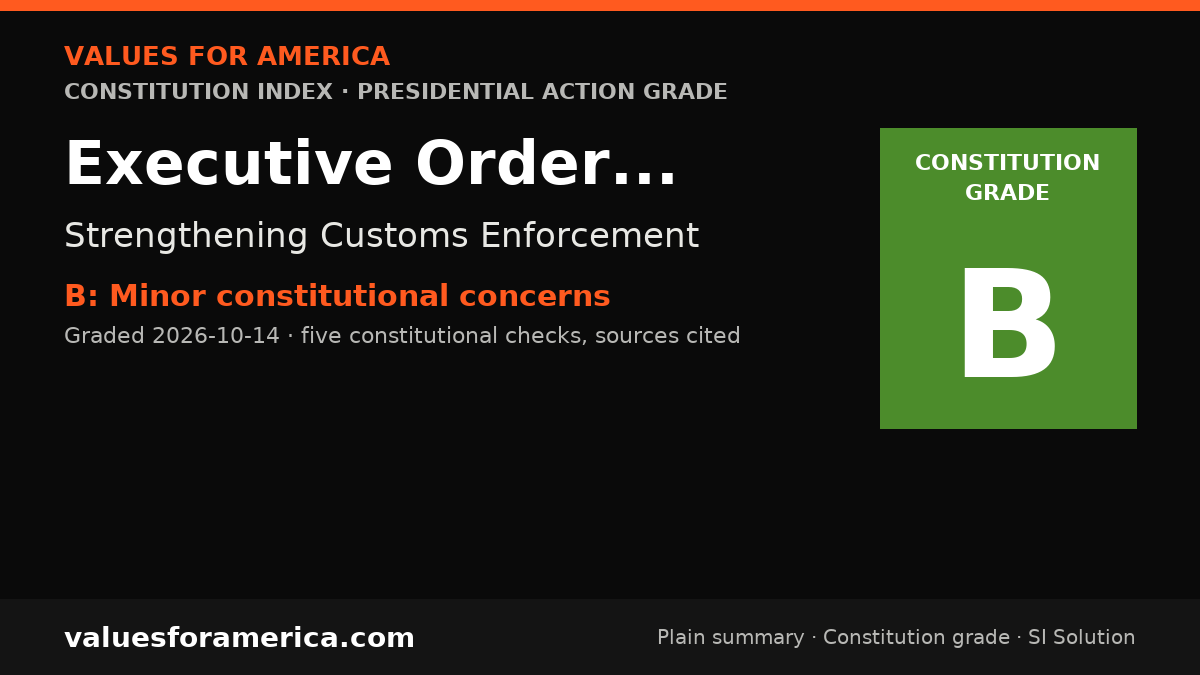
Strengthening Customs Enforcement
Signed: 2026-06-03 Published: 2026-06-10 Federal Register document: 2026-11595
Agencies: Executive Office of the President
What Executive Order 14411 says
Federal Register, Volume 91 Issue 111 (Wednesday, June 10, 2026) [Federal Register Volume 91, Number 111 (Wednesday, June 10, 2026)] [Presidential Documents] [Pages 35125-35129] From the Federal Register Online via the Government Publishing Office [www.gpo.gov] [FR Doc No: 2026-11595] Presidential Documents Federal Register / Vol. 91, No. 111 / Wednesday, June 10, 2026 / Presidential Documents [[Page 35125]] Executive Order 14411 of June 3, 2026 Strengthening Customs Enforcement By the authority vested in me as President by the Constitution and the laws of the United States of America, I hereby determine and order: Section 1. Purpose. Customs enforcement is essential to the national security, foreign policy, and economy of the United States. Effective customs enforcement prevents the importation of unlawful and dangerous goods; ensures importers of record (IORs) are correctly identified and accountable for duties owed; and guarantees compliance with numerous Federal laws, including laws governing forced labor, rules of origin, origin marking, intellectual property, revenue collection, and product safety. Customs reform is long overdue. Systemic inefficiencies, loopholes, insufficient enforcement mechanisms, and outdated processes have created opportunities for malign actors to evade Federal law. Examples of noncompliance include undervaluing imports, withholding critical...
Opening of the official text; read it in full in the Federal Register.
Constitution Index
“VFA Constitution grade”
Minor constitutional concerns
Graded 2026-10-14
SI-generated grade · five published checks · not individually reviewed by a person · methodology
The executive order operates within the federal government's enumerated power over foreign commerce and customs duties, and its measures are largely procedural and regulatory in nature. While it imposes new requirements on importers, these are within the scope of Congress's delegation to the executive branch and do not infringe on fundamental rights. The order's differentiation between foreign and domestic importers is rationally related to legitimate enforcement interests, though it raises minor due process and equal treatment concerns that are likely addressable through rulemaking. The order does not consolidate power beyond the federal level, as customs enforcement is inherently federal. Overall, the order is constitutionally sound with minor tensions.
-
✓ Passes · Enumerated powers
The federal government has explicit authority over foreign commerce and the collection of duties under Article I, Section 8, Clause 3 (Commerce Clause) and Clause 1 (Taxing and Spending). Customs enforcement is a core federal function, and the order's measures to regulate imports, require bonds, and collect data fall squarely within this authority. The order also cites specific statutory delegatio… -
✓ Passes · Bill of Rights
The order does not infringe on any of the first ten amendments. It does not restrict speech, religion, assembly, press, or petition. It does not implicate the Second, Third, or Eighth Amendments. The data collection and reporting requirements are regulatory and do not constitute unreasonable searches under the Fourth Amendment, as they are part of a closely regulated industry and are not criminal … -
✓ Passes · Individual sovereignty
The order imposes conditions on the privilege of importing goods, which is a commercial activity subject to extensive federal regulation. It does not restrict personal autonomy, speech, or belief. The requirements for bonds, asset disclosures, and good standing are reasonable regulatory measures to ensure compliance with customs laws. While they impose costs and burdens on importers, these are not… -
✓ Passes · Decentralization
Customs enforcement is inherently a federal function under the Constitution's grant of power over foreign commerce. An individual or local community cannot handle customs enforcement, as it involves international borders and treaties. States cannot regulate imports without conflicting with federal law. The order does not consolidate decision-making at a higher level than necessary; it is already a… -
✓ Passes · Due process and takings
The order does not bypass due process. It directs the Secretary to issue regulations through the normal rulemaking process, which includes notice and comment, providing fair notice and an opportunity to be heard. The requirements are prospective and not punitive. The differentiation between foreign and domestic IORs is rationally related to legitimate government interests, as foreign entities are …
Report an error in this grade
What should happen instead
“VFA SI Solution”
Customs Enforcement Enhancement Act of 2026
To strengthen customs enforcement by increasing inspections, penalties, and data sharing at ports of entry.
Bipartisan rationale: This statute honors Democratic priorities by including due process protections, voluntary state participation, and robust oversight, while honoring Republican priorities by increasing penalties, enhancing enforcement, and limiting federal overreach. Both parties would prefer this legislative solution over unilateral executive action because it provides clear statutory authority, ensures accountability through sunset and oversight, and respects the separation of powers.
Article I, Section 8, Clause 1 Article I, Section 8, Clause 3 Amendment V Amendment X
Report an error in this Solution

For journalists and bloggers
“Embed this grade”
Free to use with the link back. The badge and card update when the grade changes. Embed terms →
