Executive Order 14410 explained · Executive Order · No disposition noted
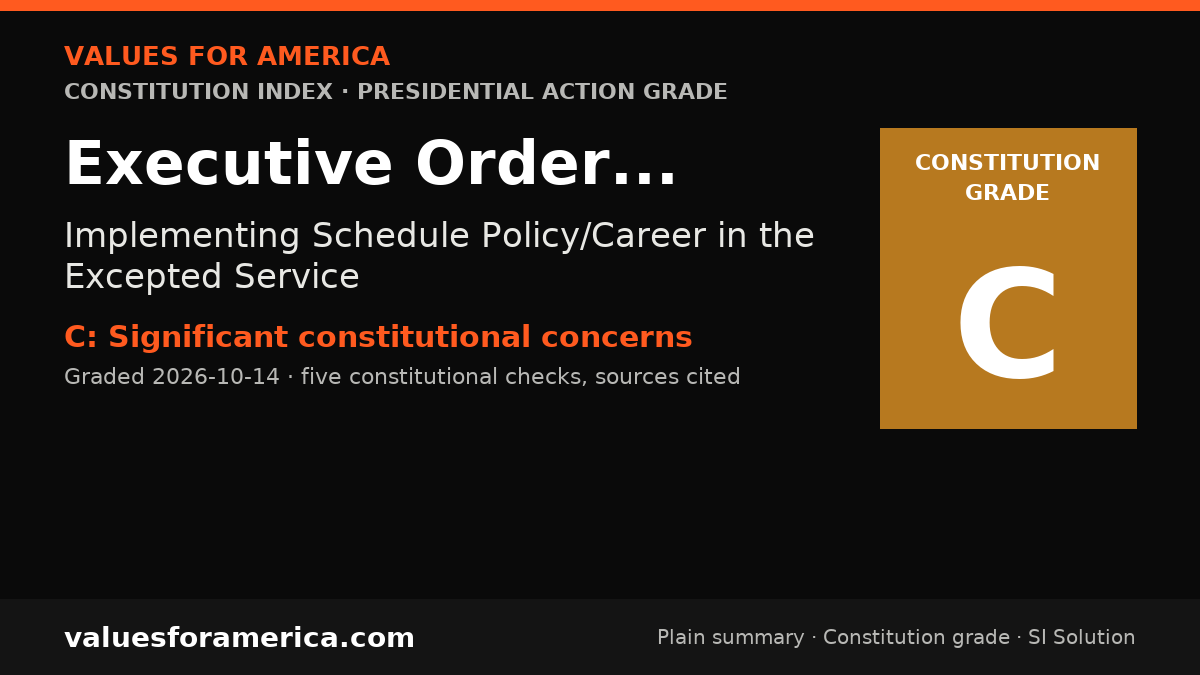
Implementing Schedule Policy/Career in the Excepted Service
Signed: 2026-06-03 Published: 2026-06-10 Federal Register document: 2026-11594
Agencies: Executive Office of the President
Federal Register notes (as of 2026-10-19): Amends: EO 13562, December 27, 2010; EO 13957, October 21, 2020; EO 14171, January 20, 2025; EO 14217, February 19, 2025
What Executive Order 14410 says
Federal Register, Volume 91 Issue 111 (Wednesday, June 10, 2026) [Federal Register Volume 91, Number 111 (Wednesday, June 10, 2026)] [Presidential Documents] [Pages 34893-35124] From the Federal Register Online via the Government Publishing Office [www.gpo.gov] [FR Doc No: 2026-11594] Presidential Documents Federal Register / Vol. 91, No. 111 / Wednesday, June 10, 2026 / Presidential Documents ___________________________________________________________________ Title 3-- The President [[Page 34893]] Executive Order 14410 of June 3, 2026 Implementing Schedule Policy/Career in the Excepted Service By the authority vested in me as President by the Constitution and the laws of the United States of America, including sections 3301, 3302, 5595 and 7511 of title 5, United States Code, it is hereby ordered: Section 1. Purpose. The President relies on subordinates in the executive branch to help him faithfully execute the laws and advance the priorities for which he was elected by the American people. Officials in confidential, policy-determining, policy- making, and policy-advocating roles (policy-influencing positions) play particularly important roles in helping him fulfill this constitutional duty. Therefore, ensuring that such employees can be removed for misconduct or poor performance is essential to protecting democratic self-government by an elected President. To enhance...
Opening of the official text; read it in full in the Federal Register.
Constitution Index
“VFA Constitution grade”
Significant constitutional concerns
Graded 2026-10-14
SI-generated grade · five published checks · not individually reviewed by a person · methodology
Executive Order 14410 raises significant constitutional concerns by reclassifying career civil servants into an excepted service schedule that strips them of standard adverse action protections, thereby undermining the merit-based civil service and potentially enabling politically motivated removals. While the President has authority over the executive branch, this action lacks explicit statutory authorization for such sweeping changes and conflicts with the constitutional framework that protects impartial administration of laws. The order also centralizes power in the executive, bypassing Congress's role in structuring the federal workforce, and raises due process concerns for affected employees.
-
✗ Concern · Enumerated powers
The President cites authority under 5 U.S.C. 3301, 3302, 5595, and 7511, but these statutes do not clearly authorize the wholesale reclassification of career positions into an excepted service schedule with reduced procedural protections. The Take Care Clause (Article II, Section 3) requires the President to faithfully execute the laws, not to unilaterally alter the civil service framework establi… -
✓ Passes · Bill of Rights
The order does not directly infringe upon the rights protected by the first ten amendments. It does not restrict speech, religion, assembly, press, petition, arms, quartering, search and seizure, self-incrimination, due process (in the criminal context), trial rights, or cruel and unusual punishment. However, the removal of procedural protections for employees may implicate Fifth Amendment due pro… -
✗ Concern · Individual sovereignty
The order restricts the individual sovereignty of federal employees by removing their statutory protections against arbitrary removal. Employees in policy-influencing positions can now be removed for 'misconduct or poor performance' without the full adverse action procedures, which historically provided safeguards against political retaliation. This undermines the ability of individuals to perform… -
✗ Concern · Decentralization
The order consolidates decision-making authority at the federal executive level, directly affecting the structure of the federal workforce. It does not involve state or local governments, but it does centralize power in the President and OPM, bypassing Congress's role in establishing the civil service system. This consolidation upward is not the minimum necessary, as Congress has historically set … -
✗ Concern · Due process and takings
The order eliminates procedural due process protections for Schedule Policy/Career employees by exempting them from standard adverse action procedures. Employees may be removed based on 'unacceptable performance or misconduct' without the full hearing and appeal rights that were previously available. This raises serious due process concerns under the Fifth Amendment, as employees have a property i…
Report an error in this grade
What should happen instead
“VFA SI Solution”
Policy Career Service Act of 2026
To convert certain policy-related positions in the federal civil service from competitive service to excepted service, thereby reducing procedural protections for career civil servants in policy roles and increasing executive control over those positions.
Bipartisan rationale: Democrats gain explicit statutory protections for career employees (retained MSPB appeal rights, 'for cause' removal standard, 5% cap, 120-day notice) and a clear legislative framework that prevents unilateral executive action. Republicans gain a legitimate excepted service category for policy roles, reducing procedural barriers to managing political appointees, while preserving institutional integrity by requiring congressional authorization. Both parties benefit from avoiding constitutional confrontation and ensuring the civil service is structured by statute, not executive fiat.
Article I, Section 8, Clause 18 Amendment V Article II, Section 3
Report an error in this Solution

For journalists and bloggers
“Embed this grade”
Free to use with the link back. The badge and card update when the grade changes. Embed terms →
