Executive Order 14406 explained · Executive Order · No disposition noted
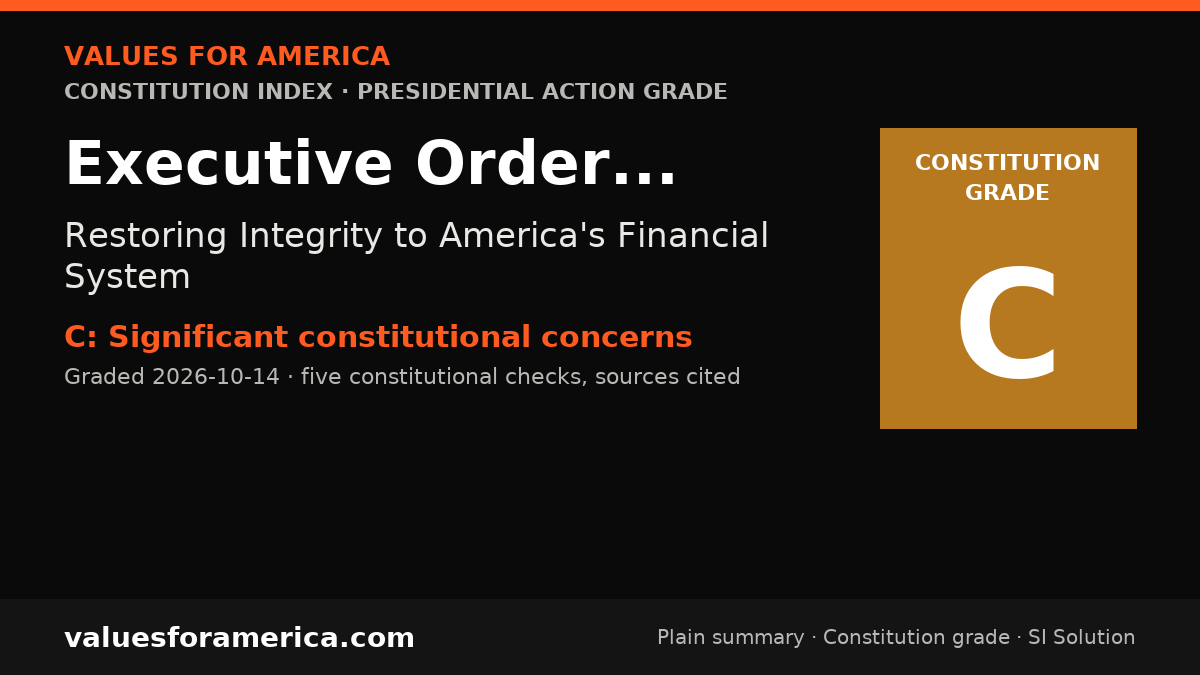
Restoring Integrity to America's Financial System
Signed: 2026-05-19 Published: 2026-05-22 Federal Register document: 2026-10400
Agencies: Executive Office of the President
What Executive Order 14406 says
Federal Register, Volume 91 Issue 99 (Friday, May 22, 2026) [Federal Register Volume 91, Number 99 (Friday, May 22, 2026)] [Presidential Documents] [Pages 30479-30481] From the Federal Register Online via the Government Publishing Office [www.gpo.gov] [FR Doc No: 2026-10400] Presidential Documents Federal Register / Vol. 91, No. 99 / Friday, May 22, 2026 / Presidential Documents [[Page 30479]] Executive Order 14406 of May 19, 2026 Restoring Integrity to America's Financial System By the authority vested in me as President by the Constitution and the laws of the United States of America, it is hereby ordered: Section 1. Purpose. America's financial institutions serve a critical role in safeguarding the American people against financial fraud and abuse. My Administration has taken significant steps to lower the costs of providing financial services for Americans and reduce unnecessary and burdensome Federal regulations that restrain economic growth and hamper the competitiveness of financial service providers nationwide. However, it has long been the policy of the United States to adopt tailored measures to safeguard our financial system from illicit use and promote safe and sound lending and other practices by financial institutions. My Administration will not tolerate national security and public safety risks caused by illicit cross-border financial activity, nor will it...
Opening of the official text; read it in full in the Federal Register.
Constitution Index
“VFA Constitution grade”
Significant constitutional concerns
Graded 2026-10-14
SI-generated grade · five published checks · not individually reviewed by a person · methodology
The Executive Order addresses legitimate financial integrity concerns, but it raises significant constitutional issues by directing financial institutions to collect and verify immigration status information, which implicates privacy and due process rights, and by potentially exceeding the President's enumerated powers in directing regulatory changes. The order also centralizes decision-making at the federal level, failing the decentralization test.
-
✗ Concern · Enumerated powers
The President's authority to issue executive orders is not plenary; it must be grounded in the Constitution or statutory delegation. While the order cites the Constitution and laws, it does not specify a particular statutory basis. The regulation of banking and finance is within Congress's commerce power (Article I, Section 8, Clause 3), but the President's directive to propose changes to Bank Sec… -
✗ Concern · Bill of Rights
The order's requirement that financial institutions collect and verify immigration status information implicates the Fourth Amendment's protection against unreasonable searches and seizures, as it compels the collection of personal information without individualized suspicion. It also raises concerns under the Fifth Amendment's Due Process Clause, as it may lead to discriminatory treatment of non-… -
✗ Concern · Individual sovereignty
The order restricts individuals' ability to access financial services based on immigration status, which is a significant restriction on their economic liberty and property rights. The government has a compelling interest in preventing financial fraud and terrorism, but the order's broad directives may impose disproportionate burdens on non-citizens and could lead to discrimination. The burden is … -
✗ Concern · Decentralization
The order consolidates decision-making at the federal level, directing federal regulators to impose new requirements on financial institutions nationwide. This fails the decentralization test because states and local communities could potentially address financial fraud and immigration-related risks through their own regulatory frameworks. The order does not allow for state or local variation and … -
✗ Concern · Due process and takings
The order may bypass procedural due process by directing financial institutions to collect immigration status information without clear standards or judicial oversight. This could lead to arbitrary or discriminatory enforcement, violating the Fifth Amendment's Due Process Clause. Additionally, the order's focus on 'inadmissible and removable alien population' could result in the denial of credit o…
Report an error in this grade
What should happen instead
“VFA SI Solution”
Financial Integrity and Transparency Act of 2026
To impose stricter oversight and transparency requirements on financial institutions to prevent fraud, money laundering, and systemic risk, and to ensure that federal contracts and benefits are not awarded to entities that violate financial integrity standards.
Bipartisan rationale: Both parties would prefer this statute over unilateral executive action because it provides clear statutory authority, ensuring due process and limiting executive overreach. Democrats gain robust oversight and anti-fraud measures, while Republicans benefit from a sunset clause, capped funding, and judicial review that prevent indefinite regulatory expansion. The institutional integrity of Congress is preserved, and the financial industry receives predictable rules.
Article I, Section 8, Clause 3 Article I, Section 8, Clause 5 Amendment V
Report an error in this Solution

For journalists and bloggers
“Embed this grade”
Free to use with the link back. The badge and card update when the grade changes. Embed terms →
