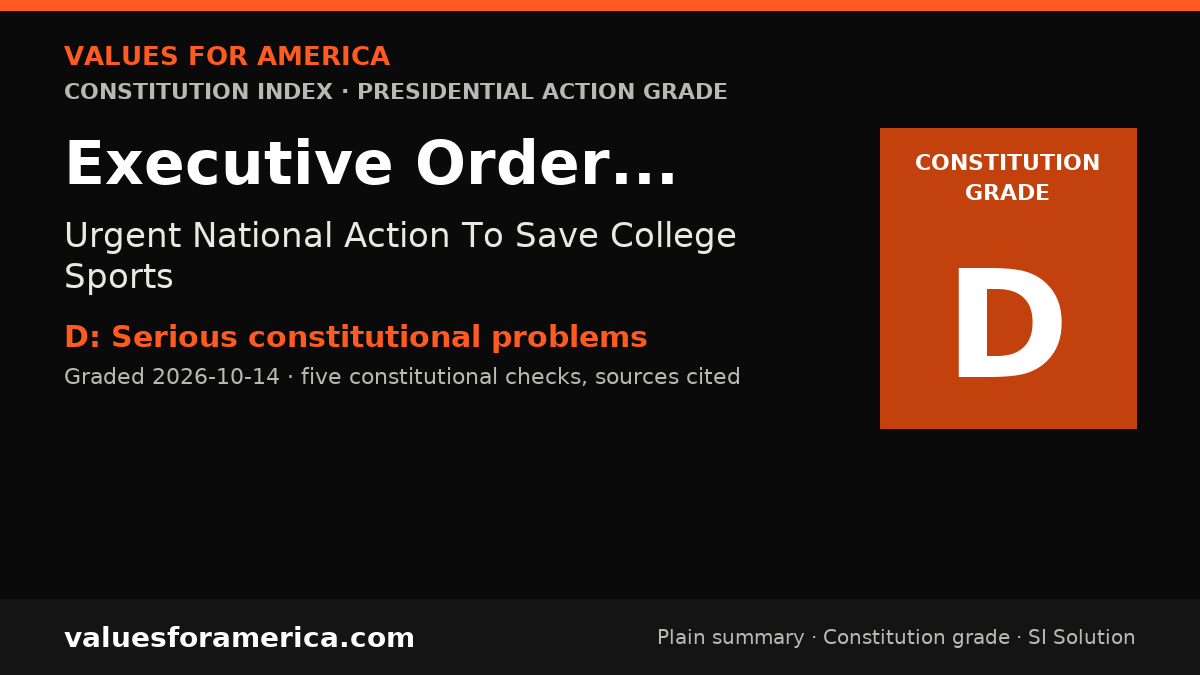
Executive Order 14400 explained · Executive Order · No disposition noted
Urgent National Action To Save College Sports
Signed: 2026-04-03 Published: 2026-04-09 Federal Register document: 2026-06961
Agencies: Executive Office of the President
Federal Register notes (as of 2026-10-19): See: EO 14322, July 24, 2025
What Executive Order 14400 says
Federal Register, Volume 91 Issue 68 (Thursday, April 9, 2026) [Federal Register Volume 91, Number 68 (Thursday, April 9, 2026)] [Presidential Documents] [Pages 18267-18271] From the Federal Register Online via the Government Publishing Office [www.gpo.gov] [FR Doc No: 2026-06961] Presidential Documents Federal Register / Vol. 91 , No. 68 / Thursday, April 9, 2026 / Presidential Documents [[Page 18267]] Executive Order 14400 of April 3, 2026 Urgent National Action To Save College Sports By the authority vested in me as President by the Constitution and the laws of the United States of America, it is hereby ordered: Section 1. Purpose and Policy. America's system of college sports has long provided scholarships and life- changing educational, athletic, and leadership opportunities to millions of America's future leaders and formed an important part of our national fabric. In July, I signed an Executive Order to protect college sports from endless lawsuits and destabilizing financial obligations that could jeopardize women's and Olympic sports, but it has become clear that more comprehensive executive action is required before college sports are lost forever. College football is the primary revenue generator for university athletic departments, including revenue to support women's and Olympic sports, and is used by many universities to attract students, donations, and goodwill...
Opening of the official text; read it in full in the Federal Register.
Constitution Index
“VFA Constitution grade”
Serious constitutional problems
Graded 2026-10-14
SI-generated grade · five published checks · not individually reviewed by a person · methodology
Executive Order 14400 exceeds the President's enumerated powers by attempting to regulate college athletics—a field traditionally reserved to the states and private institutions—without clear constitutional authority. It imposes federal definitions and prohibitions on 'improper financial activities' and 'fraudulent NIL schemes' that intrude on state-regulated contract and tort law, and it conditions federal funding on compliance with these new federal standards, effectively coercing states and universities into adopting a uniform national policy. This action also raises serious concerns under the Tenth Amendment and the Spending Clause, as it seeks to achieve indirectly what the federal government cannot do directly. While the order does not directly criminalize speech or impose physical searches, it restricts economic liberty and contractual freedom without a compelling federal interest, and it centralizes decision-making at the federal level when states and private institutions have long managed college athletics. The order also bypasses the legislative process, urging Congress to act but implementing significant policy changes unilaterally, undermining due process and the separation of powers.
-
✗ Concern · Enumerated powers
The President cites general authority under the Constitution and laws, but no specific enumerated power supports federal regulation of college athletics. The order's justification—protecting federal contractors and grantees—invokes the Spending Clause (Article I, Section 8, Clause 1), but the conditions imposed are not reasonably related to the purposes of federal research or procurement funding. … -
✗ Concern · Bill of Rights
The order does not directly restrict speech, religion, press, assembly, or petition, but it does implicate the Tenth Amendment (reserved powers) and the Ninth Amendment (unenumerated rights). By defining 'fraudulent NIL schemes' and 'improper financial activities,' the order restricts the freedom of contract and property rights of student-athletes and third parties, which are protected under the F… -
✗ Concern · Individual sovereignty
The order restricts the ability of student-athletes and third parties to enter into NIL contracts and revenue-sharing agreements, limiting their freedom to use their own name, image, and likeness for economic gain. The government bears the burden of justifying such restrictions, but the order's stated purpose—preserving college sports and protecting federal contractors—does not constitute a compel… -
✗ Concern · Decentralization
The order fails the decentralization test. (1) Individuals and families, including student-athletes and universities, can handle NIL deals and athletic governance without federal involvement. (2) Local communities and states have historically regulated college athletics and contract law. (3) States can handle this without federal involvement, as they have done for decades. (4) The order consolidat… -
✗ Concern · Due process and takings
The order imposes new federal definitions and prohibitions without prior notice or a hearing, and it conditions federal funding on compliance, effectively taking property (contract rights, NIL rights) without just compensation. The vague terms 'fraudulent NIL scheme' and 'improper financial activities' fail to provide fair notice of what conduct is prohibited, violating procedural due process unde…
Report an error in this grade
What should happen instead
“VFA SI Solution”
College Sports Preservation Act of 2026
Preserve the traditional amateur model of college sports amid antitrust and labor lawsuits by granting NCAA and colleges limited antitrust immunity, clarifying student-athletes are not employees under federal labor laws, and ensuring Title IX protections while allowing revenue sharing.
Bipartisan rationale: Democrats get Title IX equity mandates, athlete health stipends, and welfare reporting; Republicans get states' rights carveouts (no federal mandates on non-federal-fund schools), limited scope with sunset/oversight to curb bureaucracy, preserving cultural institution of college sports.
Article I, Section 8, Clause 3 Article I, Section 8, Clause 18 Amendment X
Report an error in this Solution

For journalists and bloggers
“Embed this grade”
Free to use with the link back. The badge and card update when the grade changes. Embed terms →
