Executive Order 14394 explained · Executive Order · No disposition noted
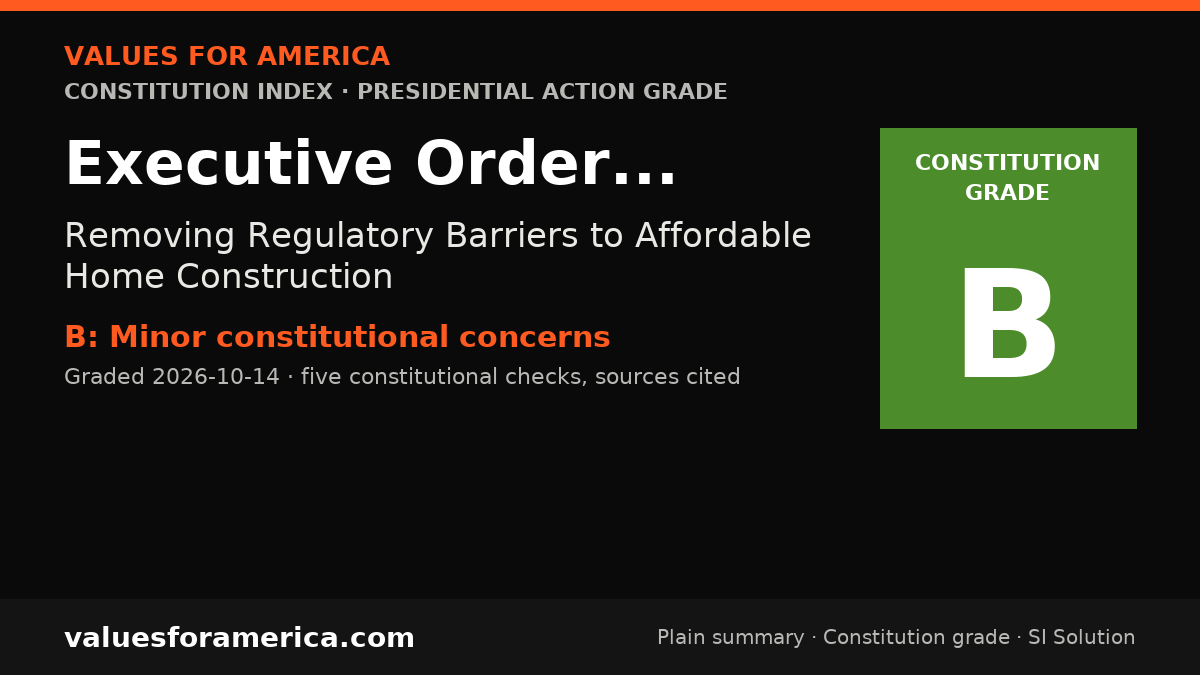
Removing Regulatory Barriers to Affordable Home Construction
Signed: 2026-03-13 Published: 2026-03-18 Federal Register document: 2026-05388
Agencies: Executive Office of the President
What Executive Order 14394 says
Federal Register, Volume 91 Issue 52 (Wednesday, March 18, 2026) [Federal Register Volume 91, Number 52 (Wednesday, March 18, 2026)] [Presidential Documents] [Pages 13207-13210] From the Federal Register Online via the Government Publishing Office [www.gpo.gov] [FR Doc No: 2026-05388] Presidential Documents Federal Register / Vol. 91, No. 52 / Wednesday, March 18, 2026 / Presidential Documents [[Page 13207]] Executive Order 14394 of March 13, 2026 Removing Regulatory Barriers to Affordable Home Construction By the authority vested in me as President by the Constitution and the laws of the United States of America, it is hereby ordered: Section 1. Purpose. The American dream of homeownership depends on a dynamic housing market in which a varied inventory of new homes is built and renovated each year. Layers of unnecessary regulatory barriers, slow permitting processes, and onerous mandates at all levels of government have delayed construction, restricted development, and driven up the costs of new housing. These constraints have made housing less affordable for many Americans. It is the policy of my Administration to reduce regulatory barriers to building homes and to steward taxpayer dollars in a manner that promotes housing affordability. Sec. 2. Targeting Federal Regulatory Barriers to Residential Development. (a) The Secretary of the Army, acting through the Assistant...
Opening of the official text; read it in full in the Federal Register.
Constitution Index
“VFA Constitution grade”
Minor constitutional concerns
Graded 2026-10-14
SI-generated grade · five published checks · not individually reviewed by a person · methodology
Executive Order 14394 is mostly sound but has minor tensions with the Tenth Amendment and federalism principles. It primarily directs federal agencies to review and revise their own regulations, which falls within the President's executive authority. However, Section 4's attempt to prescribe 'best practices' to state and local governments, and the implicit threat of conditioning federal grants on compliance, raises concerns about federal overreach into areas traditionally reserved to the states under the Tenth Amendment. The order does not directly infringe individual rights, but its push to weaken environmental and historic preservation protections could indirectly affect property rights and public participation.
-
✓ Passes · Enumerated powers
The President has authority under Article II, Section 1 to direct executive branch agencies to review and revise their own regulations. The order cites 'the Constitution and the laws of the United States' as its basis. Directing agency heads to act 'within their respective authorities' and 'consistent with applicable law' keeps this within the executive's managerial power. However, Section 4's att… -
✓ Passes · Bill of Rights
The order does not directly infringe any provision of the Bill of Rights. It does not restrict speech, religion, assembly, press, petition (First Amendment), bear arms (Second Amendment), or quarter soldiers (Third Amendment). It does not authorize warrantless searches (Fourth Amendment), compel self-incrimination (Fifth Amendment), or deny trial rights (Sixth and Seventh Amendments). It does not … -
✓ Passes · Individual sovereignty
The order generally expands individual freedom by removing regulatory barriers to home construction, which allows property owners and developers to use their land and labor more freely. It does not restrict what individuals can do with their person, property, speech, labor, or belief. The government's burden to justify restrictions is met here because the order is reducing, not imposing, restricti… -
✗ Concern · Decentralization
The order fails the decentralization test primarily because Section 4 attempts to impose federal 'best practices' on state and local land-use decisions—an area traditionally reserved to states and localities under the Tenth Amendment. While the order does not directly preempt state law, the mechanism of tying federal grants to compliance with these practices effectively consolidates decision-makin… -
✓ Passes · Due process and takings
The order does not bypass due process or take property without just compensation. It directs agencies to follow existing procedures ('consistent with applicable law') and does not authorize any deprivation of life, liberty, or property without notice or hearing. The order's streamlining of environmental review under NEPA and the National Historic Preservation Act could reduce procedural hurdles, b…
Report an error in this grade
What should happen instead
“VFA SI Solution”
No Solution yet
A sourced, Constitution-cited alternative appears here once one passes the SI Editorial Standard.

For journalists and bloggers
“Embed this grade”
Free to use with the link back. The badge and card update when the grade changes. Embed terms →
